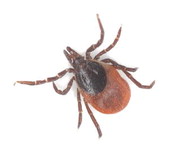

A NATURE HIKE, CAMPING TRIP, PICNIC, OR CASUAL STROLL through your favorite local park can be a pleasant, invigorating experience that puts you in touch with the great outdoors. Of course, such activities can also put you “in touch” with some creatures you’d do well to avoid—such as ticks.
Ticks are tiny arachnids (relatives of spiders and mites) that feed on the blood of warm-blooded animals, including humans. What’s worse, ticks are also known carriers of certain serious diseases, such as lyme disease, Rocky Mountain spotted fever, and babesiosis. Some of tick-borne diseases can have long-lasting effects—or even lead to death—if not caught and treated in a timely manner. Though only a small percentage of ticks are disease carriers, it’s wise to take precautions to protect yourself and your family whenever you’re spending time in tick habitat.
Contrary to popular misconception, ticks do not fly, jump, or drop onto people from trees. They do, however, lie in wait on vegetation and grasp on to an animal or person that happens to brush by. Once attached to a suitable host, they painlessly sink their mouthparts into the skin and begin to feed on the host’s blood. After feeding to the point of engorgement (during which they may swell to several times their original size), they eventually drop off.
The two types of ticks encountered most frequently in Ohio are the American dog tick and the blacklegged tick, aka the deer tick. The dog tick, which can carry Rocky Mountain spotted fever, is brownish in color and typically inhabits grassy habitat adjacent to woods. The blacklegged tick inhabits wooded areas and is known to transmit Lyme disease. The type people most commonly encounter is the dog tick, usually while hiking, camping, hunting or walking a dog in the ticks’ preferred habitat.
Traveling to other parts of the country can bring people into contact with different tick species, so it’s a good idea to research the types known to be present at your destination and to take any recommended precautions to avoid exposure when engaging in outdoor activities.
If a tick has attached itself to you, a member of your family, or your pet, the sooner you find and remove it, the better. This is especially true from the standpoint of disease transmission because the longer an infected tick is allowed to feed on your body, the greater your chances of contracting the disease.
To remove a feeding tick, grasp it as close to the skin as possible with fine tweezers or forceps and pull it straight out, using steady pressure while avoiding jerking or twisting. Do not squeeze or crush the tick in the process, or you’ll risk coming into contact with infected body fluids. If mouthparts are left behind, they will usually be expelled on their own, or a doctor can remove them if necessary. Do not try to dig them out yourself or you could develop a secondary bacterial infection. Clean the bite area with rubbing alcohol or soap and water. Also, never attempt to remove an attached tick using folk remedies such as applying gasoline, petroleum jelly, nail polish, or a hot match.
After removal, it’s a good idea to place the tick in a container, such as a pill bottle or plastic bag, and record the date and location of the bite for future reference in case the victim becomes ill. Even a photograph of the tick can help your doctor identify the species later on if necessary.
Tick-borne diseases can cause a wide range of flu-like symptoms, such as fever, chills, fatigue, muscle and joint pain, rash, and severe headache, among others. An expanding rash potentially forming a bull’s-eye pattern is often seen in the early stage of lyme disease. Seek prompt medical attention if you experience these or any other unusual symptoms following a tick bite. Keep in mind that if you suspect you have a tick-related disease, it’s very important to give your doctor a good history, including where you were when it happened, the size of the tick, where on your body it was attached, and whether it was engorged with blood, which would indicate it had been feeding for a while. Again, actually having the tick in a container, or at least a photo of it, to show your doctor can be very helpful in making the correct diagnosis.
To avoid contact with ticks and their potentially infectious feeding habits, take the following steps:
• When walking in or around grassy, brushy, or wooded areas, try to walk in the center of trails and avoid contact with tall grass or other vegetation.
• Wear light-colored clothes so ticks stand out better.
• Wear long pants, a long-sleeve shirt tucked into your pants, and closed-toe shoes. It’s also helpful to tuck your pant legs into your socks.
• Insect repellents can be used, but be sure to apply them in strict accordance with the manufacturer’s labeling.
Some chemicals used in tick repellents are safe for use on skin or clothing (e.g. DEET) while others are safe for use on clothing and gear but should not be applied directly to the skin (e.g. permethrin). Also, before applying any repellent to a child’s skin or clothing, make sure it is labeled as safe for use on children.
• After spending time in tick habitat, use the buddy system to inspect each other thoroughly for ticks. If you’re alone, conduct the inspection using a mirror. It’s also a good idea to take a bath within two hours and tumble your clothing in the dryer on high heat for several minutes. Of course, any family pets that spend time outdoors should get the once over, too. Remember, some ticks can be as small as a poppy seed and may not be easy to spot. ✲