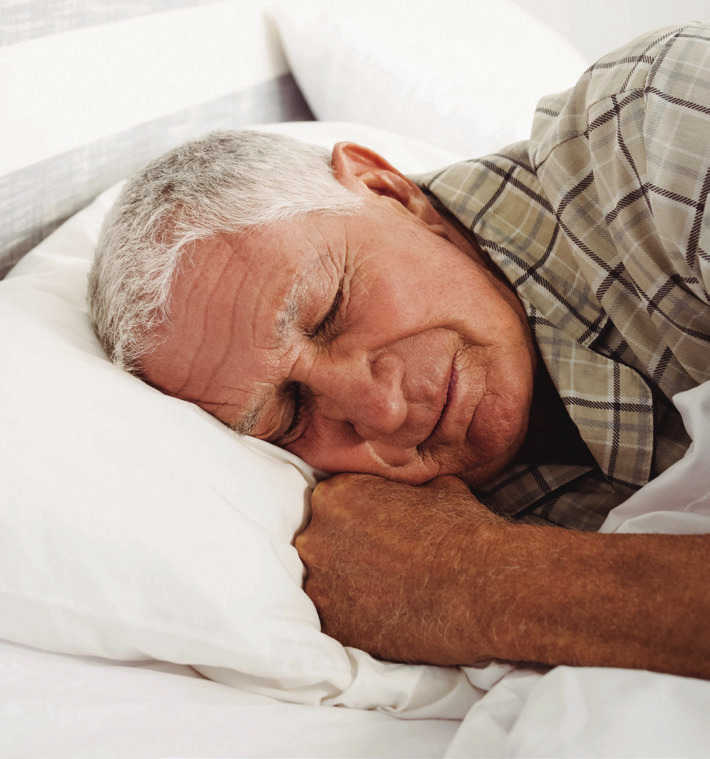
JUNE IS MEN’S HEALTH MONTH.
Health problems that may be overlooked by men include sleep disorders— in particular, obstructive sleep apnea (OSA) and rapid eye movement (REM) sleep-behavior disorder, which occur to a greater extent among men than among women.
OSA is the cessation in breathing (i.e., apnea [pronounced “AP-nee-uh”]) caused by upper airway tissues (e.g., tonsils and adenoids) blocking (i.e., obstructing) the airway during sleep. The obstruction restricts airflow and causes the blood oxygen level to fall. The fall in the oxygen level ultimately triggers a brief arousal, during which the person takes several deep, quick breaths. At this point, loud snoring may occur. On resuming sleep, another OSA episode may occur. Scientists estimate that the prevalence of OSA is approximately three to five times greater among men than among women.
People with REM sleep-behavior disorder act out their dreams. (The term “rapid eye movement” refers to the fact that, during REM sleep [commonly called “the dream stage of sleep”], a person’s eyes dart very rapidly in tandem in all directions.) The skeletal muscles of the body are normally paralyzed in this stage, which prevents a person from acting out dreams. In people with REM sleep-behavior disorder, REM sleep muscle paralysis does not occur. Therefore, a man with this disorder may scream, punch a bed partner, or jump out of bed during REM sleep. REM sleep-behavior disorder is relatively rare, affecting less than one percent of the general population. However, among all people with this disorder, scientists estimate that approximately 90 percent are men.
Scientists believe that repeated decreases in oxygen, frequent arousals, and efforts to breathe against upper airway blockage in untreated OSA may contribute to the development of health problems such as high blood pressure, stroke, coronary artery disease, heart failure, type 2 diabetes, and irregular heartbeats. Treating OSA can help reduce the risks of these diseases.
The most common treatment is continuous positive airway pressure (CPAP). In this treatment, lightly pressurized air is blown through the airway via a mask that fits over the nose or over the nose and mouth. The pressure prevents upper airway structures from blocking the airway, thereby preventing apnea episodes. Research indicates that CPAP users have a lower risk of experiencing fatal and nonfatal events from diseases affecting the heart and blood vessels (e.g., stroke).
Untreated REM sleep-behavior disorder can result in physical harm to self or others. In addition, scientists have noted that, in some people, REM sleep-behavior disorder precedes (by many years) the onset of symptoms of Parkinson’s disease and other neurodegenerative disorders. Whether REM sleep-behavior disorder causes these disorders or whether it is a very early symptom of these disorders is unclear. The most common treatments for REM sleep-behavior disorder are drug therapy (e.g., melatonin, clonazepam [trade name, Klonopin]), which reduces acting out dreams, and making an environment safe (e.g., removing objects from the floor).
If you are a man with the following symptoms, you may want to consider being assessed at a sleep center. Proper diagnosis and treatment of OSA or REM sleep-behavior disorder can improve your health.
OSA symptoms
• Sense of being choked
• Excessive daytime sleepiness
• Others witness you stopping breathing or struggling to breathe during sleep
• Awakening gasping for air.
REM sleep-behavior disorder symptoms
• Violent movements and/or sustaining physical injuries because of jumping out of bed or falling over objects during sleep
• Others report you screaming or having other vocalizations during sleep
• You have hurt or attacked your bedpartner during sleep
• Your dreams tend to have a violent theme (e.g., being chased).
Regina Patrick, RPSGT, RST, is a freelance writer/editor and a registered sleep technologist. She has been involved in the sleep field for more than 30 years.
✲