IN JANUARY 2020, the World Health Organization declared the SARS-CoV-2 virus, or COVID-19, to be a public health emergency. The virus has since spread rapidly across the globe. To slow the pace of the deadly COVID-19 infection, we are all being asked to stay home, avoid public events and social gatherings, social distance at least 6 feet when in public, wear masks and other personal protective equipment (PPE), wash hands frequently, only be in close contact with members of our own household, and get vaccinated when possible.
According to health officials across the world, the COVID-19 pandemic is far from over and could yet evolve in unanticipated ways. The worldwide impact of COVID-19 will cause us to be wearing face masks and to social distance for an unknown time into the future. Although the vaccine rollout is promising, mutations in the virus are showing to be more infectious. To our dismay, face masks and social distancing outside of our own household are here to stay and will be a part of our daily lives for the duration of the pandemic.
We’re all bothered by face masks in one way or another. Complaints range from the physical discomfort of wearing a mask to the way others aren’t wearing their masks properly. Foggy eyeglasses, sore ears from face mask loops, the perception of not being able to breathe well while mask wearing, being bothered by others wearing the face mask under their nose, and the loss of hearing aids (from removing a mask and inadvertently pulling the hearing aid out of the ear) are just some of the complaints and problems.
Although face mask annoyances are plentiful, the largest problem with face mask wearing is how the masks decrease our ability to have a conversation with someone.
Face masks decrease our ability to communicate
When talking to someone, we use our ears and brain to hear and interpret speech sounds. We also use our eyes and brain to see and interpret facial cues to gain meaning and expression from the talker. When the talker is wearing a mask, the listener loses most visual cues and some speech sound cues. If the listener has hearing loss, the speech sounds lost from a mask-wearing talker will be even greater.
Without thinking about it, all listeners use visual cues or “lip reading” while watching the speaker’s tongue, Singer, PhD from the Universi teeth, lip, cheek, and eye movements to help add to what they are hearing. Visual cues become increasingly important as speech sounds become softer or background noise levels rise. Visual cues are extremely important for people with hearing loss since they’re missing various parts of the speech signal depending on their type and degree of hearing loss.
An unintended consequence of mask wearing is that we may unconsciously get closer to people in order to hear them better to make up for the sound and visual cues lost by mask wearing. Hence, people with hearing loss struggling to hear may be putting themselves at greater risk of catching or spreading the virus when they lean in and get closer to someone to hear them. This is exactly what we’re not supposed to be doing when we’re responsibly social distancing to keep the spread of the virus down. Another consequence to the hearing difficulties caused by masking and social distancing is that people with hearing trouble will begin to avoid all social communication and end up isolated.
In their article “The Challenges of Facemasks for People with Hearing Loss,” Professor Kevin Munro and Dr. Michael Stone from Manchester University write, “The increased effort needed to listen and communicate y of Illinois at Urbana-Champ is exacerbated in people who have a hearing loss. According to the WHO, there are 1.33 billion people globally with hearing loss. Hearing loss leads to communication difficulties between family members, colleagues, and friends. It is associated with negative factors such as poor social interactions, isolation, depression and anxiety, increased risk of dementia, and reduced quality of life. In fact, there are probably many people with hearing loss who were able to manage but would struggle with the widespread use of masks.”
Does one type of mask allow easier communication?
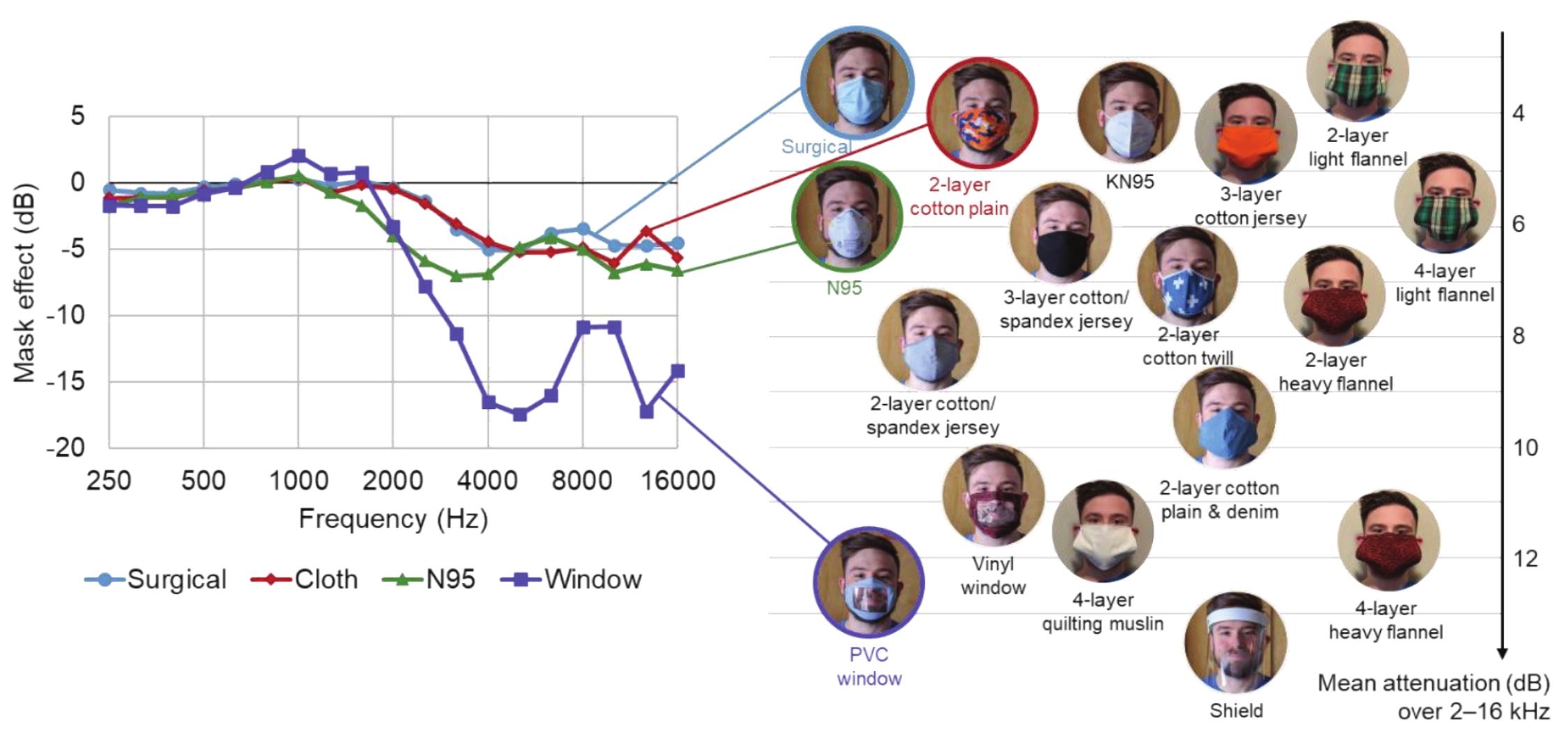
Masks are now available in cloth, surgical fabric, N95 fabric, transparent plastic surrounded by filtering mesh or foam, and clear face shields. Several studies have been conducted to measure the effects of masks on the speech signal. In general, masks muffle the high-frequency consonant sounds in speech, causing lack of clarity. Below this paragraph is a chart and an excerpt from a study comparing the effects of various face masks on speech by Ryan M. Corey, PhD, Uriah Jones and Andrew C. Singer, PhD, from the University of Illinois at Urbana-Champaign.
“The performance of cloth masks gn. varies depending on the fabric and the number of layers. Loosely woven fabrics, such as plain and jersey, have the least effect on sound. Densely woven fabrics, such as denim and twill, block more sound. To understand the effects of fabric choice and number of layers on speech transmission, we recently tested four cotton flannel masks that are identical in shape but made of either two or four layers of light or heavy fabric. These masks are grouped above in Figure 1. Although masks with more layers block more sound, the four-layer mask of loosely woven flannel performed better than the two-layer mask of tightly woven flannel. Similarly, a three-layer cotton/ spandex mask caused less attenuation than a two-layer cotton/spandex mask with a tighter weave. While the number of layers does affect sound transmission, the weave of the fabric appears to be the most important factor for acoustic performance.”
“Clear window masks and shields allow listeners to see lip movements and facial expressions. Unfortunately, they perform poorly acoustically, attenuating high frequencies by as much as 13 dB. The face shield caused especially strong distortion, even at low frequencies. It appears that face masks can provide either high-frequency sound cues or visual cues, but not both.
Fortunately, our results on the directional effects of face masks suggest that wearable microphones can be used with nearly any mask, including those with clear windows.”
Practical advice
While there is no perfect solution to mask wearing and communication, there are many actions that listeners and speakers can take to improve their ability to communicate while mask wearing. From mask studies, we know that the most loosely woven mask fabric allows sound transmission for good hearing, but these fabrics also allow respiratory droplet transmission and thus provide us with the least amount of protection. We must wear proper face masking for the situation at hand to protect ourselves and others from transmitting the virus. Below are some steps we all can take to make mask wearing less stressful:
Hearing loss or not?
If you suspect that you have hearing loss, see an audiologist for a hearing evaluation. It’s always a good idea to get a baseline hearing test. If you have enough hearing loss to warrant hearing aids, invest in a good quality set of hearing aids to make communication easier and less stressful for you. Untreated hearing loss can add stress to an already stressful situation and make you miss important information. Since visits with family and friends are already reduced during the pandemic, it’s even more important to hear the best you can when you are out in public.
Already wearing hearing aids
If you already wear hearing aids, make sure your hearing aids are in good shape and are programmed for your current hearing loss. You can ask your audiologist or hearing aid dispenser if your hearing aids can support an extra program to help turn up the high-frequency sounds lost to mask wearing. For many hearing aids, a remote microphone can be purchased to help decrease background noise and bring the speaker’s words directly to your hearing aids.
Too much background noise
When you’re conversing with someone wearing a mask, reduce the background noise as much as possible or, better yet, move to a quieter location.
Fast talkers
Ask the mask wearer to talk slowly and not to shout.
Missing important information
Get written clarification of critical information. This can be as simple as pen and paper or a whiteboard with marker. An excellent option is to download a free cellphone or tablet app that translates speech into text in real time. This can make medical appointments, banking transactions, pharmacy visits, or even family visits much easier and stress free. Android phone users can download the Live Transcribe or Ava apps, and iPhone users can download the InnoCaption app. These apps can even be used for hearing classroom lectures, conference calls, worship sessions, or anywhere else a person is struggling to hear speech and needs captioning.
What’s best for classrooms?
Teachers in classroom settings should be using soundfield microphones to amplify their voices while they are wearing masks and face shields as well as providing written backup of information to their students. This will not only provide students with proper speech cues, but it will also reduce vocal fatigue for the teacher.
Help for Zoom calls and online meetings
If you’re struggling to hear during Zoom calls or online meetings, speakers should add a microphone to improve their own speech signal to listeners at the other end, and listeners should use headphones or earbuds connected to their cell phone or computer/tablet to improve the speech signal coming from their device. Headphones provide superior sound quality over the computer, phone, or tablet speakers. Additionally, the text-to-speech transcription apps listed earlier can provide real-time transcription of Zoom or online calls.
The pandemic is preventing us from traveling, visiting family and friends, and going to public events. Additionally, our speech understanding ability is hampered by masks and social distancing once we do leave our homes. This difficulty is worse for people with hearing loss. As talkers and listeners, we can take steps to make our time together less stressful. Hopefully the above tips will improve your ability to communicate while masks are being worn. If you would like to have your hearing tested, please make an appointment to see the audiologists at Northwest Ohio Hearing Clinic.
Shelly Horvat, AuD, CCC-A, is a Doctor of Audiology with Northwest Ohio Hearing Clinic, located at 1125 Hospital Dr., Suite 50 in Toledo (419-383-4012) and 1601 Brigham Dr., Suite 160 in Perrysburg (419-873-4327).
References:
– Greenhalgh T, Schmid MB, Czypionka T, et al. Face masks for the public during the covid-10 crisis. BMJ 2020;369:m1435. www.ncbi.nlm.nih.gov/pubmed/25690777
– Lazzarino AI. Rapid response to BMJ 2020;369:m1435. www.bmj.com/content/369/bmj.m1435
– Smeds K, Wolters F, Rung M. Estimation of Signal-to-Noise Ratios in Realistic Sound Scenarios. J Am Acad Audiol. 2015;26(2):183-96. www.bmj.com/content/369/bmj.m1435/rapid-responses
– https://www.entandaudiologynews.com/features/audiology-features/post/the-challenges-of-facemasksfor-people-with-hearing-loss
– https://www.thelancet.com/journals/lancet/article/PIIS0140-6736(16)31678-6/fulltext
– https://bmjopen.bmj.com/content/8/7/e021502
– https://journals.lww.com/thehearingjournal/blog/OnlineFirst/pages/post.aspx?PostID=8