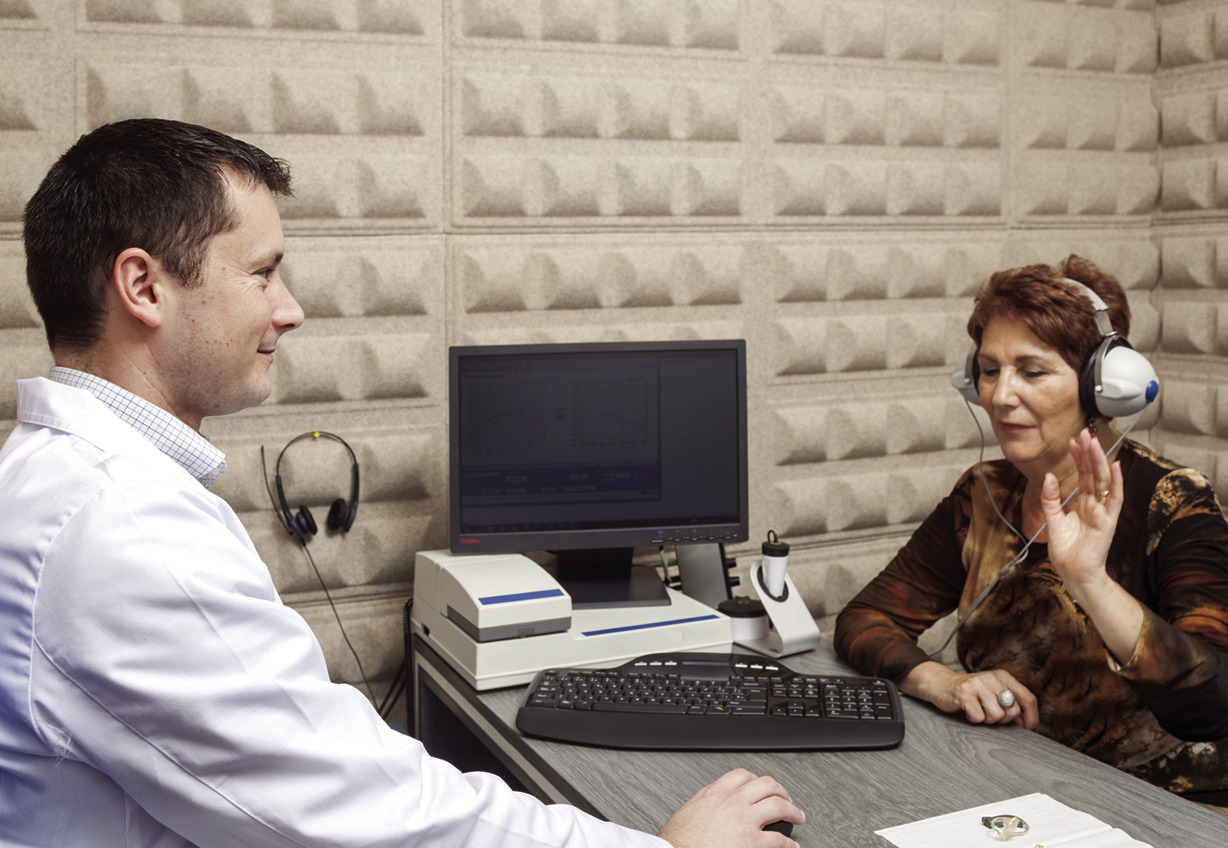
IT STARTS SLOWLY. YOU TURN UP THE SOUND ON THE TV JUST A LITTLE.
You more often ask your significant other to repeat what was said. You struggle to listen to a conversation over the phone. Such are signs of diminished hearing or hearing loss.
If this is you, you’re not alone. More than 20 percent of adults nationwide experience hearing loss to some degree, according to The Ohio State University Wexner Medical Center.
“Degree” is the key word
Sarah DeLauter, a doctor of audiology with The Toledo Clinic, said many people think that the ability to hear is either all or none. Not so. Instead, hearing loss advances by degrees. “It’s hard for people to recognize,” she said. “They can still hear, but loss happens slowly. You might say, ‘I can hear you, but you must be mumbling.’ Very often it’s a loved one, family members, or friends who recognize it first.”
The reasons for hearing loss are several: advancing age, underlying genetic predispositions, being in a noisy environment, or some medications, especially drugs that are used in chemotherapy. DeLauter said the medical community, including oncologists, is more aware of the side effect and turn to other drugs. Sometimes there are medically treatable issues that lead to hearing loss, like excessive ear wax or fluid in the ear.
What to do? Simple.
The important thing is having an evaluation to see where your hearing stands,” she said. “You have to identify if there’s a problem, what it is, and figure out a treatment plan.”
She continued, “Talk to your family doctor or go to an audiologist.” DeLauter said some people get nervous about seeing an audiologist right away because they fear they’re going to be pressured into hearing aids. But that fear is unfounded. “Because hearing loss is by degrees, even if you have some loss, it doesn’t mean you need hearing aids. Identify it and watch for a change over time.”
But should a hearing aid be the right treatment, there’s good news. DeLauter, who’s been an audiologist for almost 24 years, said the technology in those devices is much better than ever and constantly improving.
Not only is hearing aids’ technology better, but also their acceptance. There’s been a stigma about wearing hearing aids that makes some people, especially seniors, hesitate about going that route. Older people harken back to the days of those with hearing problems being called “deaf and dumb,” “but I see more acceptance among different generations,” De-Lauter said. “Younger people say, ‘If I can’t see I’ll get glasses. If I can’t hear I’ll get a hearing aid.’” DeLauter said if the need is beyond the scope of a hearing aid, there are cochlear implants, which are placed inside the ear through surgery. The Wexner Center said there are other devices and surgeries that can restore hearing or correct problems causing hearing issues.
No matter how a hearing loss is rectified, DeLauter emphasizes that the issue should be addressed. “People need to know that untreated hearing loss can lead to a lot of other social and emotional difficulties. It can be linked to depression, sadness and isolation.
There are tons of studies linking hearing loss to cognitive decline. “Communication with other people is our whole purpose in life, the building of relationships. If you can’t communicate or don’t communicate, those relationships will suffer. Hearing is important.”
In a sense, saying “Now hear this,” DeLauter urges those who think they’re losing their hearing: “Go get tested. See if your intuition is correct. Identify the problem, then figure out what the potential treatment plan could be.” ✲