Sponsored by Wood County Park District
LAST MONTH, WE CONCLUDED THE FLORIDA PORTION of our tour by leaving Gulf Islands National Seashore just off the coast from Pensacola and heading west on I-10. This installment features attractions in Louisiana that are reached after crossing very narrow portions of Alabama and Mississippi.
History buffs may be interested stopping in Mobile, AL. It has been recognized as a strategic location since it was founded in 1702 by Pierre LeMoyne operating under the direction of his brother Jean-Baptise LeMoyne, founder of New Orleans. Their objective was to secure the region against the Spanish. Hernando de Soto had claimed the area in 1538, but the Spanish failed to occupy and control it. They were repeatedly challenged by the French after LaSalle came down the Mississippi from Canada in 1682. Seneca Indians had told him about a great river, the Ohio, that eventually went all the way to the sea. LaSalle claimed the entire Mississippi watershed, half the present US, in the name of Louis XIV, and named it Louisiana. (Ironically, Jefferson’s Louisiana Purchase did not include what is now the state of Louisiana.) My sources say LaSalle also founded a trading post on the banks of the Maumee. It eventually grew into a magnificent source of upscale goods for the wives of local Indians and settlers.
You might be interested in a tour of Beauvoir, the home of Jefferson Davis, President of the Confederate States of America. It overlooks the Gulf, hence the “beautiful view.” There are numerous opportunities to visit historic homes all across the Deep South. Most are impressive antebellum mansions, but Beauvoir does not rise to that level of opulence. It is only one story but has period furnishings and 14-foot ceilings painted like the walls with geometric patterns.
New Orleans is only two hours from Mobile, so if you have come this far, you can’t stop now. As RVers, we are selective in our approach to urban tourism. Fortunately, it is relatively easy to navigate through the French Quarter. Our 20 ft. Pleasure Way can be parked right on the street, and the Quarter is compact enough to explore on foot. Still, many people choose to ride in the carriages that are stationed along Jackson Square. The tour guides have a pretty easy job. “That statue of Andy Jackson celebrates his victory over the British in 1814. That’s St. Louis Cathedral across the square. It is said to be haunted. That’s a bar. That’s a bar. And that’s a bar.”
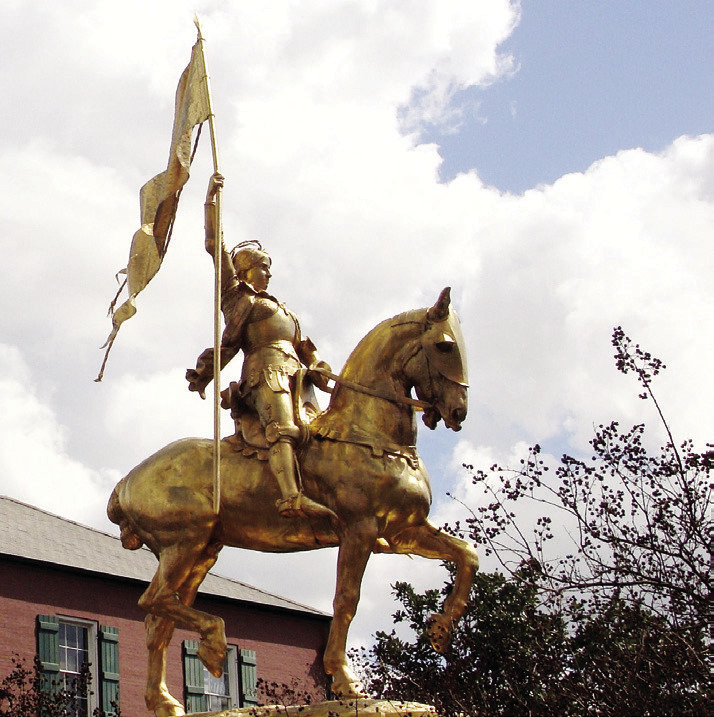
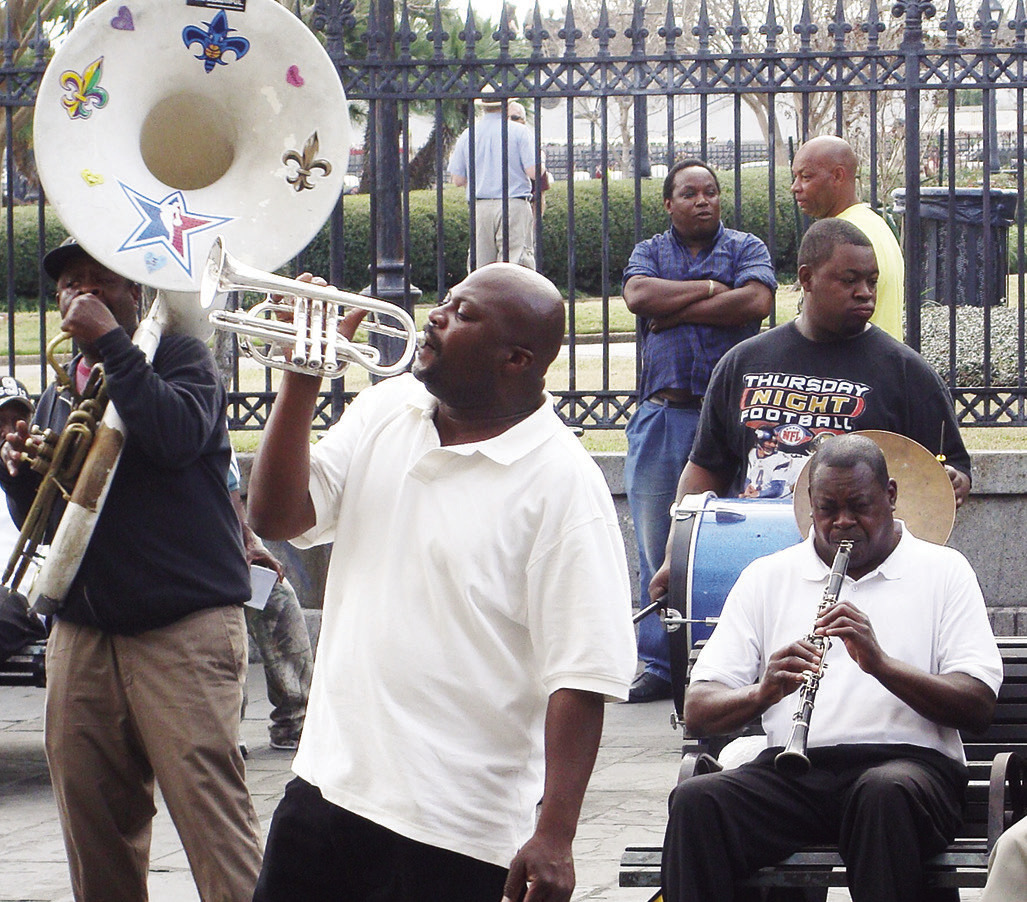
We look for a place to park near the golden statue of St. Joan of Arc, the Maid of Orleans. It’s about a half block from Cafe Du Monde, an openair coffee shop across from Jackson Square. A local ordinance requires all tourists to have a cafe au lait and at least one beignet—or “bag-net” as our friend Nelson pronounces it. Cafe Du Monde is open 24/7 except on Christmas, so it is always convenient to get a dusting of powdered sugar from beignets on your shirt. During the Civil War there was a shortage of coffee so it was stretched with chicory. Chicory coffee is still available. It’s an acquired taste that we have not yet acquired. There is entertainment just outside the cafe and all over the Quarter provided by highly skilled street musicians playing traditional New Orleans jazz.
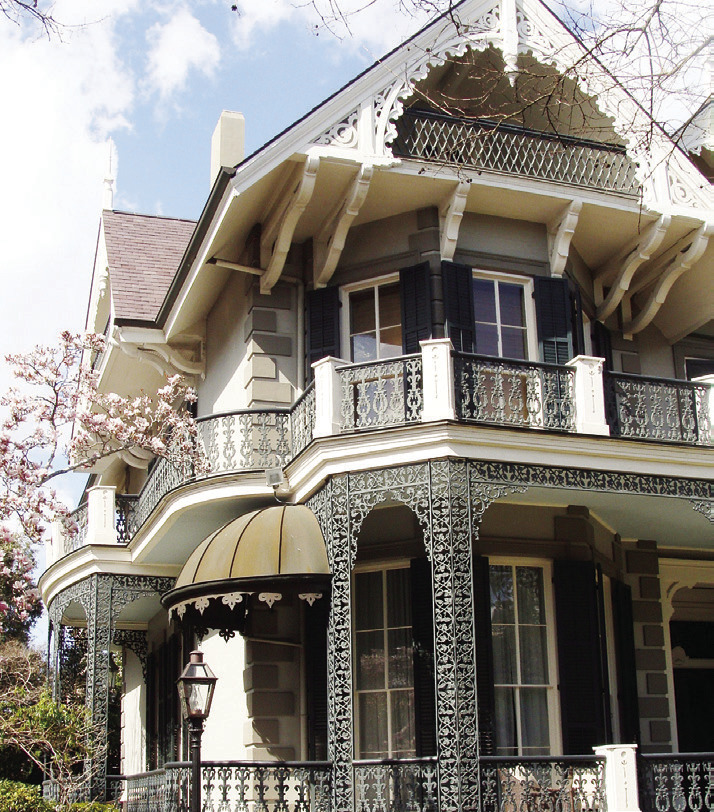
When you have finished your tour of the French Quarter, consider visiting the historic residential area called the Garden District. It was originally occupied by plantations that were subdivided into parcels sold to wealthy people who preferred not to live in the occasionally raucous French Quarter. At first, there were only a couple of mansions per parcel surrounded by large gardens—thus the Garden District. Gradually, the lots were further subdivided until the neighborhood became more famous for its mansions than its gardens.
Just five miles from town is the battlefield where Jackson earned his statue and presidency by defeating 8,000 British with a polyglot collection of 4,000 Kentucky and Tennessee riflemen, the Louisiana militia, Free Men of Color, Choctaw Indians, Jean Lafitte’s smugglers, and privateers. There are informative historical displays at the visitor center where rangers explain why the battle was significant even though it came after the Treaty of Ghent. (Cheat sheet: The treaty had been agreed to by the negotiators but not yet ratified by Congress, so the war was not officially over. No Starlink in those days.)
A couple paragraphs above, I mentioned that Jefferson Davis’s home is not an example of antebellum opulence. For that, head up The Old River Road from New Orleans where you will find several worth your attention. We think Oak Alley Plantation best exemplifies what a Southern plantation is supposed to 10.25x5_ES_AssLiv_Ad_HL_1224_HI.pdf 1 look like, which is why it has been featured in several movies and TV shows. Docents in period costumes explain what life was like before the War. Built in 1839, it is reached by an impressive quarter-mile-long allee lined by 28 impressive 300-year-old live oaks festooned with Spanish moss. Almost all the trees in the oak allees in the South are described as 300 years old no matter how improbable that is. Not all antebellum mansions were built like Oak Alley in the Greek Revival style that was dominant when Cotton was King. Some were based on wealth created when Sugar was King. Destrahan was built in 1787 in the French Colonial style and remodeled in 1840 in the Greek Revival style. Houmas House dates from the 1770s. In the 1820s, the original house became a wing of the white-columned mansion known as the Sugar Palace on 300,000 acres of land. Other sugar plantations include San Francisco, St. Joseph, and Laura. The first has elaborate gingerbread work that is reminiscent of the Victorian style. Laura, built in 1805, is still surrounded by sugar cane and is painted an unexpected yellow ocher, green, red, gray, and mauve. Again, somewhat reminiscent of Victorian “painted ladies” like those in our Old West End. One of our favorite plantations is Rosedown built in 1835 by Daniel and Martha Turnbull for a whole $13,109.20. Evidently 20 cents was worth keeping 12/31/24 9:57 AM
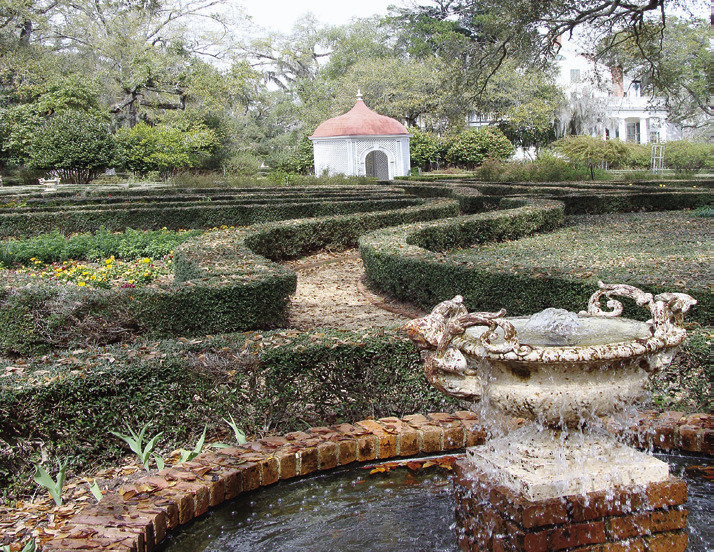
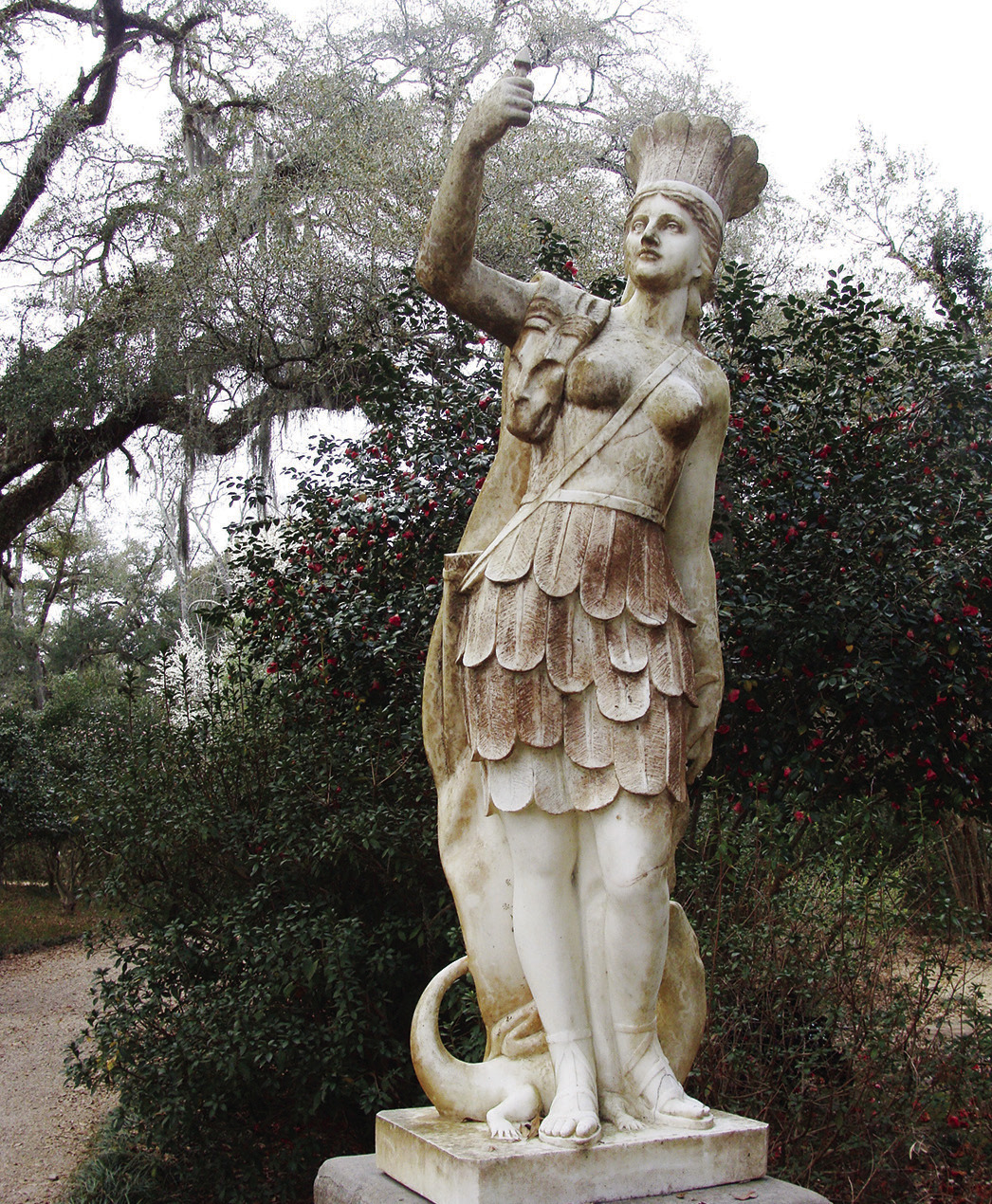
track of in those days. Ten years before the house was built, Turnbull planted an allee of live oaks. The objective was not only to create an aesthetically pleasing approach but to help funnel breezes toward the house. There are two formal gardens in the maze-like style that was popular in Italy. The Turnbulls also had reproductions of Italian Carrara marble statutes representing the continents and the four seasons. The camellia garden is where Martha experimented with grafting new varieties. She maintained three greenhouses, including one where she grew pineapples, oranges, and exotic plants. A large vegetable garden and three orchards supplied much of the food for the plantation. A dovecote provided nesting for pigeons, doves, and quail that were on the household menu. It took a lot to feed the family and about 250 slaves. Speaking of a lot, the self-sustaining plantation included a large chicken coop to provide eggs and meat. It is said that Martha used two dozen eggs in her cake batter. Grok says that 24 eggs would make a cake, depending on what kind, to serve about 100.
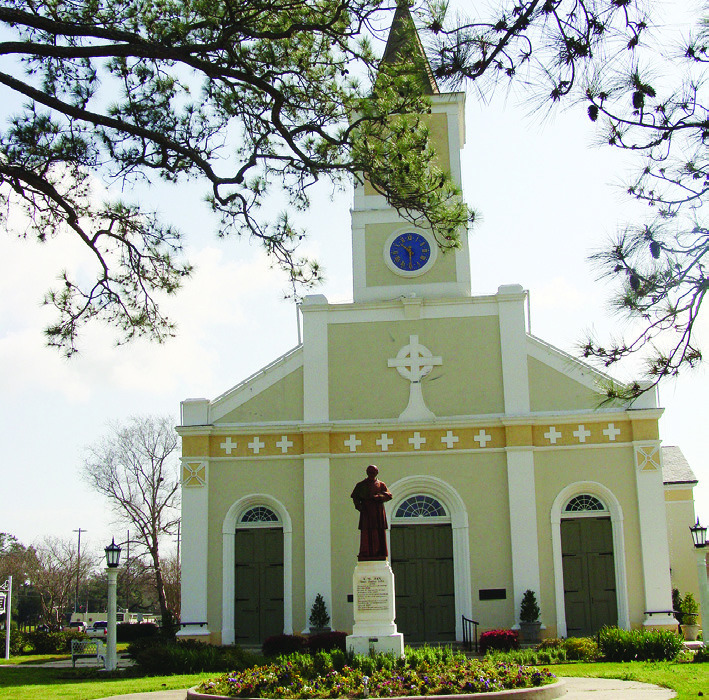
West of Baton Rouge, you enter Cajun country via the 18-mile-long Atchafalaya Basin Bridge over the swamp. “Cajun” is a corrupted pronunciation of “Acadian,” the French who were expelled from Canada by the British in 1755-64. They are not to be confused with the multi-ethnic Creole city dwellers around New Orleans. Cajun Country is mostly south of Lafayette around the small town of St. Martinville, “The Birthplace of Acadiana.” St. Martin de Tours Catholic Church, the Mother Church of the Acadians, was established there in 1765. On the site is the statue of Evangeline, the heroine of Longfellow’s popular poem. Well, once popular anyway. Nearby is the Evangeline Oak, described in tourist literature as “the most photographed tree in the world.” Perhaps. Skeptical tourists may also have photographed the huge 400-year-old Angel Oak near Charleston, SC that gets about 400,000 visitors a year. Just saying. Wise travelers engage in willing suspension of disbelief to get the full benefit of their experience.
A more complete Cajun experience is offered at Vermilionville just outside Lafayette. Think of it as a Cajun Greenfield Village that features restored original homes and reproductions of other buildings with furnishings from the period. There are local artisans and musicians who share traditional Cajun culture and skills. One of the best ways to appreciate the culture is to have lunch at La Cuisine de Maman. You can order a plate lunch, but we recommend the buffet so you can sample some crawfish etoufee, chicken and sausage gumbo or jambalaya, boudin or andouille sausage, bread pudding or fruit cobbler. Finish it off with some warm pecan pie. Mmm! Pecan pie! After all that, you’ll want to work it off by dancing to the live and lively Zydeco music in the Performance Center. It doesn’t matter if you don’t dance well. Even geezers who can barely stand up seem to have a grand old time.
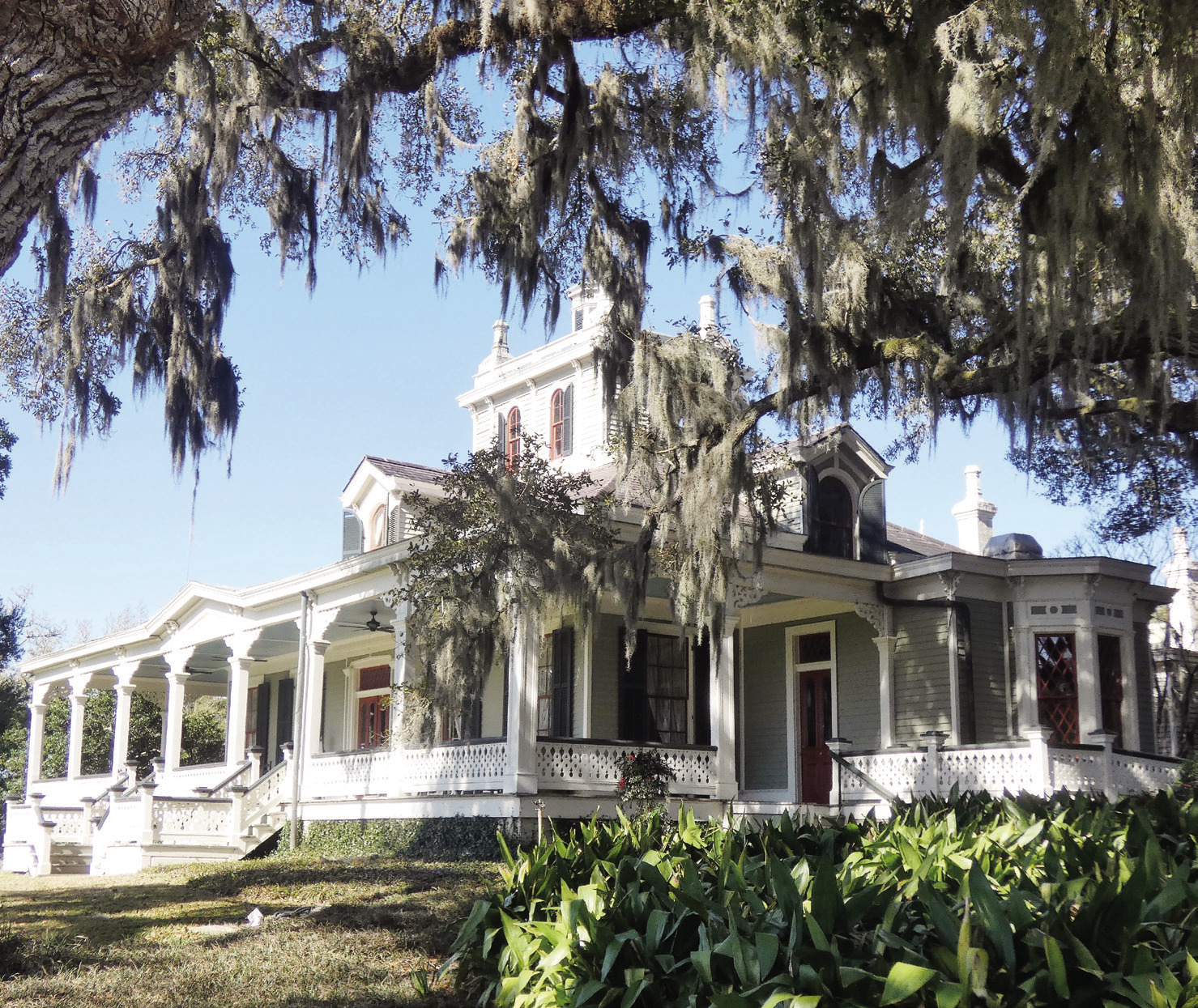
Continuing south, you come to Jefferson Island and Rip Van Winkle Gardens. First off, the “island” is actually just the higher ground of an enormous salt dome that is about seven or eight miles thick and rises above the marsh and grasslands. The mansion was built in 1870 as a winter retreat by Joseph Jefferson, a popular 19th century comedian. He made his fortune as a stage actor in Rip Van Winkle that he adapted from Washington Irving’s story. Jefferson performed it more than 4,500 times over 40 years, topping it off with a silent film version. Jefferson was visited by President Grover Cleveland who is said to have taken a nap under a live oak that was then named for him. The beautiful gardens feature magnolias, an impressive camellia collection, a dawn redwood, a grove of bald cypress, azaleas, hibiscus, a collection of bamboo species, and lotus and lily ponds. Throughout the gardens there are scattered Asian statues and fountains, a Japanese tea house, and a Balinese Gate.
Another “island” just down the road is Avery Island, the home of Tabasco pepper sauce. There are now ten widely distributed varieties based on the original recipe Edmund McIlhenny sold in 1869. You may want to tour the factory and visit the Country Store where they sell everything Tabasco. That includes experimental varieties of sauce you won’t find elsewhere as well as a rather intriguing assortment of eight Tabasco-flavored ice creams. Sample a tiny spoonful before you commit. Habanero can be a little intense.
Even if you don’t like hot sauce, you will like the Jungle Gardens. McIlhenny set aside 170 acres to showcase the largest collection of camellias in the nation and thousands of plants representing 600 species, some of which he developed personally. Grover Cleveland, because he was in the area visiting Jefferson, stopped to see McIlhenny. Naturally, there is another Cleveland Oak, but none of that Rip Van Winkle napping business. McIlhenny’s major achievement as a conservationist was to create a rookery for snowy egrets that faced extinction because their plumage was in demand for ladies’ hats. He started with eight egrets that, over the years, have multiplied into the thousands with the help of elevated nest platforms he installed in the pond. So far, from our point of view, the trip has been just a walk in the park, so next month we’ll ease on down the road to Texas.
You might want to see more of his stories and photos at AnotherWalkinthePark.blogspot.com. ✲