Sponsored by Wood County Park District
WE WERE IN Yosemite when we considered visiting Death Valley National Park for the first time. It seemed like an easy enough next stop about five hours south. It was September, so I hoped the notoriously hot summer season might be on the wane. Fellow campers said it was only about 110 or so. “But it’s dry heat,” didn’t seem entirely persuasive. Besides, the campgrounds didn’t have electric hookups so we could run our AC. So, we saved the visit for a mid-February visit when it was much more comfortable.
Death Valley was given its name by a party traveling to the gold fields of California in 1850. From the eastern side of Death Valley, the Panamint Mountains, only about 15 miles away, appear reachable in a day or two even at a leisurely pace. Their scout, William Manly, had agreed to lead some of the travelers who wanted to take a shortcut from Salt Lake City through the desert in Utah and Nevada to the gold fields of California. Any woman who has traveled with a male driver knows what to expect when he takes a “shortcut.” Instead of two days, the Manly party wandered around in the valley for two months in search of a way over the mountains.
The party, which included women and children, found little to drink except at aptly named Badwater. Their animals became emaciated. Some were slaughtered for food. Just to make things even more interesting, hostile Indians were in the area keeping an eye on them—which must have been rather amusing from their point of view. Manly’s account includes observations about what happens to interpersonal relationships when people are actively engaged in dying of thirst and starvation. Eventually, Manly was able to look back from a high mountain pass and give the place its name. “Goodbye, Death Valley.”
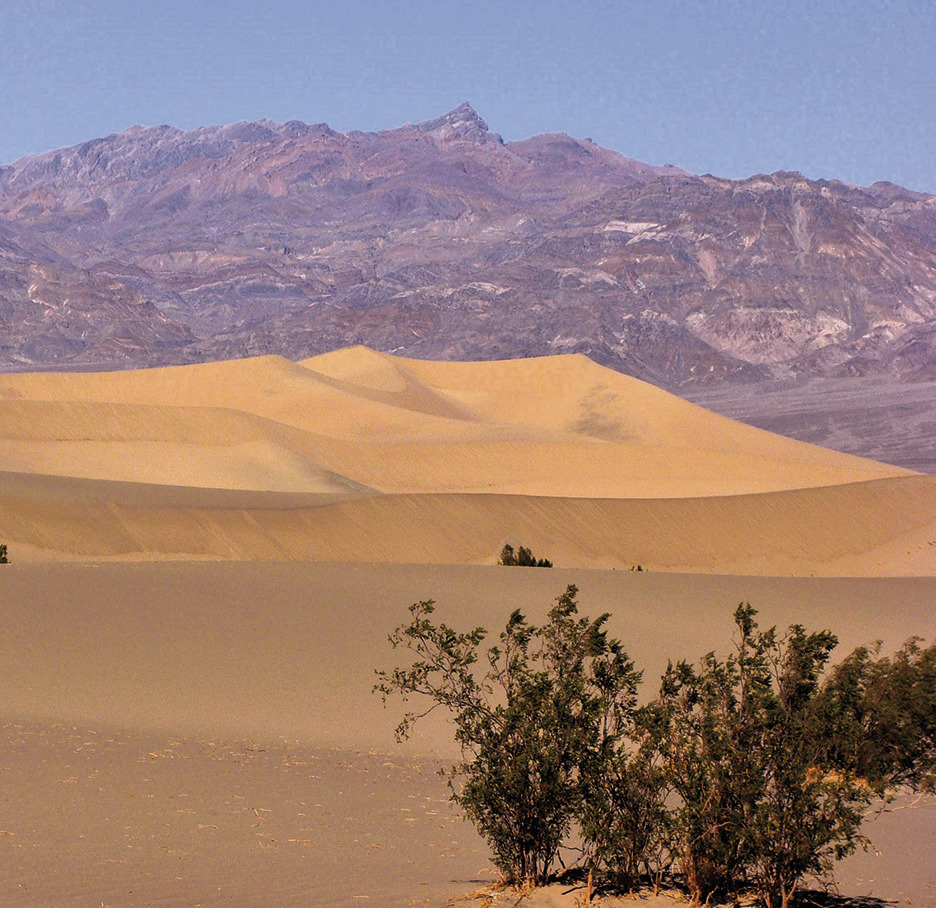
Why is the place so daunting? Death Valley is the driest and hottest place in North America. Moisture- laden winds from the Pacific are forced up by four major mountain ranges on their way east. As the air rises, moisture condenses and falls as rain or snow on the western side of each range. This leaves a drier “rain shadow” on the eastern side. Rainfall in Death Valley averages less than two inches a year. Some years there is none at all. Most mountain valleys have a river flowing through, but Death Valley is a closed basin. The only way moisture leaves is via evaporation.
But why is it so hot? A record 134° was recorded in 1913. The Sahara Desert topped this by two degrees in 1922, but, on average, Death Valley is the hottest place in the world. The reason is that the long, narrow bowl is completely walled in by mountains that absorb and radiate back the heat. As the hot air rises, it cools but is trapped by the high mountains and recirculated. Without moisture there is little vegetation on the floor of the valley, so the ground itself absorbs and holds heat. The temperature of the ground has been measured at 201°. That’s not a typo. Death Valley is no place to wear your flip-flops.
Most of the million visitors the park gets each year arrive between February and April when it is comfortable and generally safe. Generally. Park literature offers an extensive list of suggestions about how to avoid becoming victims of the environment. Take plenty of extra drinking water—a gallon each per day. If you start feeling dizzy or nauseated, get out of the sun. Desert rains are rare and brief, but even a short rain can produce deadly flash floods. Never try to cross washouts. Don’t pet the rattlesnakes, scorpions, or black widow spiders.
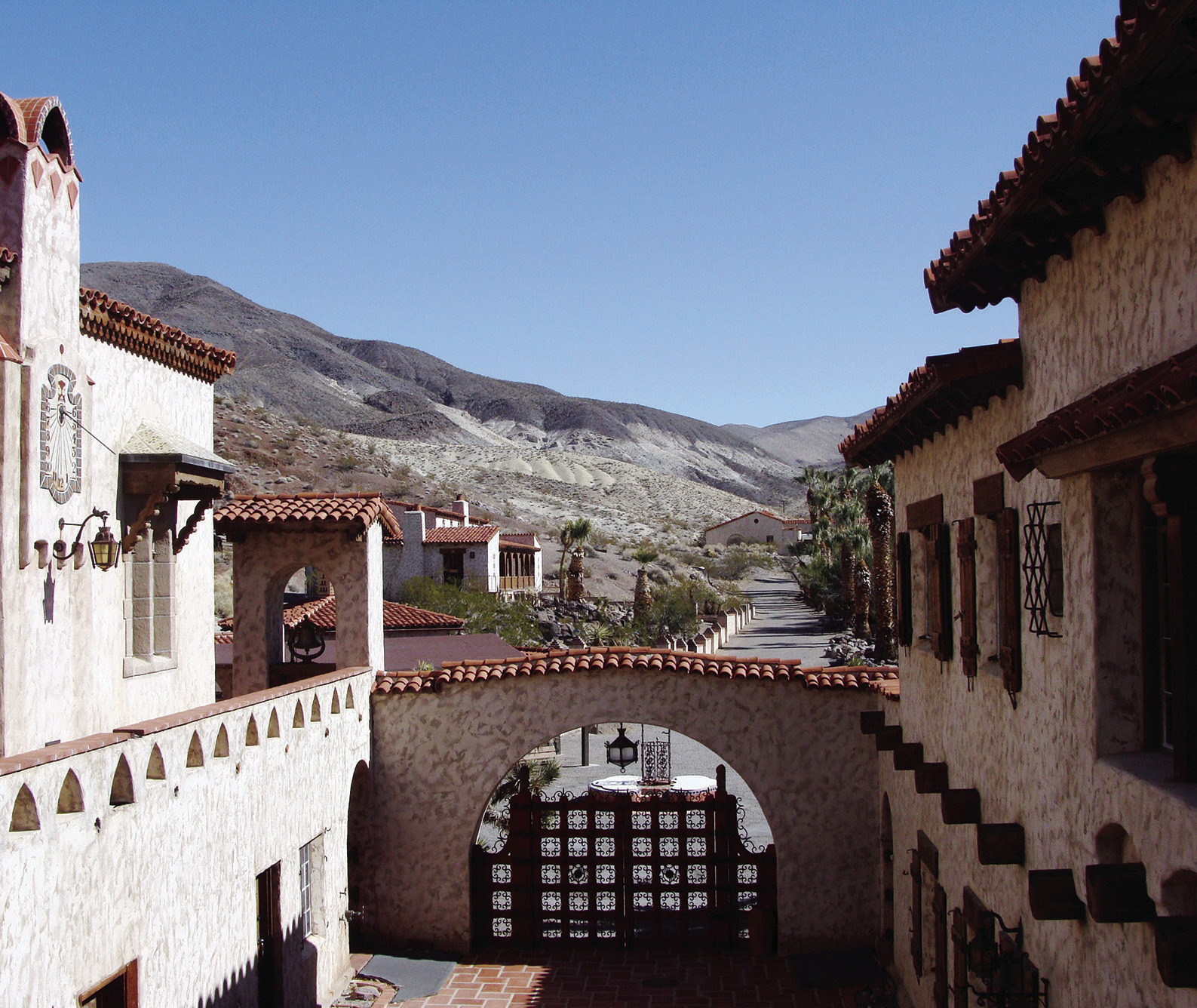
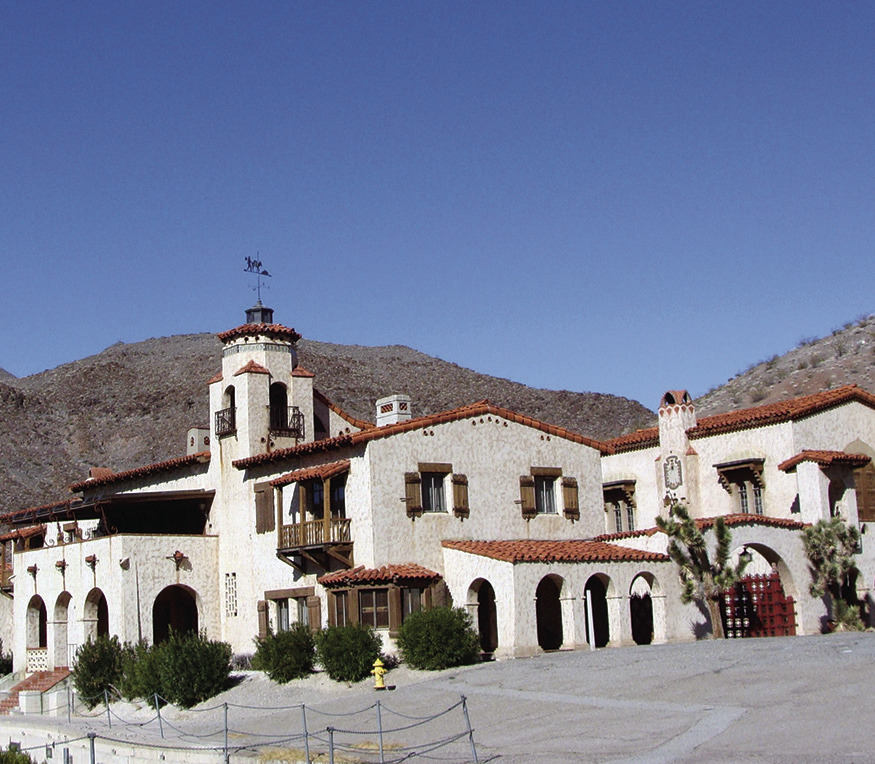
Considering all the creative ways Death Valley can do you in, what makes the place so fascinating? Ironically, the climate was a major attraction for Albert Johnson, a wealthy Chicago businessman whose physician advised him to seek a hot, dry climate for his health. (Some of us would be a little nervous if our doctor sent us to a place called Death Valley for our health.) Johnson and his wife, Bessie, began acquiring property for an estate in Grapevine Canyon, in the northeast corner of Death Valley. At about 3,000 feet elevation, it was comfortable most of the year with neither the stifling heat of the Valley floor nor the winter cold and snow of higher mountain locations. Even more importantly, there were mountain springs for a reliable water source. Plus there was access to railroads just 20 miles away that could bring building materials and, later, their guests.
Johnson became friends with Walter Scott, Death Valley Scotty, a prospector, cowboy in Buffalo Bill’s Wild West Show, teller of tall tales, and con man. Scotty sold him shares in a fraudulent gold mine, but Johnson liked him anyway because he told such fascinating stories. Evidently Scotty was pretty good at the con man role if he could cheat Johnson and still remain his friend with a guest room reserved just for him.
Scotty was the caretaker of the place when the Johnsons were away. He bragged that it was Scotty’s Castle even though it was not an actual castle and it did not belong to him. He claimed that he had built it with the proceeds of his secret gold mine that were concealed somewhere on the property. The Castle, by the way, had been mistakenly built on national park land instead of farther up Grapevine Canyon, but that issue was not resolved before Johnson’s death. Tours of Scotty’s Castle then became one of the major attractions in the park.
Until October 2015, that is, when more than a year’s worth of rain, almost three inches, fell in five hours. Powerful flash floods undercut and destroyed the road and left several feet of mud and debris in and around the house and outbuildings. Sometime this year, restoration is expected to be completed. Finally. By way of partial compensation, the rainfall produced a Super Bloom of desert wildflowers in 2016. The rains awakened billions of dormant seeds and turned normally barren land all golden. Desert wildflower seeds have a special coating that prevents them from sprouting until conditions are just right. When that happens, the barren desert is transformed as hundreds of acres are covered in desert gold, blue mariposa lilies, white desert stars, and desert five spots. They are referred to as because of their short lifespan. Instead of struggling to survive a little longer, they put all their energy into producing seeds quickly for future generations.
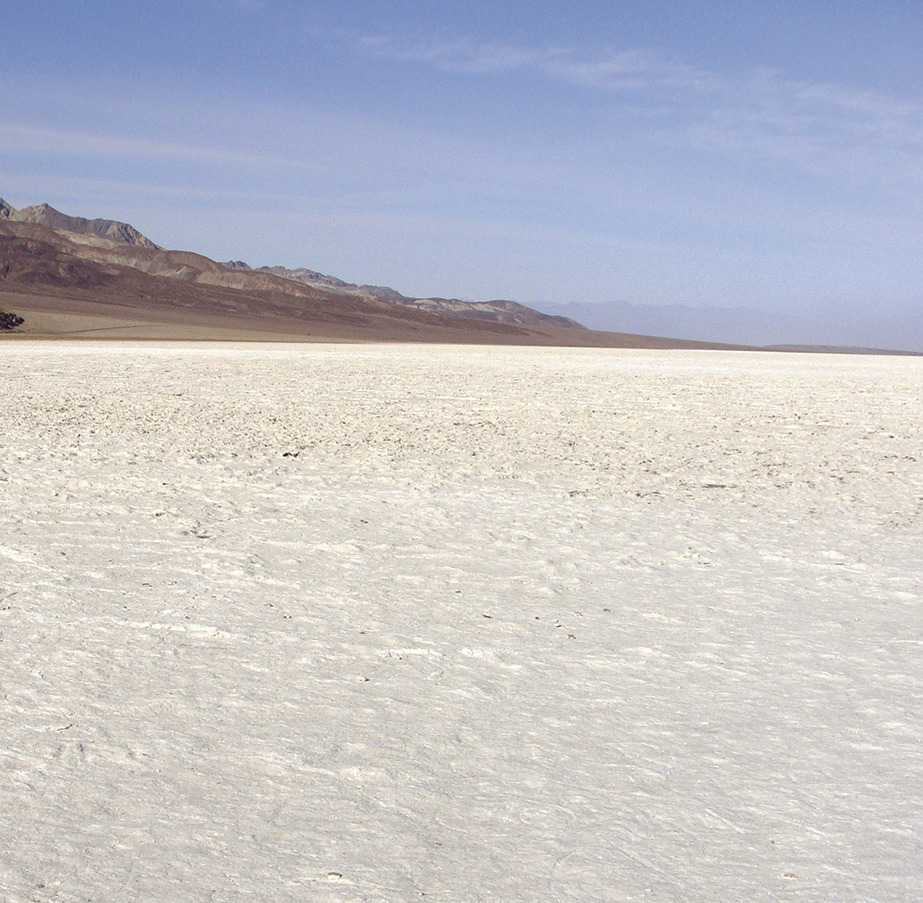
Even when there is not a Super Bloom, Death Valley is a fascinating place for travelers who are not directly threatened by the prospect of thirst and starvation. Badwater Basin, for example, at 282 feet below sea level, is the lowest point in North America. If you look way up, on the cliff face there is a paint line representing sea level. A few thousand years ago, there was a 30-foot-deep lake at Badwater, but the lake evaporated leaving a five-foot-thick layer of salt. We took a little walk out on the salt flats. I caught myself walking gingerly (and stupidly) because the salt flats looked like ice even though it was in the upper 80s.
Dante’s View (of The Inferno, of course) at 5,745 feet is a mile above Badwater Basin. You can see across to the Panamint Mountains and Telescope Peak on the western side of the Valley. From Dante’s View, you might convince yourself, like the 49ers, that crossing there should be an easy shortcut. All you would need to do is find a way to get your wagons down to the smooth and level valley floor and then up the mountains on the other side. How hard could that be? If you squint, you might be able to distinguish the little blip on the horizon that is Mt. Whitney and thus score a twofer—a simultaneous view of the highest and the lowest points in the contiguous 48 states.
Devil’s Golf Course is another salt flat. Except the salt is not even close to flat. The devil created what must be the world’s largest golf hazard. The salt there has crystallized into lumpy-bumpy, jagged-edged chunks. The Park Service says you are allowed to walk out there. But there is a significant risk of twisting an ankle or falling on the rugged, uneven surface. We chose to take the one-stroke penalty instead.
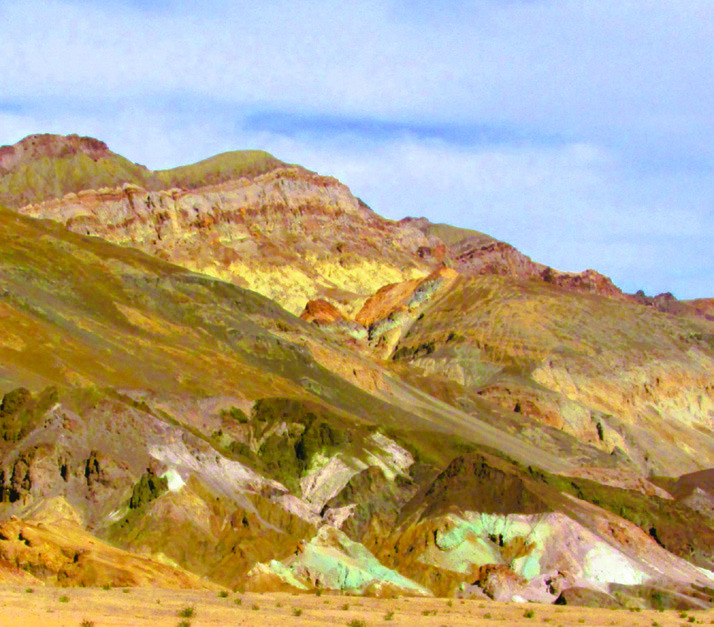
A better place for a little walk in the park is along the nine-mile Artists Drive loop road. It is oneway, narrow, sharply twisting, dipn ping and rising steeply. The colors of Artists Palette were created by the oxidation of volcanic minerals deposited millions of years ago. We followed a trail into an increasingly narrow canyon through multicolored rock until it dead ended at a cave. There are plenty of places to pull over if, like most visitors, you prefer not to wander away from your vehicle.
Zabriskie Point is another place up on the eastern rim from which you can see all of Death Valley spread out below you. The geology up there is still more colorful, deeply eroded badlands made even more stunning at sunrise and sunset.
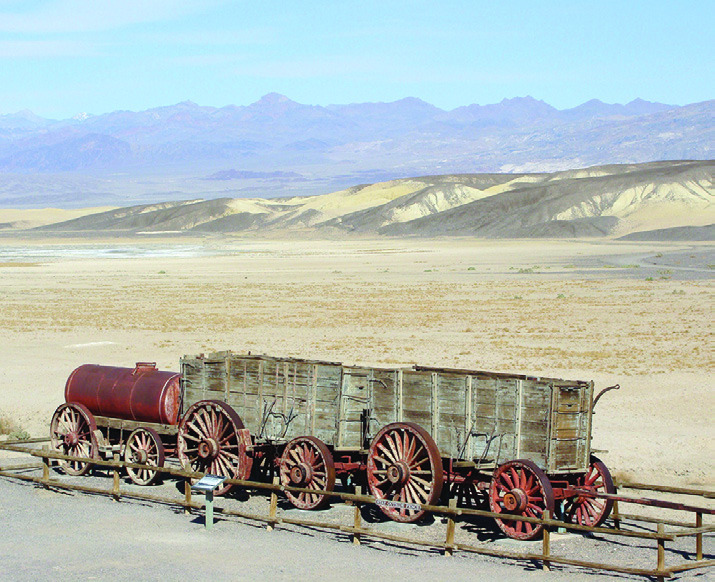
The Point was named for the General Manager of Pacific Coast Borax Company. Borax doesn’t seem all that interesting or valuable in comparison to gold if you think of it only as a hand cleaner or laundry detergent. Actually, it is a key ingredient in the production of glass and fiberglass (Hello, Toledo!), and boron is now used in more than 300 high-tech products. The company employed 40 miners who produced three tons of ore a day. It took 30 days to haul it in 20-mule-team wagons to the rail head in Mojave, CA 165 miles away. Each of the huge wagons had six-foot-high rear wheels and carried ten tons. The wagons in turn towed a water tank that held 1,200 gallons. Readers of a certain vintage may remember the TV series in the ‘50s and ‘60s that was sponsored by 20 Mule Team Borax and hosted by Ronald Reagan. You might want to take the Harmony Borax Works Interpretive Trail to see some of the original mine equipment and wagons.
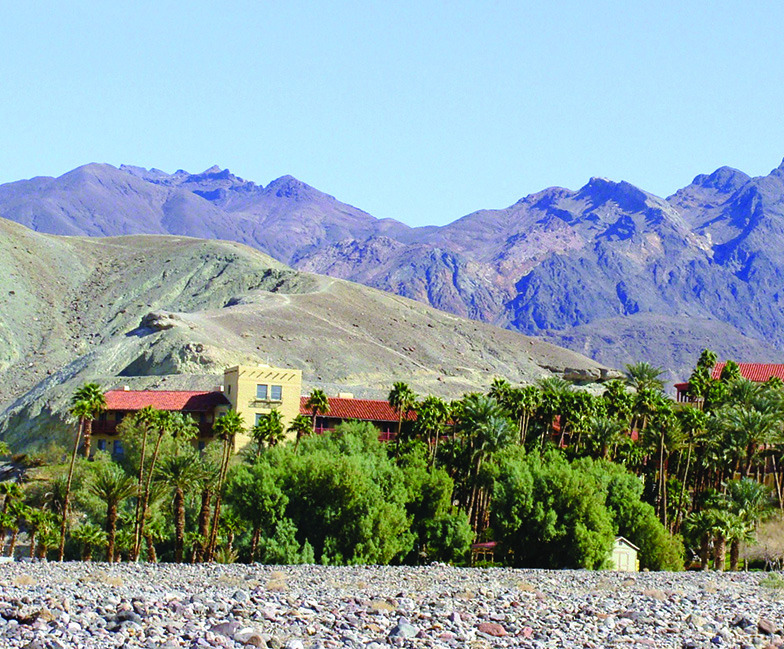
All of Death Valley is not barren desert. Visit the Furnace Creek Oasis up on the side of the mountain where the park visitor center is located. There is an inn and guest ranch open mid-October to mid-May. The Oasis features a palm garden and a spring-fed swimming pool. The Inn Dining Room, which attracted Hollywood celebrities and high-level political figures, until recently had a strict dress code in keeping with the high quality of the menu. We hear that the rules have been adjusted somewhat to permit “casual elegance.” The Oasis Lounge welcomes guests who prefer shorts, T-shirts, or tank tops. As campers, Shirley and I rarely travel with formal attire, but if you plan to stay at the Inn, you should pack appropriately. When you are ready to say hello to Death Valley, you will find the experience just a walk in the park. Provided you go at the right time, of course.
You might want to see more of his stories and photos at AnotherWalkinthePark. blogspot.com. ✲