THEODORE (“DON’T CALL ME TEDDY”) ROOSEVELT claimed that his ranch in North Dakota is what made him president. He was born into a wealthy and prominent New York family but was a sickly child. His asthma was so bad that his father feared he might die during the night. As a boy, he became a highly skilled naturalist with an extensive collection of specimens. As a small, nerdy looking young man with pincenez glasses, he did well at Harvard where he graduated Phi Beta Kappa and magna cum laude. Looking back on his Harvard experience, though, he later concluded that it had little real benefit. Still, he soon gained recognition for his efforts as a naval historian with the publication of The Naval War of 1812. This may be more attributable to his high level of self-motivation and personal interest than an endorsement of his formal education.
On a family vacation that included hiking in the Alps, young Roosevelt found that vigorous exercise relieved his asthma symptoms. This was further enhanced when he took up rowing, boxing, and other strenuous activities. That included hunting trips that involved considerable physical hardship and challenges. In 1883, he visited the Dakotas to hunt buffalo before they were all gone. As an ardent conservationist later in life, the irony was not lost on him. In the Dakotas he met Westerners who were far different from the people in the social class he associated with back East.
In 1884, both his young wife and his mother died on St. Valentine’s Day. Roosevelt was devastated and headed back to Dakota to grieve far from the superficial social whirl of upper-class New York. While there, he purchased the Elkhorn Ranch near Medora, ND on the Little Missouri River and soon became involved with other ranchers in finding solutions for problems such as overgrazing. He also founded the Boone and Crockett Club with the goal of conserving game animals and their habitat. But the habitat did him in.
The winter of 1886-87 brought horrific blizzards and temperatures dipping to -48F that wiped out cattle herds in the region including his. Roosevelt returned to New York and dived into politics. What he took with him from the Dakotas was a vastly increased respect for the virtues of ordinary people like the cowboys he associated with daily and with whom he shared long hours of dangerous, hard work. He was a hands-on rancher not just an owner in the mold of his neighbor Marquis de Mores from France, married to an American heiress.
Roosevelt’s political career, helped undoubtedly by his book on naval warfare as well as his family connections, led to his appointment as Assistant Secretary of the Navy. He resigned that position during the Spanish-American War to raise a regiment of volunteers he called the Rough Riders recruited based on his experiences in the West. The heroics of the charge up San Juan Hill led to his election as governor of New York and, in 1900, as William McKinley’s vice president. Six months later, McKinley was assassinated and Theodore Roosevelt became president at the age of 42.
So, two things: Roosevelt’s experience as a rancher introduced him to people who were far, far removed from his normal social orbit; as leader of the Rough Riders, which he could never have been without the ranch experience, he gained national prominence as a war hero. They even named a toy stuffed bear after him. Roosevelt was undoubtedly right. Without his ranching experience, he would never have been president.
If your eyes have not completely glazed over by this point, I highly recommend David McCullough’s biography of TR, Mornings on Horseback.
Theodore was a complex and fascinating man who both entertained and infuriated his contemporaries. Even some fellow Republicans worked to restrain his exuberant vitality.
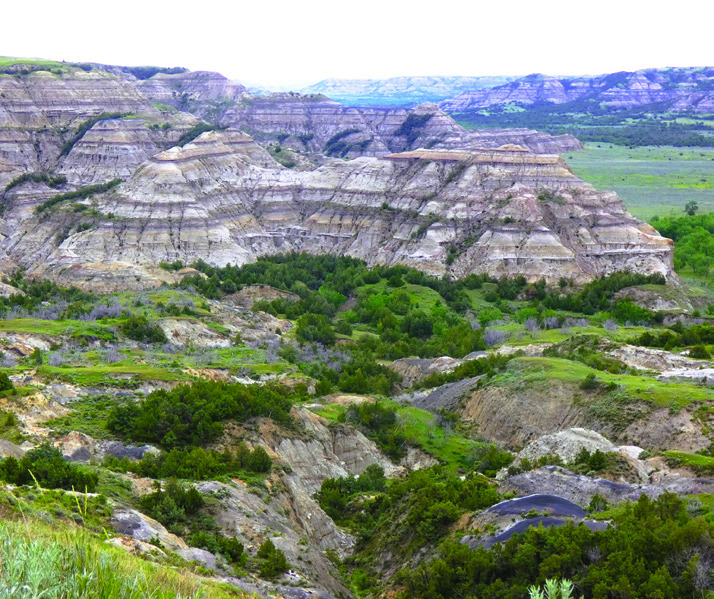
But we did not go to Theodore Roosevelt National Park for political reasons. This is a travel column, after all. Our first visit there, years ago, was on the way to Glacier National Park in Montana via the Upper Peninsula of Michigan. We stopped at the South Unit near Medora just off I-94. On the way back, we stayed at the North Unit near Williston on Rt. 2. This year, we went through the UP on our way to Yellowstone and the Tetons. The attractions at TRNP, as at most national parks, are the scenery and the wildlife. The scenery is dominated by the Little Missouri River and the Badlands. The notable wildlife includes bison, wild horses, and pronghorns. Almost as entertaining are the antics of thousands of prairie dogs.
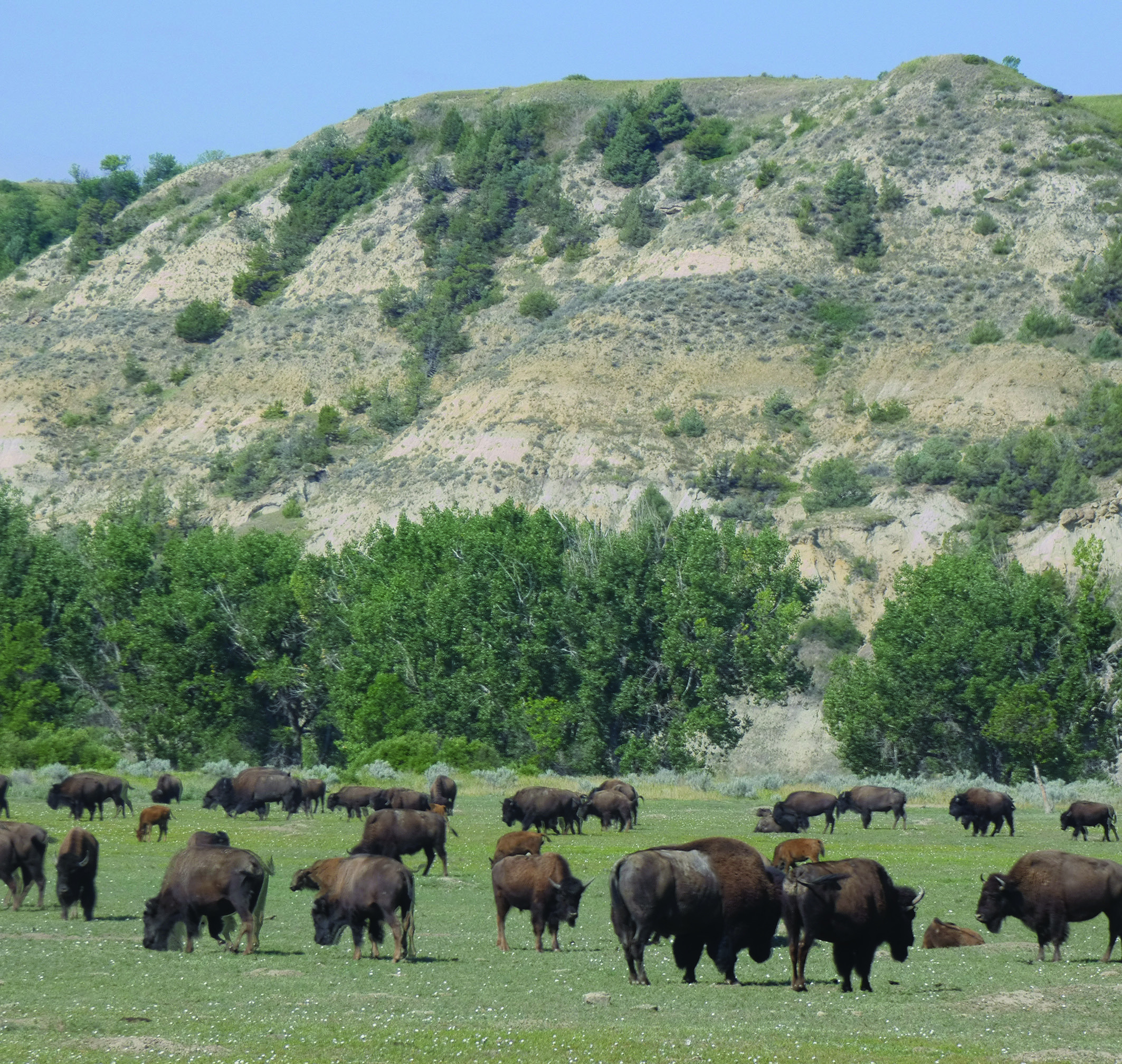
As in Yellowstone and the Tetons, bison go where they want, when they want. In TRNP, the topography tends to keep them hidden until they emerge from narrow passages between the hills in small groups of less than a half dozen. Then, suddenly, there are hundreds of them as if by magic. Bison jams are created when they decide to cross the road. Or, like squirrels that can’t make a decision, they cross and then circle back. Typically, a large bull will stand in the middle of the road blocking traffic like a school crossing guard while the herd passes.
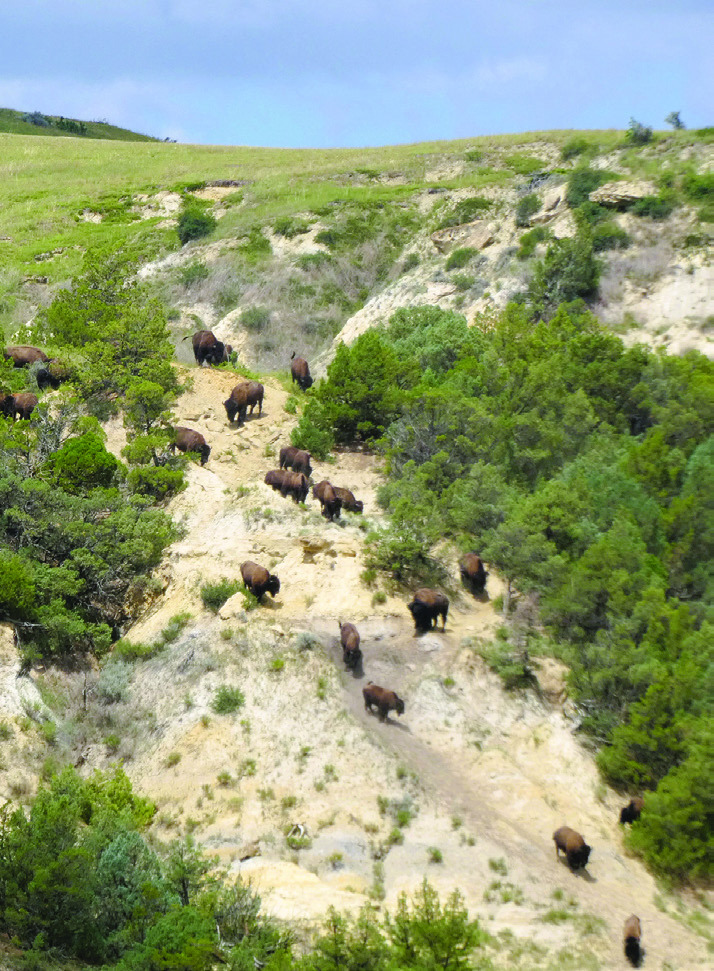
One day, Shirley and I pulled over at one of the numerous prairie dog towns to have lunch while watching their antics. A couple hundred yards away, the Little Missouri wound its way along the base of nearly vertical bluffs. We could see a mass of big brown things along the skyline at the top. It soon became clear that they were bison beginning to descend where it appeared too steep for even bighorns or mountain goats. With binoculars and the zoom lens, though, we could see them using a well-worn path that zig-zagged down to the river. The calves went bounding along, but adults weighing a ton or so had to fight gravity to stay under control. At the base of the bluff, the river is slow and shallow enough for even the calves to ford easily. The herd soon emerged from the willow trees along the bank and spread out in the prairie dog town. Some bison decided to take dust baths on the mounds of dirt piled up at the entrances to prairie dog dens. The dogs protested with a few highpitched yips, but there was nothing much they could do about it.
Timing is everything when it comes to witnessing events like this. Had we arrived just a few minutes later, we would have missed the impressive descent. Once the herd was clearly visible, other tourists joined us. The bison lollygagged for awhile before moving on to the north, disappearing into a notch between the bluffs. Bison may appear to be big, hairy, slow-moving animals, but somehow they manage to arrive and disappear without making a fuss. One minute there. Next minute gone.
In all of the Western parks we have heard visitors ask where to go to see bears or moose or pronghorns or elk or wolves or…. The short answer is “it depends.” National parks aren’t zoos. Animals go where they please. They sometimes hang out in predictable places. Moose like streams where they can feed on willows. Pronghorns, which depend on speed for safety, prefer open meadows rather than the deep woods. But you are not guaranteed to see a particular kind of animal just by going to the kind of places they prefer. Which reminds me of the old story about the tourist who suggested that rangers move the Animal Crossing signs to places that would make viewing more convenient for visitors.
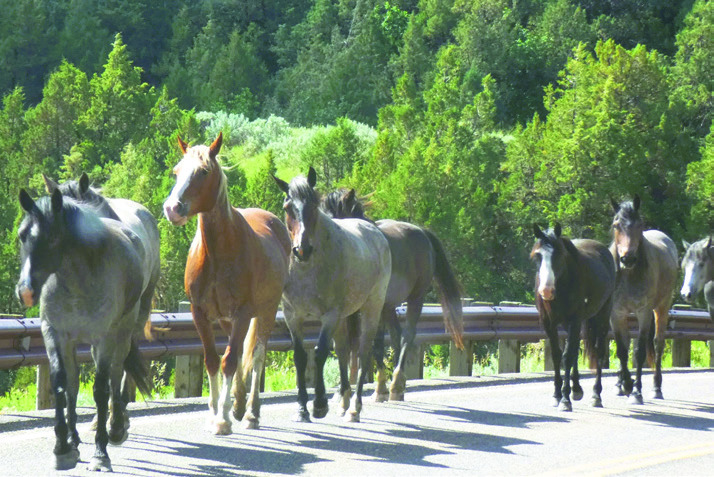
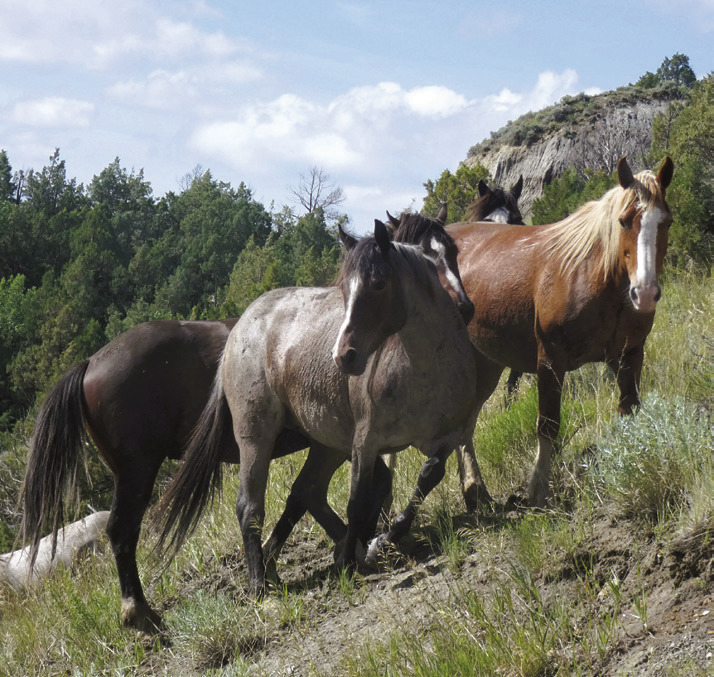
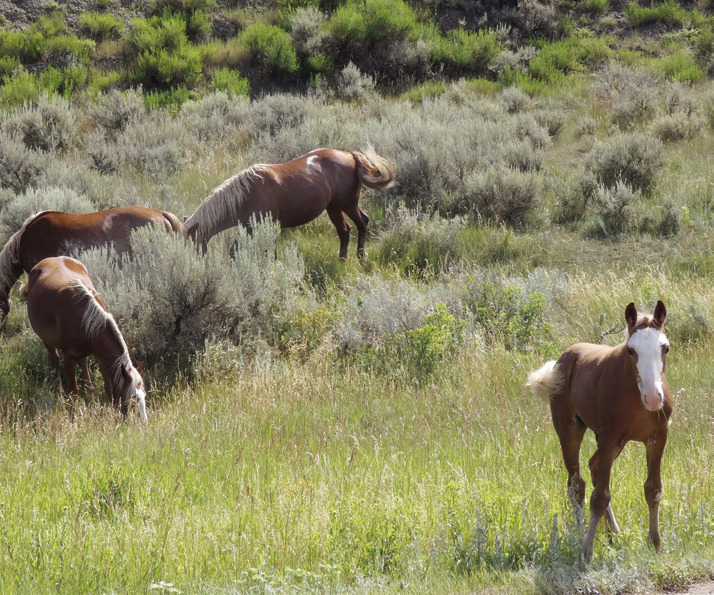
Obviously, the more time you can spend in any park, the more opportunities there are for wildlife encounters. At TRNP, we were particularly pleased to meet up with wild horses. One morning we took a trail for about a half mile into the Badlands just to admire the scenery from the crest of a hill. As we headed back to the pullout, a herd of horses went galloping through. Caught off guard, I barely got my mouth shut and my camera up before they disappeared into the steeply rolling countryside. Then there was an instant replay when a half dozen mares with their colts came straggling after the main herd.
But wait, there’s more. Driving on, we rounded a bend in the road and still more horses were coming right at us. They were trapped between us and several vehicles coming up behind them. Clearly distressed, they tried vainly to climb the cliff face to our right. No go. On the left, they peered down a sheer drop-off. Fortunately, there was nobody behind us so I was able to back up around the curve, carefully adhering to Shirley’s advice not to drive off the cliff. Once beyond that short stretch of road, the horses quickly disappeared.
There were other opportunities, though still just as unpredictable, because the Badlands provide thousands of places into which herds of bison or horses or cows may disappear. This is in sharp contrast to the open grasslands of the Great Plains stretching for hundreds of miles. Pioneers traveling west often spent the night within sight of where they had camped the night before. There are certainly grand vistas in the Badlands, but you have to climb to the top of a ridge to see them.
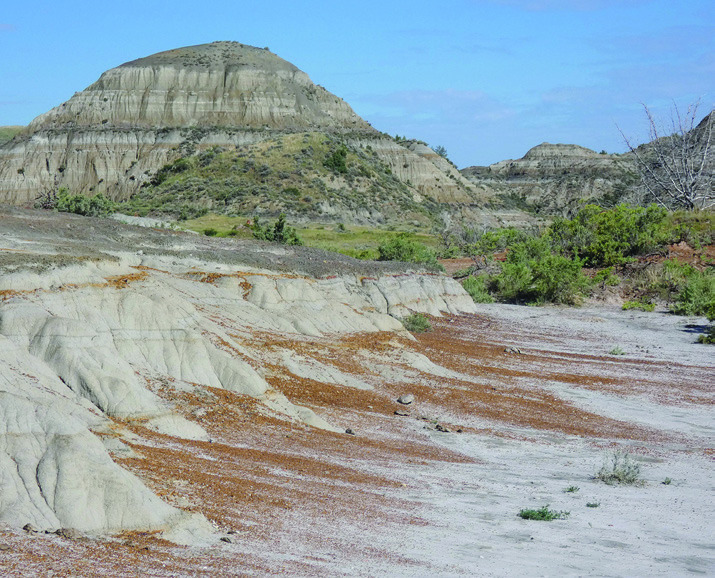
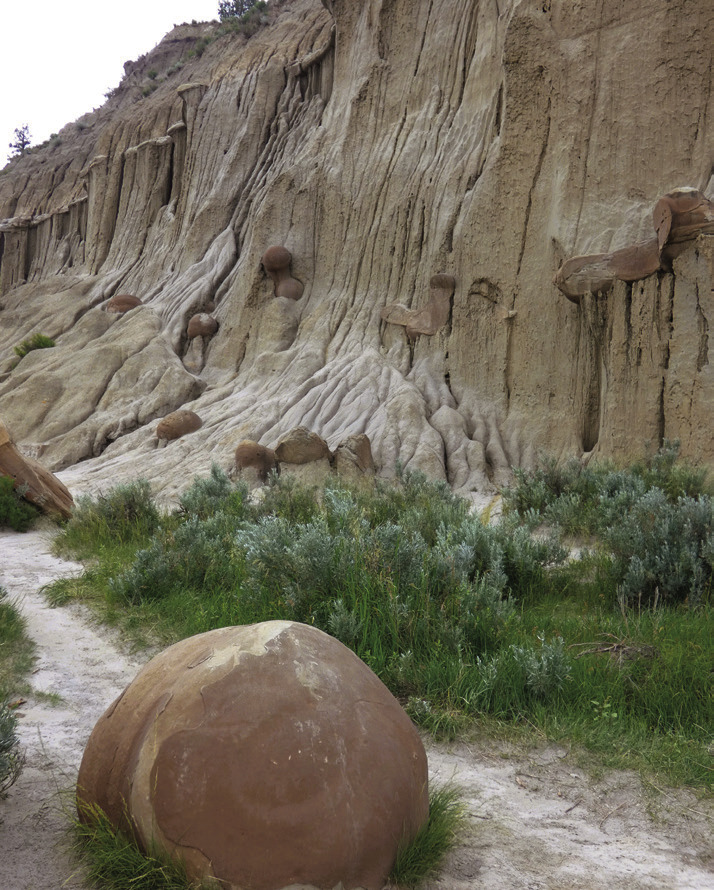
Even so, there is still plenty of fascinating geography close at hand. Cannonball concretions, for example, are stone spheres that were formed by mineral deposits that built up in layers like giant pearls. The exposed rock of bluffs is sedimentary deposited in clearly defined layers of different colors and textures. Caprock is harder and sits on top of softer layers that erode more quickly beneath it. This erosion creates pillars of rock called hoodoos. Blue-gray rock is bentonite that originated in volcanic activity 60 million years ago. Give or take. There are bands of brick red that I assumed were iron-rich layers. Turns out it is clinker, a layer of rock hardened by natural fires in coal seams below it the way clay is hardened in a kiln to make pottery. Some coal seams continue to smolder. Right next to the park road is a fenced off area with a sign saying Do Not Report. They already know about the coal fire, but thanks for your concern.
Roosevelt arrived via the Northern Pacific Railroad. Its successor company, the Burlington Northern Santa Fe, runs parallel to Interstate-94, so getting to Medora, ND these days is relatively easy. But TR’s ranch was about 30 miles back in the Badlands, which were definitely not easy to traverse in those days. You need not bother visiting the ranch site unless you are an especially hardcore history buff. There is nothing left but a few foundation stones. What is still clearly visible is that this must have been a challenging life. Winter blizzards with temps in the -40s are balanced by summer temps of 100+. So, the average temperature is, mathematically speaking, quite pleasant.
After visiting Yellowstone and the Tetons, Shirley and I decided to return to TRNP. She checked the weather forecast because a heat dome was expected in the Northern Plains and we wanted to stay ahead of it. There are no RV hookups in the national park, so running our air conditioner would not be an option. Somehow we have grown soft. In four days, the dome had caught up with us and it was time to move on in search of another place to take a walk in the park.
LeMoyne Mercer is the travel editor for Healthy Living News. You might want to see more of his stories and photos at AnotherWalkinthePark.blogspot.com. ✲