ACCORDING TO THE SKIN CANCER FOUNDATION, more people are diagnosed with skin cancer each year in the US than all other cancers combined. In fact, one in five Americans can expect to develop skin cancer by the age of 70.
However, a future with skin cancer is not a foregone conclusion for anyone. To avoid becoming another skin cancer statistic, it’s important to:
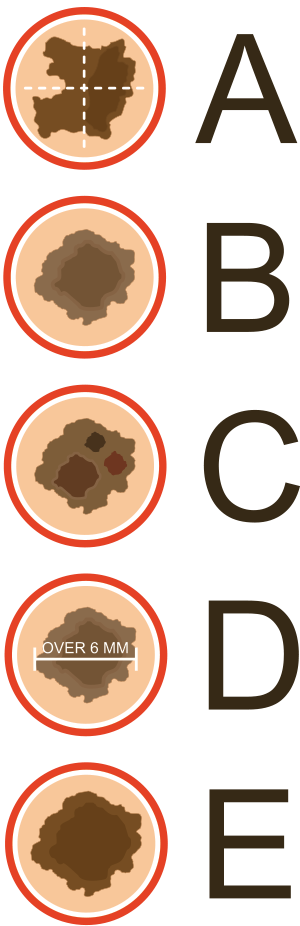
Know the symptoms of skin cancer It’s vital to be attuned to any changes occurring on your skin. Of course, not all skin growths are cause for alarm. The best way to assess whether a particular growth, lesion, or change in your skin warrants a doctor’s examination is to apply the mnemonic “ABCDE,” which stands for:
Asymmetry: If you were to draw a line through the center of the growth, one side would look different from the other side.
Border: The margin of the growth is irregular, jagged, or scalloped.
Color: Rather than being uniform in color, the growth has different shades of black, brown, white, or even blue.
Diameter: The growth is larger than the diameter of a pencil eraser.
Evolving: The growth has changed over time. For instance, a once small, symmetrical growth has become larger and irregular.
However, skin cancers aren’t always glaringly obvious—and they don’t always occur where they’re easy to spot. For example, your arms, legs, and face might appear free of suspicious growths, but what about your scalp, your back, the back of your neck, the soles of your feet, and other hard-to-view areas of your body? To ensure skin cancer isn’t developing somewhere on your body that’s out of sight and out of mind, it’s vitally important to see a dermatologist once a year for a full skin exam.
Be smart about sun exposure While not all cases of skin cancer can be linked to UV exposure, there’s no question that it’s the most significant contributing factor. The best thing you can do to reduce your risk is take measures that limit your exposure to sun or protect your skin from its harmful rays when you are outdoors. These measures include:
Keep in mind that experiencing a severe, blistering sunburn, especially as a child, leads to a higher risk of skin cancer later life. This is particularly true for individuals who have fair skin and blonde or red hair color. Also, don’t assume you can’t burn—and therefore don’t need to protect your skin—on overcast days. The sun’s harmful UV rays penetrate clouds and can still cause burns even when the sun isn’t shining.
Before heading outdoors, liberally apply sunscreen to all exposed skin, and be sure to reapply it as recommended on the product label (i.e., at the specified time intervals, after swimming or perspiring, etc.). The American Cancer Society recommends using a broad-spectrum sunscreen with a minimum sun protection factor (SPF) of 30.
Wear protective clothing
Your outdoor attire should include sunglasses rated to block UVA and UVB rays, a wide-brimmed hat, and a long-sleeved shirt.
Know when to stay in the shade The sun’s rays are most intense between the hours of 10:00 a.m. and 2:00 p.m. Give your skin a break during that period by spending it indoors, under an umbrella or awning, or in another shady location.
Skip the tanning bed
There’s no such thing as a safe suntan—whether you get it in natural sunlight or on a tanning bed. In fact, more than 419,000 cases of skin cancer in the US each year are linked to indoor tanning, the Skin Cancer Foundation reports.
Schedule your screening
While all these sun-protective steps are important, they should not be considered a substitute for annual skin cancer screenings performed by a dermatologist. Screening is a critical aspect of prevention because any precancerous growths that are discovered can be removed before they have a chance to evolve into something more sinister. Furthermore, if skin cancer does develop, routine screening greatly increases the odds of catching and treating it in the earliest stage when it’s most likely to be curable. ✲