Sponsored by Wood County Park District
WHEN SHIRLEY AND I winter in Florida, we always schedule at least one of our stays at Alexander Springs. We enjoy both the springs and the campground there, but the dates of our stay are determined by the Winter Horse Trials at Rocking Horse Stables, about 15 miles away in Altoona.
Central Florida is a Mecca for the equestrian set who come, before COVID anyway, from all over the world. Many, though, don’t travel far at all. Drive down country roads in the Ocala area, and you will find horse farms shoulder to shoulder just as they are at Lexington, KY. In early March, there were 520 entrants at Rocking Horse in dressage, show jumping, and cross-country races. Rocking Horse has also hosted qualifying trials for the Pan American Games and Olympics. A sizable horse trailer village assembles on the property to accommodate all those participants. While we were strolling through the trailer village, Shirley and I stopped to admire a good-looking bay-colored Irish Sport Horse mare. This relatively new breed, only about 100 years old, is a cross between a Thoroughbred and Irish Draft Horse. It may sound like a strange combination, but the offspring are easy to work with, quick learners, excellent at jumping, and known for courage and endurance. These attributes are particularly on display in cross-country events where the distance and the complexity of the jumps challenge both horse and rider.
The horse’s owner, Caitlyn, emerged from the trailer to introduce us to Lucy and suggest it was OK to “give her some loving.” Which was easy to do. Lucy was true to breed—friendly and gentle. Soon we were joined by Caitlyn’s mother, Sharon, and we chatted about preparations for the dressage event that afternoon. Caitlyn and Lucy were also scheduled for show jumping at 8:10 the next morning and then cross country at 8:30—which didn’t seem like enough time to catch their breath. Mother, daughter, and horse were so charming and outgoing that we promised to attend and support them.
While Caitlyn and Lucy were in the dressage ring, Sharon explained that Caitlyn was dealing with asthma and lupus. She experienced flareups that had prevented her from training vigorously and competing for several months. In effect, Lucy was her therapy animal, providing both emotional support and physical activity. Lupus patients are advised to stay active even on days when they don’t really feel up to it. At the same time, Lucy had been out of competition for eight months with a broken nose. Given the size of a horse’s nose, that was a pretty big deal. So, you could think of Caitlyn as Lucy’s “therapy animal” as well.
Technically speaking, horse trials are a competition. Caitlyn insisted, however, that equestrians support each other and focus on improving their own performance rather than defeating others. This is Rules for Life Number 4: Compare yourself to who you were yesterday, not to who someone else is today.
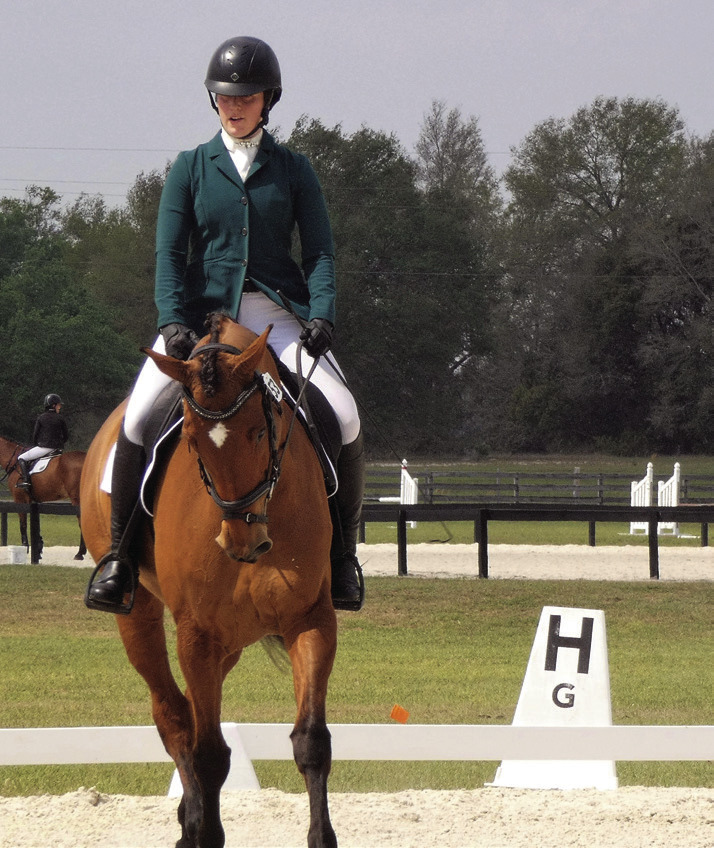
Dressage is a good way to ease into the competition because the required paces require precision rather than intense physical exertion. This event is about mastering little details that call for absolute accuracy in apparently simple things, such as maintaining a straight line without wobbling left or right. Then there is the exact place at which a transition is to be made from a straight line to a diagonal or circle and the changes from a walk to a trot or a canter. Straight means absolutely straight. Diagonal means absolutely diagonal. A 10-meter circle means an absolutely round circle of exactly 10 meters. There are letters in the dressage ring to indicate where these moves are to take place. K, F, M, H, etc. represent terms in German that come from the 18th century heritage of the sport. You don’t need to know what K stands for in German as long as you know what you are supposed to do when you get there. And it is essential to know that “getting there” is when the rider’s body, not the horse’s head, arrives at the designated place. At which point there is to be an immediate transition to the next gait. Not too soon. Not too late.
Appreciation for dressage is based on a knowledge of the subtle requirements that a casual observer is not likely to find very exciting. For some reason, Shirley is under the impression that I understand this stuff. (She is mistaken. On those rare occasions when I have my wits about me, I refrain from telling her she is wrong about this or any other subject.) Dressage is like an equestrian version of ice dancing. Only the well-informed judge can tell the difference between mediocre and outstanding unless the performers do something as obvious as falling down. The point of dressage is to make the required specific paces look so well practiced that they appear easy, elegant, and flawless. Nothing dramatic. Caitlyn and Lucy looked pretty good to us even after the long layoff.
There was possible rain in the forecast for the next day, so I asked an official what the procedure was in that case. She said events would be suspended if there was lightning in the area but would continue if it were just wet. Caitlyn showed us the studs that easily screw into horseshoes like the cleats on football shoes. The studs come in varying lengths that are chosen based on how muddy the course is at the time. Winter is “dry season” in Florida. Since 2010 we had never experienced rain during the horse trials. As it turned out, there was no rain this time either, so the short studs for better traction on dry turf were sufficient.
When Shirley and I arrived the next morning, Sharon’s brother Jordan was there as well. We soon discovered that an engaging personality is a family trait. Now, Shirley is a widely acknowledged people person, but I am often considered abrasive and harder to get along with. Soon, however, Jordan and I were enjoying each other’s company and wit. (He is an attorney, so perhaps he is accustomed to dealing with questionable characters.) By the time we had walked from the trailer village to the show jumping ring, we were getting along famously.
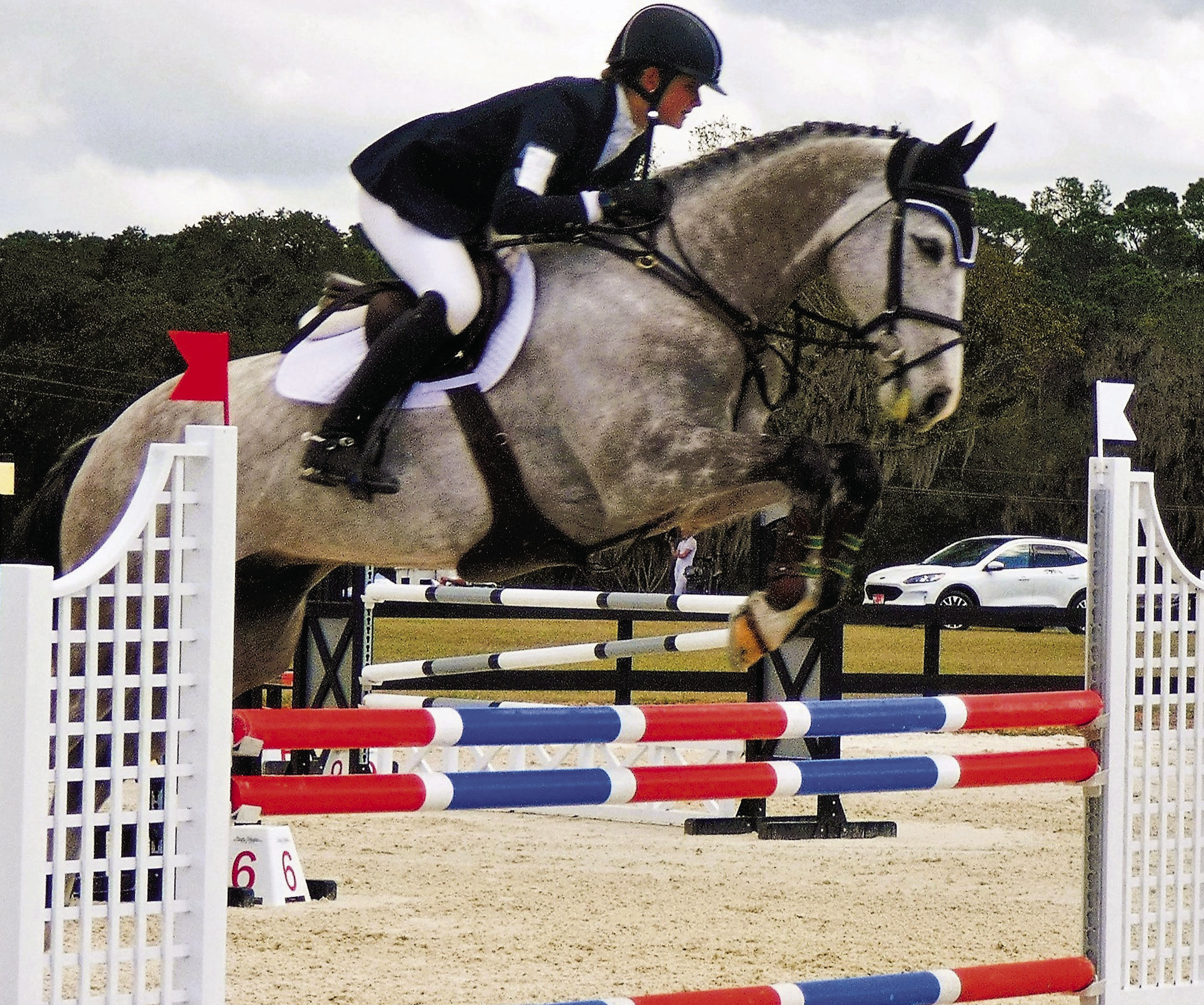
Show jumping is much easier to appreciate than dressage. Horse and rider are required to clear 12 to 15 jumps within a specified length of time. Points are subtracted for knocking off a rail or, as in one case, knocking down the whole thing. Before the event, riders walk the course to memorize the order in which the jumps must be taken and count the strides between them so they can signal the horse when to take off. Some riders are constantly talking to their mounts. Some just rely on body language. Wandering off the course results in elimination. The levels of jumps, or fences, are ranked 0 to 9 based on the number, height, complexity, and time allowed to complete the event. Fences in the 0 level are for beginning riders and are only 2-1/2 ft. high. Fences in level 9 for experienced riders are up to 5-1/4 ft. high and are more challenging because they are longer and more complex. The vertical, the simplest jump, looks just like a rail fence. An oxer is two verticals placed together to make the jump longer even though the same height. A hogsback is three fences stacked together that make it still longer with a higher one in the middle to make it even more challenging. The fences look solid but the rails are lightweight and easy to dislodge from their supports.
That sort of a fault is pretty obvious even to laymen. Lucy knocked off one rail. Caitlyn took responsibility for that. “Lucy did everything I asked her,” she told us. She was the one, after all, who determined Lucy’s speed and the timing of the jumps. Nor did she ever mention, as Sharon had confided to us, that this was their first competition after being sidelined for eight months. Rule No. 4 applies.
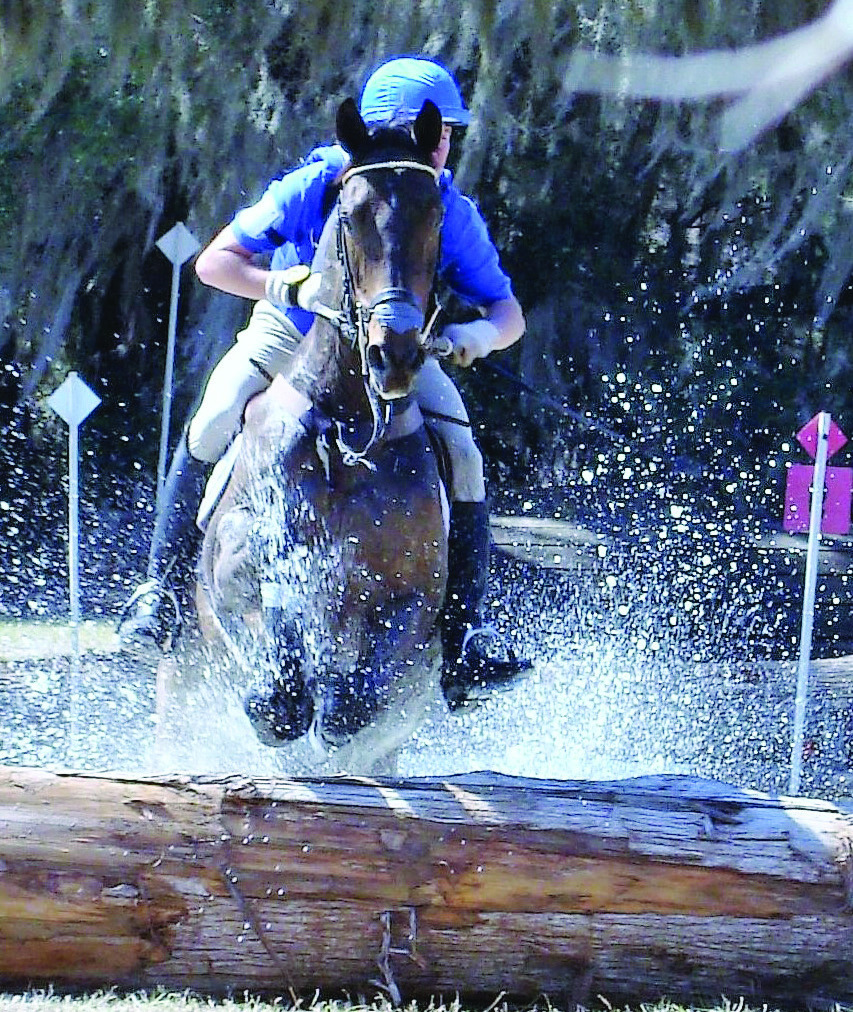
Cross Country is our favorite event because horses are required to clear a variety of complex and more difficult jumps covering distance at full gallop. The course at Rocking Horse is a beautiful venue as it winds through palm trees and live oaks draped with Spanish moss. Most of Florida is rather flat, but the 150 acres at Rocking Horse have some gentle rolls like a well-designed golf course. In addition to the jumps, there are water hazards, ditches, and sunken roads that challenge horse and rider. At an earlier event, we met a soaking-wet rider on foot. At a water jump, his horse suddenly threw on the brakes and dumped him in. Then his mount continued without him. Last year, a horse caught his rear hooves on an obstacle at that same jump. He performed an Olympic-style cartwheel but failed to stick the landing—unless landing on his rider counts. Cross Country requires skill and courage on the part of all participants.
As in show jumping, there are different levels of competition. The novice course is 2,420 meters with 18 jumps. Intermediates cover 3,070 meters and 21 jumps, while the advanced course is 3,640 meters with 23 jumps. The jumps themselves become both higher and longer. Sometimes the horse can see what he has to clear, but the landing point is obscured. The horse needs a lot of confidence in the rider when asked to go someplace blindly.
Shirley and I typically choose places to stand where jumps require more athleticism. Spectators are allowed on the course as long as they avoid interfering with the race by getting run over by galloping horses. Unlike human cross-country and marathon races, the equestrian participants don’t start in a huge pack, but at three-minute intervals. So, if you wait for a horse to pass, you have about three minutes to cross a stretch of the course before the next horse comes bearing down on you with thundering hooves, creaking harness, and loud huffing. At the starting gate, a judge counts down to the start time and sends horse and rider on their way. The judge then communicates by radio the time of departure and the entry number of horse and rider. Judges at each of the jumps note the time at which the horse cleared—or failed to clear. You can almost hear some of the horses thinking, “You want me to go where and do what? You gotta be kidding!”
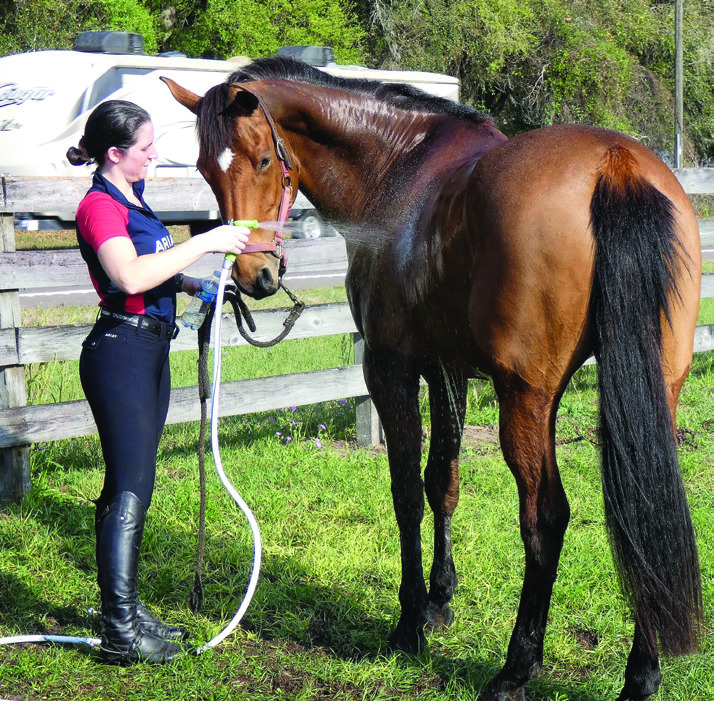
Unfortunately, Lucy was among these. She and Caitlyn were disqualified because of two refusals. They finished the course, but their time did not count towards the competition. We walked with Sharon and Jordan back to the trailer village where Caitlyn gave Lucy a nice shower and a snack. Were they disappointed? Obviously. Still, I remain impressed that Caitlyn never once made excuses even though it had not been just a walk in the park.
For more of his photos and stories see AnotherWalkinthePark.blogspot.com.
✲