FRIENDS OF OUR daughter Sarah contacted Shirley and me about planning their RV trip to Alaska next summer. There were a thousand things to consider even before COVID pretty much destroyed travel flexibility. It was once possible to pause a little while longer if you found a location more enjoyable than anticipated or keep going if the weather was disappointing. Now reservations may be required or highly recommended at national parks and state/provincial parks in the US and Canada. Shirley says that I am afraid of commitment. To my way of thinking, reservations are just the travel equivalent of a shotgun wedding. Even so, you might just take your chances of finding commercial establishments that were not fully booked six months in advance. They offer amenities many RVers insist on: full hookups (water, electricity, sewer, even cable), recreation facilities and community halls, restaurants and gift shops. Shirley and I prefer to experience scenic wonders and wildlife in peaceful solitude rather than with neighbors 10 feet from us. One advantage of RVing is you can have it whichever way you prefer.
The first thing we suggested to Kim and John was to get a copy of The Mile Post, an annually updated publication that identifies everything along every road that connects directly to the Alaska Highway and all the major roads in AK. (It is an 8½ x 11 soft cover book running about 750 pages.) An hour later they messaged that it had been ordered. This indicated they recognized the level of planning required and were enthusiastic about getting on with the process.
The first step is to define what you think of as a summer trip. You could “do Alaska,” as some of our friends and family have, in a couple weeks. Fly to Seattle, take a cruise ship up the Inside Passage, board a tour bus for a few days, and fly home out of Anchorage. This requires minimal planning because someone else decides what you should see, where you should stay, and what kind of restaurant you should prefer. There are similar tour companies for RVers who like to travel in a pack. They make all the reservations at campgrounds and decide which sights are worthy of your attention.
Shirley and I define “a summer trip” as one that takes all summer. We prefer to decide where to go and how to get there, where to stay and for how long. This takes a little more effort, but we find the research and planning phase helps establish priorities and builds the anticipation.
A priority of many Alaska travelers is to visit Denali, the highest mountain in North America. Most of them, however, will not get to see Denali. The mountain is so massive it creates its own weather pattern that wraps it in clouds about 70% of the time. If your tour group is scheduled for one day in Denali National Park and the mountain is clouded over, well…. The way to increase your odds of joining the 30% Club is to book several days or a week in or near the national park. There are plenty of things to see and do while you are waiting for a clear day: sightseeing and wildlife viewing on the road out to Savage River, flightseeing in a plane or helicopter, hiking, biking, watching sled dogs enthusiastically pulling even without snow, shopping and dining just outside the park.
You could also stay at Denali State Park where, on clear days, you can see The Mountain through the telescopes provided. But it is rather like going to the Louvre to see the Mona Lisa from 75 feet away. Not quite as satisfying as it ought to be.
If Denali is your number one objective and you have reservations, you can then decide what to do going and coming. Most people we talk to about driving “all the way to Alaska” find it rather daunting. Kim and John are experienced RVers who don’t fall in this category. Like us, they are bound to find that getting there is half the fun. There is something wonderful to do every single day. Here are some highlights. Even if I were less verbose, there is no way to mention all the marvels that await.
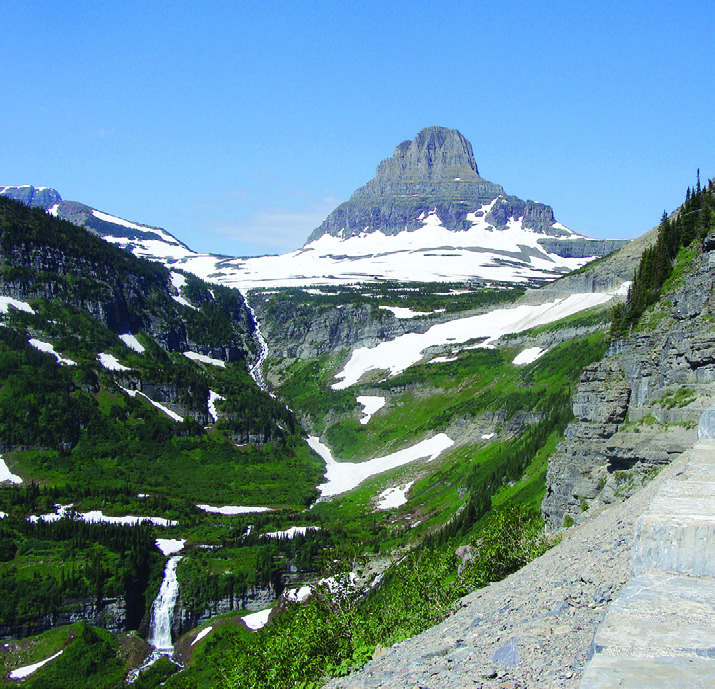
First, a trip to Alaska provides an excuse to go by way of Grand Teton and Yellowstone National Parks in Wyoming and then north through Montana. Glacier NP is right on the Canadian border, but, until early July, Going-to-the-Sun Road is still closed by several feet of snow. In 1992, on our first trip to the Canadian Rockies, Glacier was open, so we could include that and the adjoining Canadian national park, Waterton Lakes. Waterton and the other Canadian national parks (Banff and Jasper in Alberta and Kootenay and Yoho in British Columbia) are superb. Don’t get so fixated on reaching Alaska that you overlook the breathtaking scenery and wildlife they have to offer. A Canadian national parks annual pass is $72.25 per person, $61.75 for seniors—in their money, of course. It pays for itself in the equivalent of seven daily entrance fees. Besides, although there is technically no toll to drive the Icefields Parkway, it passes through Banff and Jasper Parks, so you do have to pay the daily entrance fees to use it even if you don’t stay in the parks. Which you should do.
If you just can’t resist the urge to keep moving, the 167 miles of the Icefields Parkway between Banff and Jasper are chockablock with impressive mountains, alpine lakes, waterfalls, and wildlife. In 1992, Banff was still a quaint, little alpine European-style town with elk wandering around downtown eating flowers out of the hanging baskets. Since then, it has evolved into what someone at Disney World would think a quaint, alpine European town is supposed to look like. You might like it anyway. The architecturally magnificent Banff Springs Hotel is worth visiting even if you don’t stay there. Poke your head into the lobby, and walk the grounds. Really. No kidding.
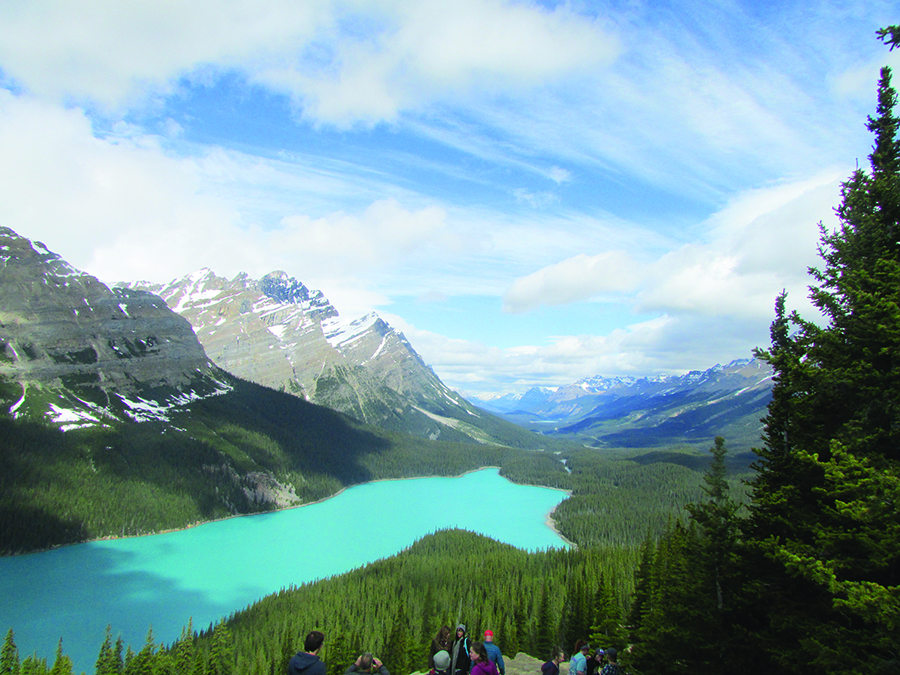
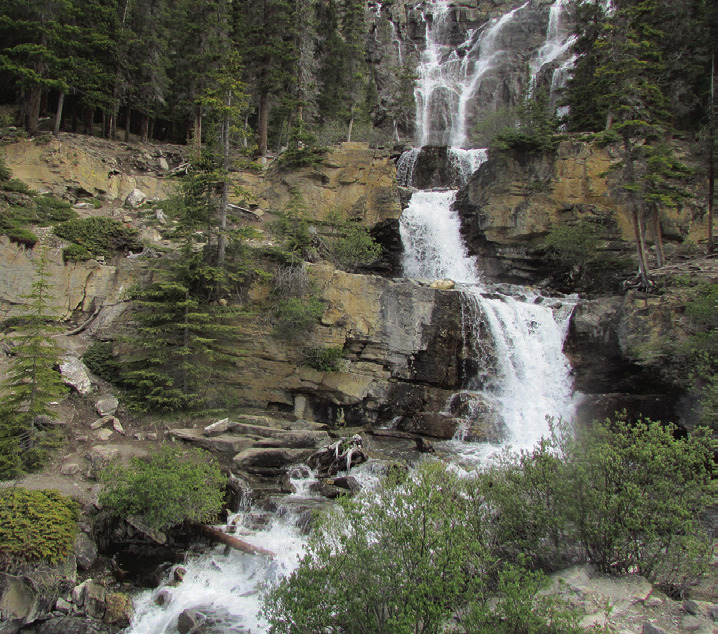
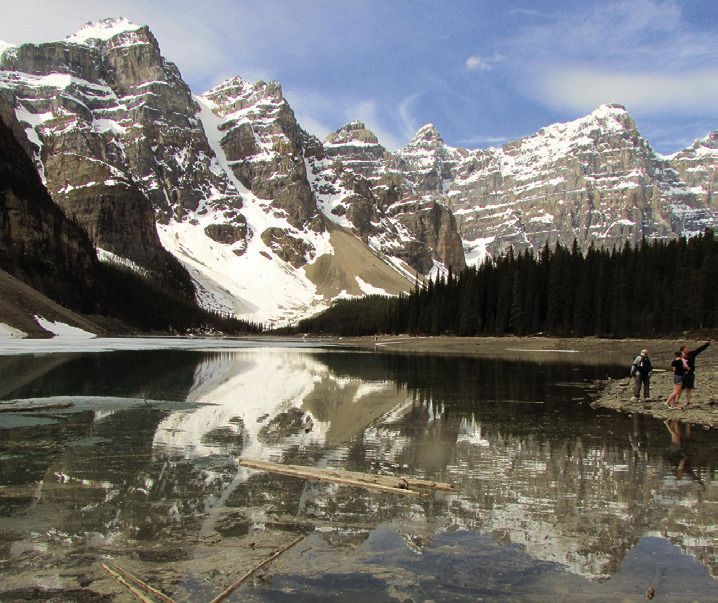
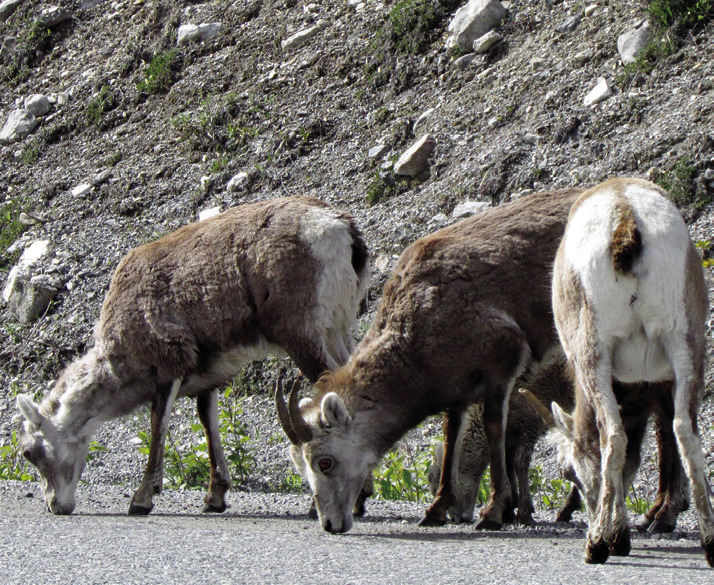
Must stops on the Parkway include Lake Louise just west of Banff, nearby Moraine Lake, Bow Lake, Peyto Lake, as well as Sunwapta, Athabasca, and Ragged Creek Falls. In June, snowmelt creates waterfalls on every mountainside. Oh, and it is called Icefields because of the glaciers. You might take a walking tour or ice buggy ride on Athabasca Glacier and tip-toe out the glass-floored platform hanging 900 feet above the valley—unless vertigo or acrophobia is a problem. You will probably decide there are a lot more places of interest on the Parkway than I have touched on. In ‘92, I scheduled three hours to drive the Parkway. Boy, was that stupid! At least I had enough sense to throw the schedule away. You are undoubtedly much smarter and would not hurry on down the road.
Perhaps you are already familiar with the Rocky Mountains in the US. There are a couple things that convinced us that things just get better and better the farther north you go. First, the treeline is lower in the Far North, so the mountains appear even more massive even if they are not actually higher. Then, in the US, roads tend to run east-west through gaps in the mountain ridges. In Canada, they tend to wind though the valleys. Every time you come around a bend, the impulse is to lift your chin out of your lap and say, “Holy cow! Would you look at that!”
In Canada, you should also be prepared to enjoy the quaint customs of the natives, many of which are related to money. Before our trips, I order some of their currency from our bank. It is very colorful and pretty, but I intend it mostly for minor purchases at the few places that don’t take plastic. Some campgrounds, for example, are staffed by “iron rangers”—slotted cylinders at which you self-register and deposit an envelope containing the fee. Be sure you have plenty of smaller denomination currency for this. Smaller denominations include $1 and $2 coins called “loonies” and “toonies”—not to be confused with the cartoons featuring Bugs, Daffy, and Porky. Most Canadian merchants are glad to accept your credit card and let your bank figure out the exchange rate and charge you what that is in real money.
You might as well get used to everything costing more than you thought it would. At a supermarket, I was considering some chicken thighs until I saw the price—$12.69. Then I noticed that was per kilo rather than pound. Besides, it was Canadian dollars not US, so who knows what that translates into. Even so, I estimated US $6 per pound, more or less. For chicken thighs? I passed. Meanwhile, Shirley was checking out the box wine that goes for about $20 in the US. At $50, she decided to wait until the Fred Meyer store in Fairbanks. At the Costco in Grande Prairie, they had Kirkland Canadian whiskey. In the US, it sold for $22.99. In Canada, it was $44.99. Why does Canadian whiskey cost more in Canada?
We didn’t have the option to pass on fuel. Gasoline is sold in liters (or litres) rather than gallons and paid for in Canadian dollars—which makes it even more difficult to calculate an equivalent US price. (Shirley assures me there is an ordinary linear differential equation for that.) It really doesn’t matter, though. When you commit to the trip, you also commit to X and Y, the unknown variables. At a gas station, I met a fellow headed in the opposite direction. He wanted to know if I had passed a station that might have gas for two or three cents less. I told him that once it got north of $6, I stopped worrying about two or three cents. The Canadians don’t care about cents either. They stopped making pennies in 2012, so store clerks adjust the price to the nearest five cents. Rumor has it they are now thinking of dumping nickels. This may sound silly until you consider what the US is doing to the value of a dollar. Pretty soon, six bucks for chicken thighs or gasoline might not seem all that outrageous.
Canadian humor extends to all sorts of things. At national and provincial park campgrounds in Alberta and British Columbia, firewood was free. Woohoo! But you are not allowed to burn it without a permit that costs $8.80. Way up in the Yukon, though, it really was free so, on average, we were golden. Besides, there is no point quibbling over a few pennies or nickels here and there.
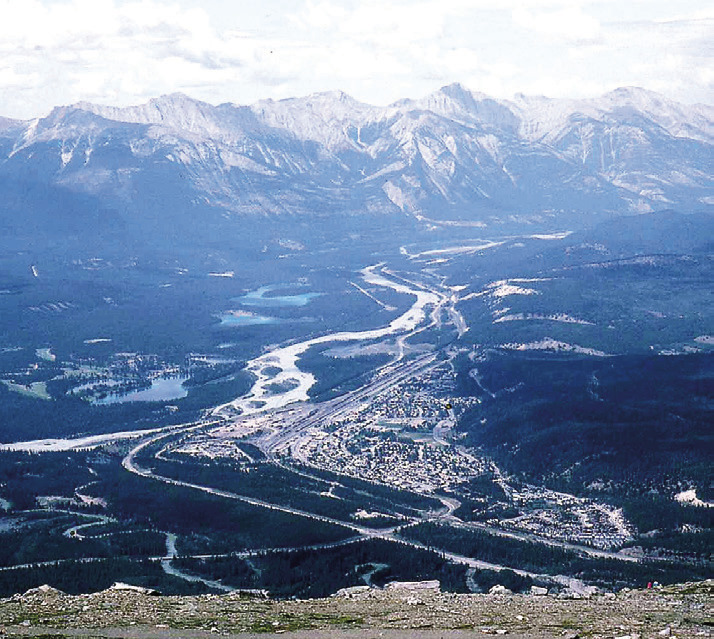
At Jasper we took the Skytram gondola up Whistlers Mountain for a glorious view of the Athabasca River braiding through the valley. From the end of the lift there is a trail to the summit that is even more breathtaking—because it is 3.7 K and climbs to an elevation of 8,100 feet—or 2,463 metres as they say. The air is thinner up there.
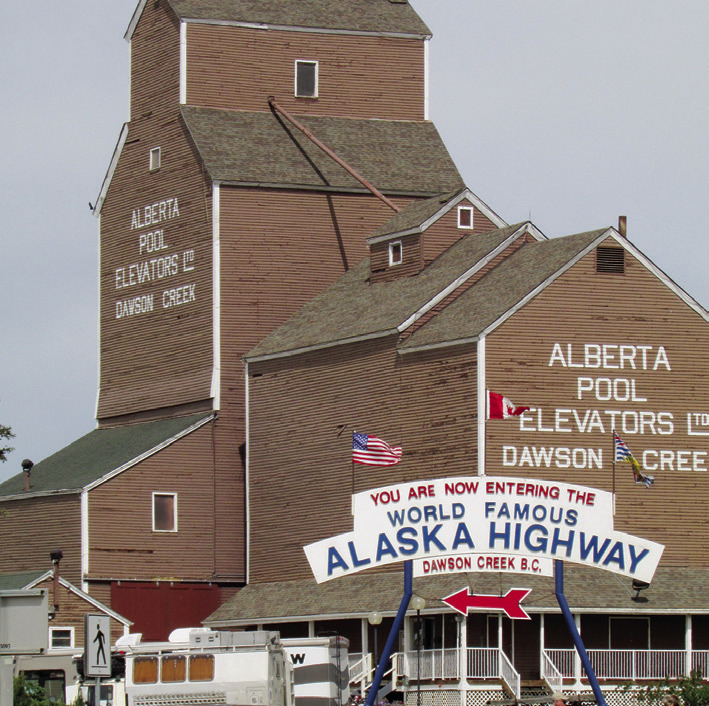
From Jasper we continued to Hinton and then up through Grande Prairie to Dawson Creek, British Columbia, where the Alaska Highway begins. The road from Hinton climbs numerous long, steep hills through thickly forested country. Heavily laden timber trucks struggle to make 20 mph uphill but come roaring downhill behind you at 80+. Screw your courage to the sticking place. At Grande Prairie the terrain lives up to its name by becoming gently rolling grasslands with cattle ranches that look like they could be in Wyoming or Montana.
From Dawson Creek it is only another 1,400 miles to Alaska. (The Alaska Highway is to Alaska not in Alaska.) The town is so proud of the Highway that they erected signs in two different locations marking Mile 0. This is a good place to layover for a couple days. Visit the Highway Museum for a history of how and why the US army managed to build 1,400 miles of road between March 8 and Oct. 25, 1942. Today, they couldn’t finish the paperwork in only eight months. Walk through the Walter Pioneer Village to see how the early settlers lived. Buy a Mile 0 T-shirt. Admire some more Canadian humor. I saw a promo for a wildlife tour: bears, whales, eagles, mountain goats. Wait. Wait. What was that second thing? I’ve heard of flying fish but had no idea that whales could get that far inland.
It is only about 3,300 miles from Toledo to Dawson Creek via this route. On our first trip, it took 16 days to get there because we were so eager. The second trip took 23 days as we learned to savor the experience.
In next month’s column we’ll continue along the highway and all around Alaska. People ask where we go in Alaska. The short answer is wherever the paved roads go. And a few places where they are not paved. You could get a head start on next month’s story and see many more pictures by logging on to my posts for 11/28/17, 10/22/21, and 11/10/21 at Healthy Living News. ✲