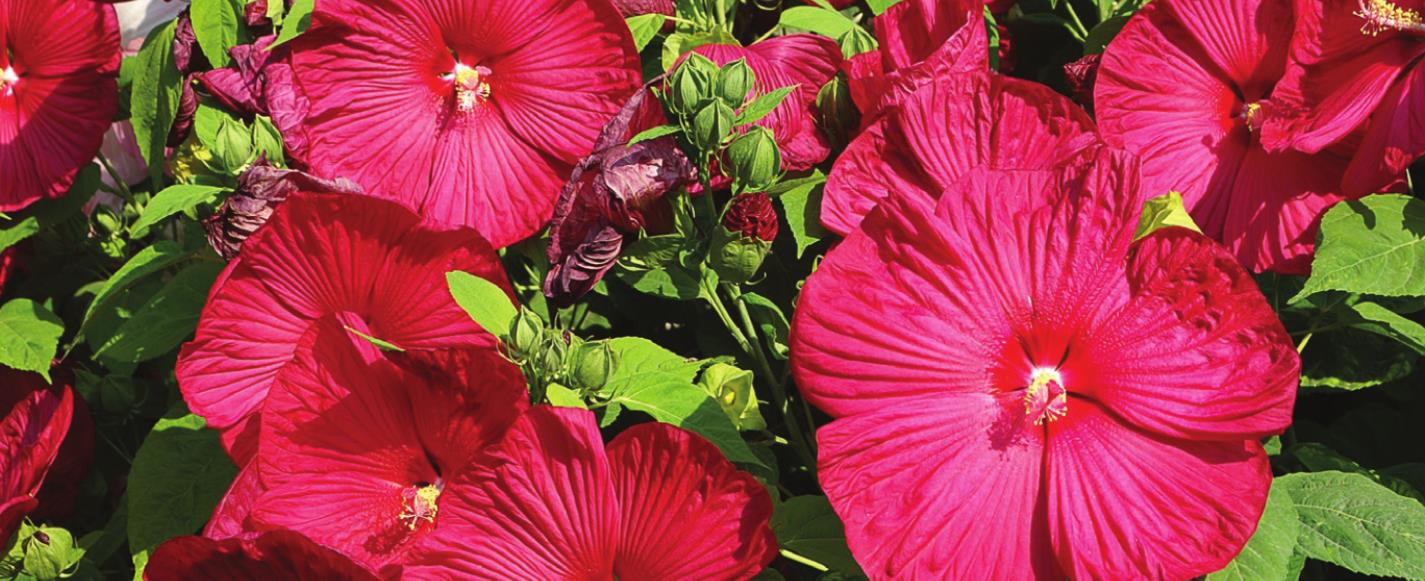
JUST WHEN YOU THOUGHT THE LOCAL FLOWERING PLANTS were all played out until the mums and asters come into their own in autumn, along comes the hardy, or perennial, hibiscus with its spectacular display of color. Adorned with dinner-plate-sized blooms of pink, purple, white, rose, yellow, or combinations thereof, these plants are real showstoppers from mid-summer through early autumn.
So what’s in a name?
Perennial hibiscus, or Hibiscus moscheutos, is not to be confused with the tropical Chinese hibiscus, or Hibiscus rosa-sinensis, which has equally stunning blossoms but can’t survive our local winters. The two are relatively easy to tell apart. Tropical hibiscus plants tend to have glossier foliage borne upon woody stems while perennial hibiscus have soft, dull leaves and tender stems. One would think that the hardy version should have woody stems and vice versa, but such is not the case—just one of the many small ironies in the gardening world.
A deciduous shrub form of hibiscus (Hibiscus syriacus), commonly called Rose-of-Sharon or Althea, is also relatively ubiquitous in our local landscape and, like the perennial version, blooms from mid-summer through autumn. Its blossoms can’t hold a candle to the hardy hibiscus when it comes to sheer size, but they’re every bit as attractive and produced in abundance.
One noteworthy drawback to H. syriacus is that it can be quite invasive, easily spreading beyond the mother plant via seed. Prompt deadheading of spent blossoms, though tedious and labor intensive with larger shrubs, will help prevent this shrub from overrunning the surrounding landscape.
Growth habit and care requirements
Perennial hibiscus plants have an upright growth habit and can reach a height of five to six feet. When planted in clusters, they make a most impressive display. They have fuzzy, oval- or pearshaped leaves and trumpet-shaped flowers, measuring up to 12 inches in diameter. Each individual flower lasts only one day, but they bloom continuously until the first frost shuts down flower production. Despite being non-woody, hardy hibiscus stems are quite strong and sturdy. Nonetheless, staking is recommended as a hedge against leaning or wind damage.
Considered a herbaceous perennial, the perennial hibiscus dies back to the ground each winter. It is also slow to break dormancy in spring, leading many gardeners to fear that their beloved hibiscus did not survive the winter. Have patience in springtime, and your slow-to-grow hibiscus will soon get back on its feet.
The hardy hibiscus requires rich, organic, well-drained soil that is kept constantly and uniformly moist, so keep a close eye on watering. Full sun is preferred, but it will also thrive in partial shade. Feed perennial hibiscus on a regular schedule with a high-phosphorous fertilizer (indicated by the middle number of the three-number analysis displayed on the fertilizer package) to promote large, healthy blossoms.
Uses for hardy hibiscus
Perennial hibiscus plants make outstanding additions to container gardens, cutting gardens, and perennial borders where they are usually best placed toward the back. They’re especially welcome in hummingbird gardens where their large blossoms prove irresistible to these little winged beauties. In fact, if you make the modest effort to meet this plant’s basic care requirements, you’ll find that it really earns its keep in a variety of garden settings. ✲