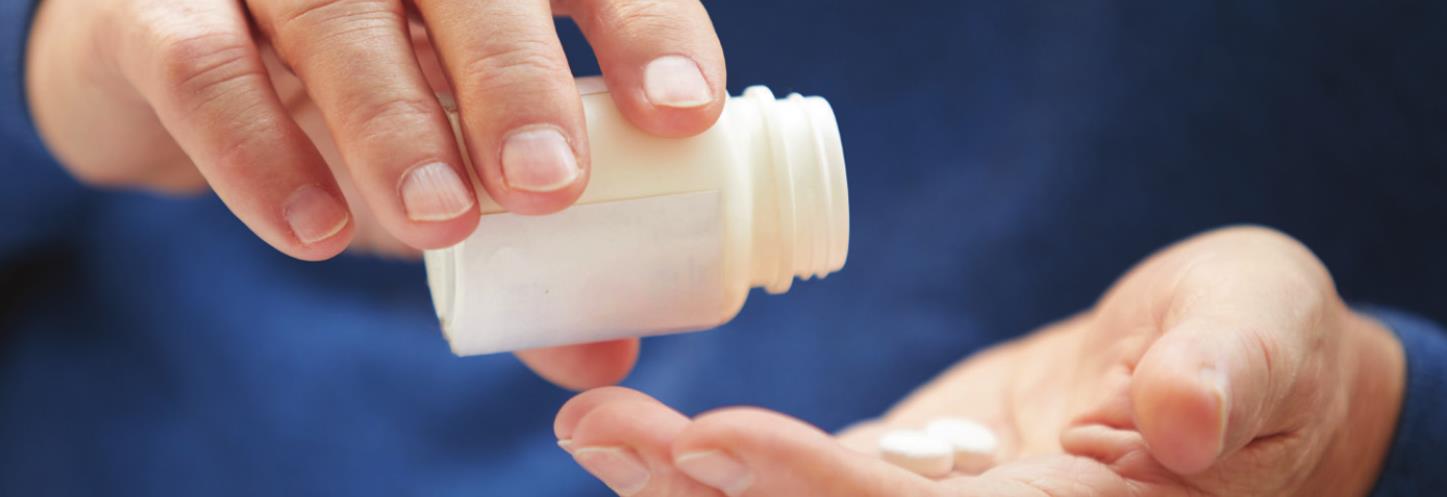
I RECENTLY STARTED taking a monthly pill that is pretty small in size and easy to take. Well, almost. I can swallow it in no time, but opening up its packaging was hard. It took me minutes; the pill came covered with hard plastic on a foil-covered tray. To remove the pill, I used scissors, a paring knife, a letter opener, tweezers, and finally, a cocktail fork. Swallowing it was nothing compared to actually handling it!
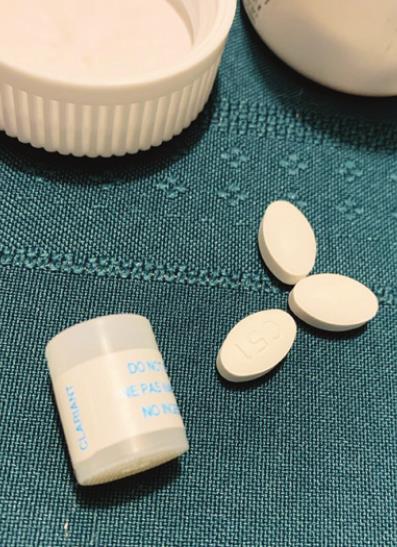
Some of my pills come in easyopen, non-childproof bottles. I can remove two daily pills with no problem. One thing I have to be careful about is making sure the desiccant (a little container in the bottle that keeps moisture out of the pills) does not come out with my pill. A desiccant can be a covered barrel or a paper packet that says “do not eat” on it. (Like anyone would eat a plastic, bitter smelling container).
I did, however, have an experience a few times with the drug dehumidifier. When I was getting my pill one morning, the “do not eat” thing fell into my cereal bowl. Another time, it plopped into my coffee. I did not eat it and was grateful I was able to read the warning on the container before this happened. I wondered whether it was dangerous to swallow one of these dehumidifiers? Luckily, I didn’t, but what if I had? Is that dangerous?
According to experts, no. The small paper packets or plastic packages you find in certain containers of medications, supplements, and vitamins are drying agents called desiccants that contain nontoxic silica gel, a kind of sand. I even found a little desiccant insert in a bag of bacon crumbles I had in my refrigerator.
“It might be a choking hazard, but you wouldn’t need to go to the ER based on what’s in the desiccant,” says Mike Yudizky, an educator with the North Texas Poison Center and a member of the American Association of Poison Control Centers. Manufacturers add the packets to some containers of medication to maintain drug quality by keeping moisture at bay, says Desmond Hunt, PhD, senior scientific liaison with U.S. Pharmacopeia. “Silica gel tends to be the best drying agent; it can hold 40 percent of its weight in water.”
A pill is not always easy to swallow. I think of the saying “a hard pill to swallow” or the song lyrics “just a spoon full of sugar makes the medicine go down.” Art truly imitates life. Many people have difficulty swallowing pills. Sometimes people have physical difficulties swallowing food or liquids due to some medical issue. Harvard Medical School reports that one in three people gag, vomit, or choke when trying to take their pills. These reactions can cause people to stop taking their medications, which can make them get sicker.
I can usually take my pills, but sometimes, when I have to take a large antibiotic, or what I call a “horse pill,” I have to make a little more effort. Somewhere in my life, someone told me to take two quick swallows, right after each other, which forces the throat to stay open so the pill goes down. That works for me. I told a few friends about this technique, and they said it helped.
Molly Gerzetich, SLP (speech language pathologist), says that pill swallowing can be difficult for multiple reasons. “As we get older, our muscles get weaker all over our body. So, when a person swallows, the muscles might not be as strong as they used to be and a person’s ability to squeeze down a pill can be a problem.” she adds that some people have hyper-gag reflexes, and they choke because of it. Many people have trouble swallowing pills if they have a neurological disorder; if they have a chronic disease like Parkinson’s, multiple sclerosis, or GERD; or if they’ve had a stroke.
She adds, “If a pill is large and not coated, it can be cut in half and placed into a lubricant like yogurt pudding or applesauce. You can also put a pill on the back of your tongue—you are halfway there—and drink water. If the pill is stuck in your throat, you can try drinking water and taking a hard swallow.”
I remember swallowing my pill in applesauce when I was a little kid. It worked for me—and even for our family dog. We put his pills in dog food. A friend of mine cuts her pills into smaller pieces. Some pills are timed-release and or enteric-coated medicines and should not be broken apart. Ask your pharmacist if your medicine can come in another form such as a powder, cream, or liquid.
If you have trouble not only taking pills but swallowing in general, talk to your pharmacist or family doctor. They might refer you to an ear, nose, and throat specialist or a speech language pathologist for a swallowing assessment. It might be tough to find out that you have a swallowing disorder, but you might overcome it by learning new ways to swallow.
Harvard Medical School offers hope for the pill-challenged. They offer two methods to help swallow pills: the pop-bottle method (designed for swallowing tablets) and the lean-forward method. (http://www.health.harvard.edu/blog/two-tricks-make-easier-swallow-pills-201411137515)
See a healthcare professional about your pill problem. Swallowing a little pride never choked anyone.
Sister Karen Zielinski is the Director of Canticle Studio. Canticle Studio is a part of the Sisters of St. Francis of Sylvania, OH’s overall advancement effort and has a mission of being a creative center where artists generate works, products, and services in harmony with the mission of the Sisters St. Francis. She can be reached at kzielins@sistersosf.org or 419-824-3543.