AT THE GARDENS OF ST. FRANCIS, the staff is dedicated to making the living environment as homelike as possible and helping residents maintain strong connections with loved ones, the broader community, and the natural world. In keeping with the facility’s namesake—St. Francis of Assisi—The Gardens of St. Francis also enriches residents’ lives through regular visits from furry, four-legged friends.
“Visits with pets—dogs in particular—really seem to help residents keep that connection to their prior life when many of them were still taking care of an animal. They bring a sense of normalcy while residents adjust to living in a new community, which is a big change in their lives,” says Brandon Webb, Executive Director of The Gardens of St. Francis.
Webb’s own dog, Brutus, a dachshund-Labrador mix, happens to be one of the regular canine visitors, usually coming to the campus twice a week. Webb describes Brutus as a “40-pound wiener dog,” and notes that he’s been going to nursing homes since he was a puppy and is quite accustomed to the routine. “He’s used to being around residents and is very gentle. He’s gotten so comfortable in the building that he’ll just go around doing his own thing,” Webb remarks.
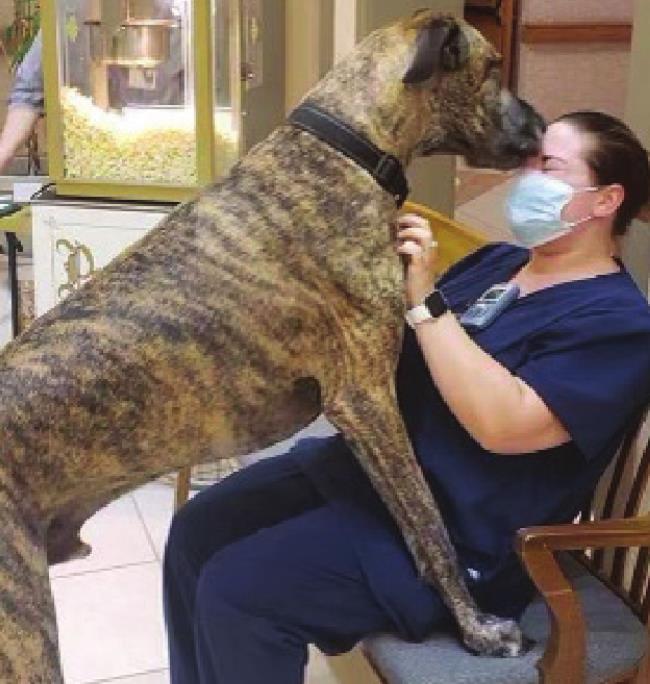
Duke, a four-year-old Great Dane who belongs to State Tested Nursing Assistant (STNA) Emily Guth, is another regular visitor to The Gardens of St. Francis. Guth says that Duke is a “gentle giant” who gets very happy and excited when he has the opportunity to visit her workplace. “When he gets there, he bounces around and knows to go straight to the door, moving at more of a trot than a run. Inside, he likes to greet everybody and usually goes with me to morning meetings. He’ll often then follow me from room to room to visit with residents—unless they’re not comfortable around dogs, in which case we steer clear,” Guth says.
Duke may not be an official therapy dog, but he does have an official title—“Comfort Giver”—which appears, along with his name and photo, on his ID badge.
The visits are usually informal, with individual pets going room to room, though there are also scheduled times for pet therapy in the facility’s activity center that residents can take part in if they wish. Webb says that the residents love to hold and pet the dogs, play games with them (such as fetch in the hallways), and give them treats. “Residents families sometimes bring in toys and treats for the dogs to help build that relationship as well,” he states.
Guth comments, “When pets come to visit, the residents get so happy that their faces just light up. Some even keep treats in their rooms to give to the dogs. The Activity Department also makes and bakes dog bones for them. With Duke, we have to limit the access to treats so he doesn’t gain too much weight.”
Beyond simply providing a change of pace, pet visits and animal-assisted therapy can have a dramatic impact on residents’ health and well-being. According to the American Senior Communities website (asccare.com), studies have revealed that in people with dementia, pet therapy reduces agitation and negative behavioral expressions, resulting in fewer moments of upset and other behavior changes throughout the day; improves nutrition, with residents eating more, gaining weight, and requiring fewer nutritional supplements; boosts physical activity levels, for example by stroking the animal’s fur, tossing a ball when playing fetch, or taking the animal for a brief walk; and eases feelings of loneliness and depression by providing companionship and unconditional love.
“We’ve definitely observed all these trends in our residents after spending time with animals,” Webb states. “Pet visits are one more way to help keep our residents active and engaged mentally and emotionally, prevent loneliness and isolation, and provide a living environment that’s as much like home as possible.”