WITH COVID-19 NUMBERS still unacceptably high courtesy of the Delta variant, more and more people are turning to the (well-ventilated) great outdoors for recreation opportunities. For many of us, that means paying a visit to a national park, state park, metropark, or other outdoor venue to do some hiking and exploring. And now that cooler weather has arrived and the trees are beginning to cloak themselves in splendid fall colors, there's no time like the present to get back to nature.
If you’re one of the many people expected to be hitting our nation’s hiking trails this fall, there are certain hiking-etiquette guidelines you might want to familiarize yourself with first in order to help promote a positive experience for everyone on the trail as well as to minimize your impact on the natural environment. They include (but aren’t limited to):
1. Stay on the trail
Always stay on marked trails. It may be tempting to wander off trail for better or closer views of your surroundings when hiking, but doing so can be incredibly destructive to sensitive plant life and causes erosion, which in turn degrades the condition of the trail.
Avoid taking shortcuts or cutting corners on switchbacks to eliminate sections of trail. Shortcuts may save you a few steps, but they can also cause extensive damage that takes years to recover and can even result in trail closures. Also, while it may seem counterintuitive, if you come across a puddle or patch of mud that spans the trail, don’t go off trail in an attempt to skirt it, thereby widening the path. Walk right through it instead.
2. Share the trail
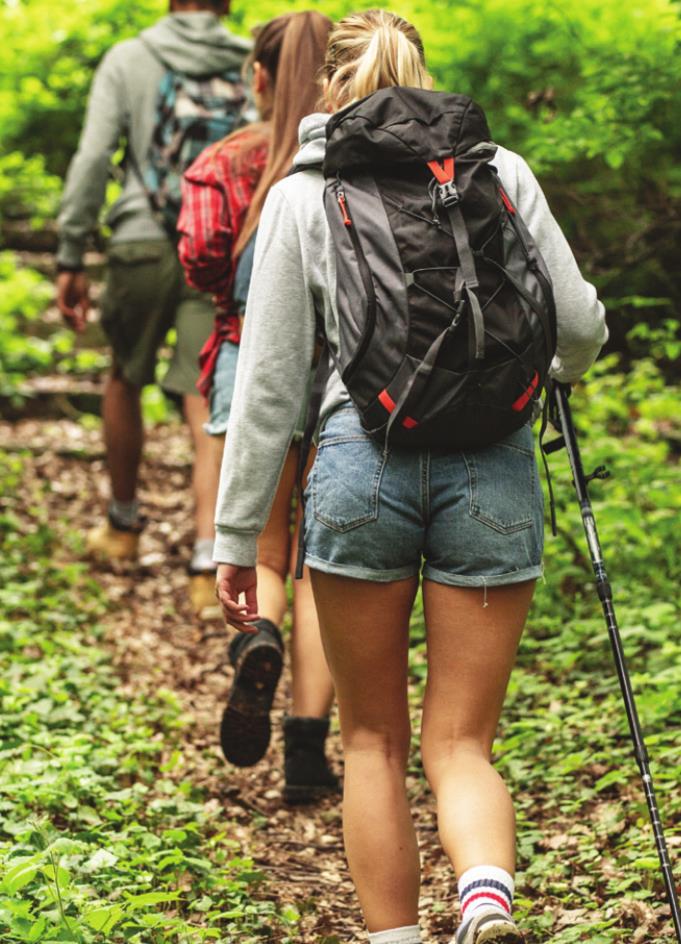
This point is especially important to keep in mind when hiking in a group of any size. Groups should hike in single file or at least be prepared to form a single file line when other hikers approach. Taking up the whole trail can force other hikers off trail and, in mountainous terrain, potentially put them in dangerously close proximity to a steep drop-off.
Sharing the trail also means knowing who should yield the right of way to whom on narrow trails. As a general rule, hikers heading downhill should yield to hikers heading uphill. The reason being, uphill hikers have a tighter field of view and are working against gravity to maintain their momentum.
When the paths of hikers, bikers, and horseback riders meet on the trail, bikers are expected to yield to both hikers and horseback riders, while hikers are expected to yield to horseback riders and/or pack animals. Horses and pack animals are placed at the top of the right-of-way hierarchy because they can be skittish and unpredictable. If you encounter one of these animals on the trail, move to the downhill side of the path (if there are uphill and downhill sides) and stand quietly while it passes to avoid spooking it.
Of course, these are all just rules of thumb that may need to be bent depending on the specific circumstances and conditions on the trail. For example, an uphill hiker struggling up a steep incline may be more than happy to yield to a downhill hiker so he or she has a chance to take a quick “breather.” Plus, rules may differ from location to location, so be sure to read any trailhead signage regarding right-of-way before hitting the trail.
3. Be considerate when passing
As with motor vehicle traffic (in the US anyway), think “keep right, pass left” when hiking. When approaching a slower-moving hiker or group, alert them to your presence in a friendly way and let them know you’re passing on the left. If possible, wait until you reach a wider section of the path to make your move.
Also, try to maintain a reasonable distance and steady pace on the trail so you don’t end up playing a frustrating game of leapfrog with another hiker or group on the trail. In this all-too-common scenario, one individual or group races up to and surpasses another individual or group only to spot something of interest and then come to a complete stop on the path, forcing the hiker or group they just passed to now go into passing mode. Then, as soon as the point of interest has been observed, they race up to and pass the same individual/group again so the process repeats ad infinitum. Be considerate and give other hikers their space, passing only if necessary.
4. Respect wildlife
The opportunity to encounter wildlife (hopefully at a safe distance) is one of the main features that attract people to hiking in the great outdoors. However, it’s important to be respectful of any wildlife you might come across and to avoid putting yourself or the animals at risk through your behavior. Never approach or attempt to touch, feed, or otherwise interact with wildlife.
Feeding wildlife may seem like an act of kindness, but in reality, it can disrupt animals’ natural foraging behaviors and teach them to associate humans with food. In the case of bears or other potentially dangerous wildlife, this is not an association we want to encourage. If you encounter any animals on the trail, give them plenty of space and simply enjoy observing them.
5. Leave no trace
In keeping with the previous point and the admonition to stay on the trail, try to adhere to the “leave no trace” philosophy when hiking. Anything you pack in should be packed out. Obviously, this includes trash, but it also applies to food waste, such as apple cores or banana peels. While biodegradable, these items left alongside the trail are not only unsightly but can also attract wildlife to the area, creating the potential drawbacks discussed in tip #4.
In addition to packing out whatever you pack in, you should leave everything just as you found it along the trail and in the surrounding environment. An exception can be made for any trash left behind by other hikers. Why not carry it out and leave the area looking even better than you found it? ✲