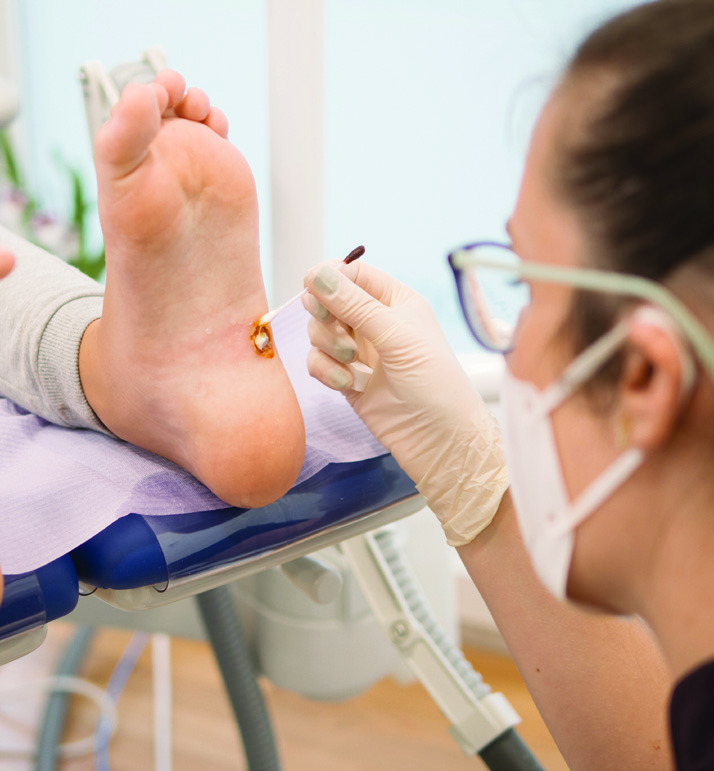
YOUR 14-YEAR-OLD son plops himself down on the couch next to you, dexterously extends the sole of his bare foot towards your face and asks, “Mom, what’s this?” You put on your “up-close” glasses, examine his heel, and notice a small, spongy growth that is yellow, gray, or brown in color with dark pinpoints. He complains that it hurts a little when he walks—like he has a pebble in his shoe—which brings out the anxious mother in you.
Could it be something serious? Something malignant? A visit to the podiatrist puts these fears to rest. Your child has a plantar wart—a benign growth that develops on the sole, heel, or ball of the foot. She assures you that plantar warts are fairly common in children between the ages of 12 and 16—especially among those who walk barefoot on potentially contaminated surfaces, such as around public swimming pools, showers, and locker rooms. You cringe when you think how often your son, an avid swimmer, walks barefoot around the pool.
Plantar warts can develop when the human papillomavirus (HPV) enters the bottom of the foot through tiny cuts, cracks, or scrapes. These warts commonly develop beneath pressure points, which is why they most frequently appear on the heel or balls of the foot. It’s also possible for the HPV virus to travel to the feet from other areas of the body. Like an iceberg, the part of the plantar wart that you can see is much smaller than the part that lies beneath the surface. That’s due to the fact that pressure from standing and walking prevents the wart from pushing above the skin’s surface, instead causing it to grow inward into the deeper layers of the skin.
Anyone can get plantar warts, but some individuals are at greater risk. Those who spend a lot of time walking barefoot in potentially contaminated areas, such as public pools, locker rooms, and bathing areas, and those with a weakened immune system are more prone to developing them.
Though plantar warts are benign and can sometimes clear up on their own, doctors often recommend removing them because they can cause pain and discomfort. Also, untreated warts can grow much larger or spread into a cluster of warts. The pain and discomfort associated with untreated plantar warts can, in severe cases, even affect the individual’s gait and posture, leading to back or leg pain.
Over-the-counter products are available for the treatment of plantar warts, but self-treatment with these products is not necessarily the best approach. The chemicals they contain can damage the healthy tissue surrounding the wart, which can actually result in the wart spreading further. Self-treatment products should not be confused with the mild acid that podiatrists use for the topical treatment of plantar warts. These products, which typically require repeat applications over the course of several weeks, disintegrate wart tissue without damaging healthy surrounding tissue. Healthy skin cells can then fill in the void left after the wart tissue has been destroyed.
In addition to the topical application of mild acids, podiatrists have several techniques at their disposal for treating plantar warts, including laser treatments, cryotherapy, and surgical removal.
During cryotherapy, or freezing, a very cold solution is used to destroy the wart tissue, which then darkens and falls off in a few days. For this method to be effective, the solution must penetrate deep enough to destroy all of the viral cells, which isn’t always possible with warts that have grown into deeper layers of tissue.
Laser treatment, which is effective in most cases, is conducted on an outn patient basis using local anesthesia, often right in the podiatrist’s office, and causes minimal scarring.
If other treatment approaches fail, surgical removal of the wart can be performed under local anesthesia in the podiatrist’s office.
As with any medical condition, an ounce of prevention is worth a pound of cure when it comes to plantar warts. The American Podiatric Medical Association (APMA) recommends the following preventive measures:
• Avoid walking barefoot whenever possible.
• Change your socks daily.
• Keep your feet clean and dry.
• Check your children’s feet periodically.
• Avoid direct contact with warts on other people or on other parts of your body.
• Do not ignore growths on, or changes in, your skin.
• Visit a podiatrist as part of your annual health checkup. ✲