
THE IMPORTANCE OF CANCER SCREENINGS, such as mammogram, colonoscopy, Pap testing, and others, cannot be overstated. With virtually any type of cancer, the earlier the disease is identified and appropriate care and treatment are initiated, the better the patient’s outcome is likely to be.
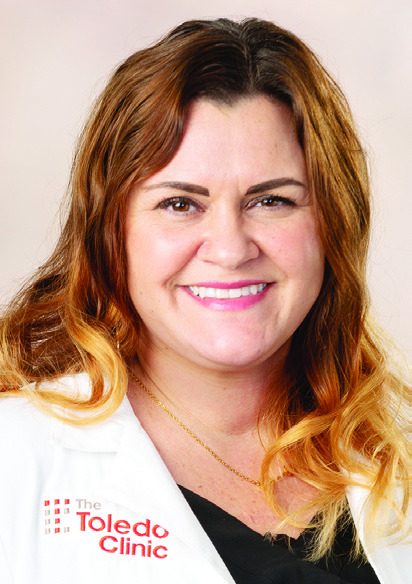
“Screening allows us to detect early-stage cancer or precancerous growths in patients who are otherwise healthy and asymptomatic, when we can usually do something about it,” states Danielle Goodell, NP, of The Toledo Clinic Cancer Centers.
“In most cases, identifying cancer early greatly increases the odds of a more positive outcome. Simply put, cancer screening saves lives.”
Goodell explains that the recommended timing for cancer screenings is based on the patient’s age, family history, and other factors. It’s important for both men and women to consult with their family doctor about which screenings they should be getting as well as whether they might need to get a particular screening earlier than is recommended for the general population. “For example, women at average risk of developing breast cancer should start getting mammograms at age 40. However, individuals with a strong family history of breast cancer may need to start screening much earlier based on when the family member was diagnosed.
The same logic applies to other cancer screenings such as colonoscopy, which is recommended beginning at age 45 for men and women who are at average risk of colon cancer. Goodell states, “If you have a first-degree relative—meaning a parent or sibling—who had colon cancer, not only should you start getting screened earlier, but it’s also important that you get an actual colonoscopy rather than rely on an at-home test like Cologuard.”
Goodell also highlights the importance of seeing a dentist twice a year—not just for the sake of maintaining strong, healthy teeth, but also because, whether patients realize it or not, oral cancer screening is a routine component of dental exams. “Many people are completely unaware that their dentist is also checking for signs of oral cancer when looking around inside their mouth,” she notes. “Regular dental visits that include an oral cancer screening are critical for everyone, but especially for individuals who smoke, chew tobacco, or drink alcohol.”
With lung cancer being the leading cause of cancer death among both men and women in the US, Goodell reminds long-time smokers that they may be eligible for screening with an innovative technology called low-dose computerized tomography, which can detect nodules in the lungs long before lung cancer symptoms arise. Eligible individuals are those between the ages of 50 and 80 who have at least a 20-pack-year smoking history and either currently smoke or quit smoking within the past 15 years. (A “pack year” equals the number of cigarette packs an individual smoked per day multiplied by the number of years he or she has smoked.)
Are enough people taking advantage of these and other vital cancer screening tests? “Absolutely not,” Goodell states emphatically. “I see patients all the time who, for example, are being treated for colon cancer but haven’t had a mammogram in years, or they might be compliant when it comes to mammograms but are long overdue for their first colonoscopy,” she says.
Oftentimes, Goodell finds that patients fail to follow through with cancer screenings because they’re either not seeing a primary care physician or they simply don’t understand the importance of getting screened for cancer. Patients may also fail to comply with screenings because they can’t afford the cost, they’re concerned about losing time at work, they don’t
n have the personal time due to other responsibilities (e.g. taking care of a loved one), they feel fine and think they don’t need a screening, or they simply don’t want to know what a screening might reveal.
Goodell’s advice for people who let one or more of these barriers prevent them from getting screened is, “At the very least, make yourself a priority. If you think you don’t have time because you’re taking care of someone else, keep in mind that you won’t be much help to anybody if you don’t make time for your own health. Once you get on track with a cancer screening—for instance if you always get your mammogram in the month of June—it’ll just become something you do, part of the larger pattern of your life. It’s worth making the time for cancer screenings because you’re worth it.”
Cancer screening options for women include Pap test, mammogram, oral exam, low-dose chest CT, and colonoscopy or Cologuard. Options for men include PSA blood test or prostate exam, low-dose chest CT, colonoscopy or Cologuard, and oral exam. “See your primary care physician to discuss which tests you need and how often they should be performed,” Goodell advises.
The Toledo Clinic Cancer Centers, located at 1200 Medical Center Parkway in Maumee and 4126 N. Holland Sylvania Road, Suite 105 in Toledo, also provides imaging, laboratory, chemotherapy, specialized pharmacy, and IV services. The cancer center consists of 13 physicians and 11 advanced practice providers. The cancer center also has satellite centers in Napoleon, Bowling Green, Wauseon, Bellevue, Oregon, and Monroe.
The Toledo Clinic Cancer Centers has earned Patient-Centered Specialty Practice recognition and Oncology Medical Home recognition from the National Committee for Quality Assurance. Oncology homes align systems and resources with coordinated care focused on cancer patients and their needs. This reduces fragmentation, supports shared decision making, and improves the patient experience. They are the first oncology practice in the state of Michigan and the second oncology practice in the state of Ohio to receive this recognition.
For more information, please call The Toledo Clinic Cancer Centers at 419-479-5605. ✲
