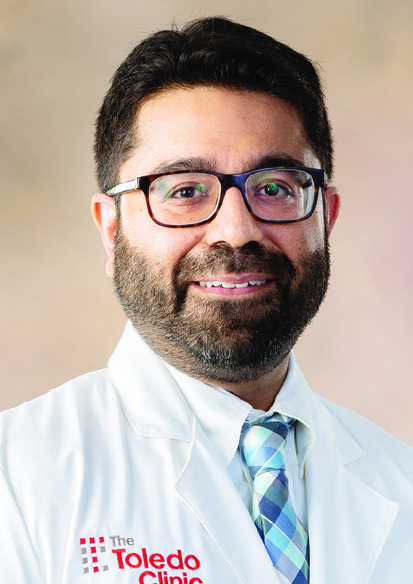
THE WAY PATIENTS RESPOND TO A CANCER DIAGNOSIS varies from individual to individual based on a variety of different factors. However, according to Apoorva Chawla, MD, of The Toledo Clinic Cancer Centers, there are certain common reactions cancer care providers tend to see in newly diagnosed patients, including fear, confusion, questioning “Why me?”, and worry over how their family will be impacted.
Although a cancer diagnosis is stressful and can seem overwhelming, patients who develop a strong rapport with their doctor and ask the right questions to empower themselves with knowledge about their disease can find comfort and hope as they look to the future. Dr. Chawla finds that the following six questions are especially impactful in terms of helping patients understand their cancer and its treatment:
1. How have things changed in the management of this cancer?
Sharing the major scientific advances that have taken place in treating a particular cancer can reassure patients and give them cause for hope. For example, Dr. Chawla says that 20 to 30 years ago, the treatment options for breast cancer were fairly limited. If the cancer had spread to the lymph nodes, the patient would be given intravenous chemotherapy; if there was no lymph node involvement, the cancer was considered low-risk and no chemotherapy was given.
“Today, breast cancer treatment is much more refined. We now understand the biology of cancer much better. Since around 2004, we’ve used Oncotype as a molecular scoring system to determine whether chemotherapy will be beneficial after surgery. In some cases, women with breast cancer in the lymph nodes don’t need intravenous chemotherapy, while some with no lymph node involvement do need it. For a newer example, a recent study was published showing a role for an oral form of chemotherapy for some high-risk women with cancer in the lymph nodes. So, we not only have a much better understanding of who actually needs chemotherapy, but now there’s potentially an oral option as well,” says Dr. Chawla.
2. What is the natural history of this cancer?
“Natural history” refers to the normal pace or speed for a particular cancer, and answering this question can help your doctor clear up a lot of potential misconceptions. For instance, the diagnosis of leukemia can be frightening, but not all forms of leukemia are the same. Chronic lymphocytic leukemia, or CLL, can be a long-term, slow-progressing form of leukemia, and oftentimes patients with this disease don’t even require treatment, Dr. Chawla notes.
3. What is the stage and biology of my cancer and what does that mean for my prognosis?
It’s certainly important to know the stage of your cancer, but even more important is understanding the biology and prognosis given the treatments available. “Being diagnosed with stage 4 breast cancer might make you think you’re out of alternatives, but you’re not. We still have a multitude of new and advanced treatment options to try including targeted therapies and immunotherapies. In fact, several women with stage 4 breast cancer will still be alive for years and years to come while maintaining good quality of life,” Dr. Chawla states.
4. Am I a candidate for targeted therapy?
Scientific advances have made it possible to profile individual cancers and identify specific mutations that can be targeted with advanced therapies. This technique is called next generation sequencing. One example is the PIK3CA gene mutation in breast cancer, which can be targeted using oral chemotherapy.“Whenever we can target particular abnormalities, the side effects of treatment tend to be fewer and the prognosis tends to improve. So, a top question to ask is which therapy is best for me based on my molecular testing, my tumor profile, and any comorbidities I have,” says Dr. Chawla.
The cancer journey is more of a marathon than a sprint, and it’s important to have the right support system in place along the road. For example, you may need to work with a nutritionist or dietitian to ensure you’re getting sufficient calories and protein in your diet. “It’s also important to discuss every treatment with your care team so they can be proactive about side effects such as nausea. You should know what steps will be taken to help manage potential side effects before treatment even begins,” Dr. Chawla says.
6. What other resources are available to me?
Beyond the support of a multidisciplinary care team, cancer patients have access to a wide range of informational resources that can help them learn more about their cancer and treatment, such as the American Cancer Society, the National Cancer Institute, the United Way, and cancercare.org to name a few. “Of course, any provider will be happy to guide you to these and other resources so you don’t feel you have to go it alone,” Dr. Chawla states.
The Toledo Clinic Cancer Centers, located at 4126 N. Holland Sylvania Road, Suite 105, also provides imaging, laboratory, chemotherapy, specialized pharmacy, and IV services. The cancer center consists of 10 medical and 3 radiation oncologists along with 9 advanced practice providers. The cancer center also has satellite centers in Maumee, Napoleon, Bowling Green, Wauseon, and Monroe.
The Toledo Clinic Cancer Centers has earned Patient-Centered Specialty Practice recognition and Oncology Medical Home recognition from the National Committee for Quality Assurance. Oncology homes align systems and resources with coordinated care focused on cancer patients and their needs. This reduces fragmentation, supports shared decision making, and improves the patient experience. They are the first oncology practice in the state of Michigan and the second oncology practice in the state of Ohio to receive this recognition.
For more information, please call The Toledo Clinic Cancer Centers at 419-479-5605.
✲