SCIENTISTS KEEP WRACKING THEIR BRAINS to come up with a definitive explanation for the current epidemic of obesity that is impacting the US and much of the developed world. But to most people blessed with common sense, it’s clear that a number of factors enter into the equation. To name a few: high-calorie foods are available in abundance 24 hours a day, seven days a week, and at relatively low cost; we’re constantly barraged with messages that entice us to eat in the form of television commercials, billboards, and other advertisements; we’ve become far more sedentary than our forebears were, both at work and play; and our food portions have become ridiculously oversized.
This last point is often overlooked by people seeking to shed pounds because the increase in the size of the portions we eat took place very gradually, almost imperceptibly, over a period of decades. So now, what was way too much for our ancestors looks just about right to us. To a large extent, this trend toward “portion distortion” coincided with the popular shift toward eating more takeout and restaurant foods.
Because the most cost-effective way for food establishments to compete with one another is by offering consumers more food for less money, purveyors of fast food have made “supersized” or “value” meals (which also tend to be “supersized” in terms of their caloric value) the norm and your average sit-down restaurant now offers individual portions that would once have fed two people—if not an entire family.
What’s worse, because takeout and restaurant foods have for so long dominated the American menu, those absurd portion sizes are starting to be reflected in our home-cooked meals. So, how can we reverse portion distortion and get back to sensible serving sizes?
Use the measure-and-weigh method
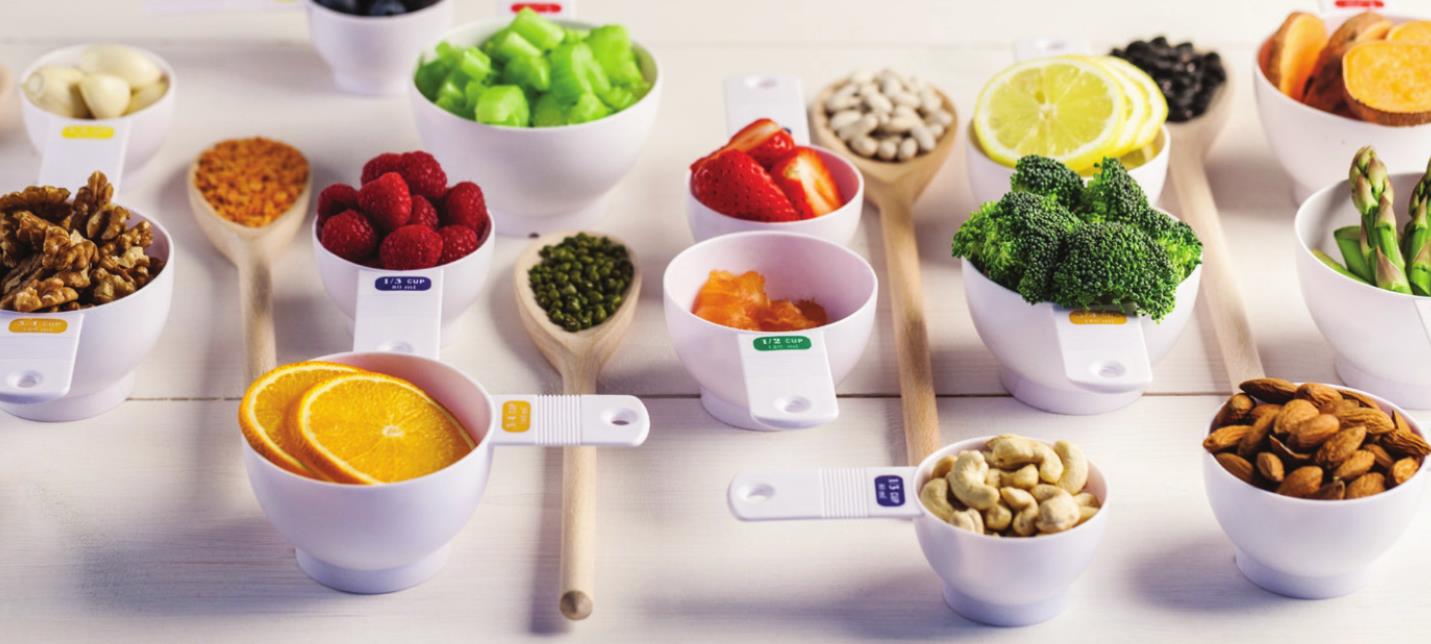
The most reliable method for taking control of your meal portions is to read food labels so you know the recommended serving size for each food item (and how many calories a serving contains) and then measure out your portions using measuring cups and spoons and an inexpensive kitchen scale.
Admittedly, this is a tedious process, but you don’t have to sustain the habit of measuring for very long—just long enough to retrain your mind to recognize appropriate portion sizes for common foods. Occasionally reintroducing the measuring imple ments will help keep your portion sizes from re-expanding.
Use portion “models”
If measuring food portions isn’t quite your speed, you can help control your serving sizes by visualizing models that approximate portion sizes. Not surprisingly, many of these models are quite a bit smaller than one might expect. For example, to determine how much meat, poultry, or fish constitutes a recommended three-ounce serving, picture a deck of cards or your computer mouse. A one-and-a-half-ounce serving of cheese is approximately the size of four dice. To visualize a one-half-cup serving of fruit, vegetables, rice, or pasta, picture a baseball cut in half. A one-cup serving of yogurt or fresh greens is approximately the same size as a small hand holding a tennis ball.
Downsize your dishes
Since it’s a natural inclination to fill up your plate (or bowl or glass) and then to “clean it” afterward, reducing the size of the dishes you use—for example, doling your meal onto a salad plate rather than a full-size dinner plate—will trim away a lot of extra calories while tricking your mind into thinking you’re getting the same amount.
Switch sides
In the traditional American mode of eating, foods like meat and pasta tend to dominate the plate while vegetables and fruits are treated as “sides.” A healthier alternative is to reverse the order of things by first filling half your plate with veggies and fruits and then allotting a quarter plate each to items like meat and pasta.
Keep the food source out of sight
We eat what we see, so one trick that will help minimize the amount you consume at each meal is to keep the food-filled pots and pans in the kitchen, serve reasonable portions onto your plate, and then carry the plate to the dining room to eat. Resist the urge to return for seconds, and put leftovers away in the refrigerator immediately.
Pre-apportion snacks
Avoid eating chips, crackers, cookies, and other snacks directly out of the bag or carton as you’ll almost invariably end up consuming far more than the recommended serving. Instead, buy these items already packaged in snack-size servings or divide them up into appropriate servings in plastic baggies as soon as you get home from the supermarket.
Have it your way at restaurants
Sit-down restaurants commonly offer smaller portions at lunchtime, and many are willing to serve these lunchtime portions at dinnertime if asked. You may even get the meal for its lunchtime price, which can be considerably lower than the price you’d be expected to pay for the dinner portion. If that isn’t an option, don’t give in to the temptation to eat until you’re full and then box up the rest at the end of the meal. Instead, divide the meal in half (or take out what you deem to be a sensible portion if half is still too much) as soon as it arrives at your table and ask the waiter or waitress to box the rest for you.
When eating fast food, try to resist the allure of supersized and value meals, even if they are cost-effective. And, be sure to take advantage of the nutrition information signs that are now being posted in many fast-food venues to determine which of the food items they offer are the lowest in calories and fat grams. ✲