I KNOW.YOU’RE THINKING SUMMER IS OVER and it’s already too late to plan your summer vacation. But I’m talking about next summer. For which it may also be too late.
This came to mind when Shirley and I met our neighbor Lisa on the Chessie Trail. She had recently retired and asked about Yellowstone because... well, because everyone wants to go to Yellowstone. Almost five million people a year visit, most trying to squeeze in between late May and September. It used to be difficult to get a campsite, lodge room, or cabin there. Now it’s impossible. Required reservations become available a year in advance. (At most national parks, it is still only six months ahead.) If you don’t have yours for Yellowstone by January, you’re not getting any. We told Lisa that, if she was serious about going, she should begin planning immediately.
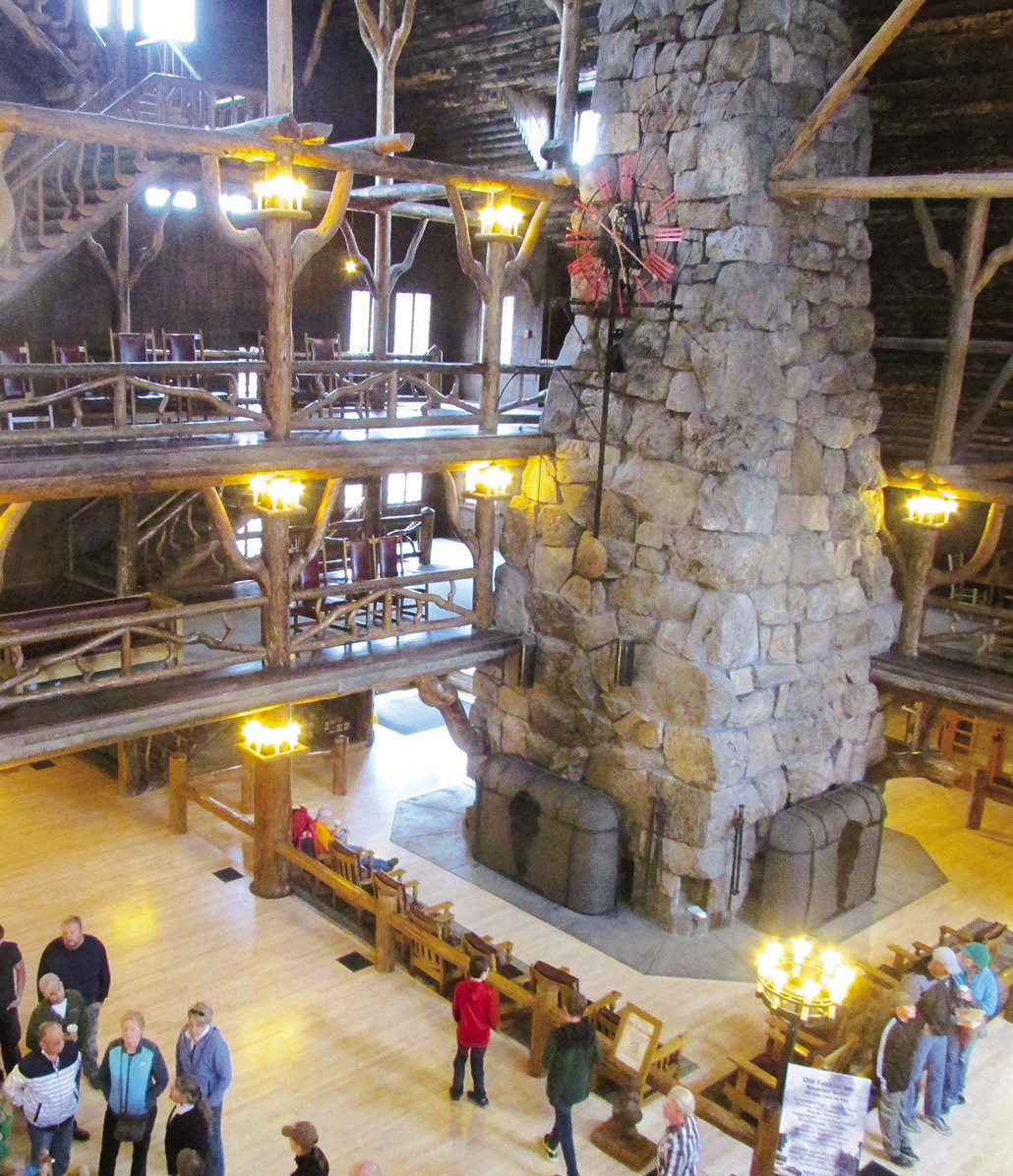
Hypothetically speaking, let’s assume that, like Lisa, you would like to go to Yellowstone next summer. (You will probably encounter the same issues no matter which national park you choose, so we might as well stick with the first and still the best.) We suggested to Lisa that she should check out the iconic Yellowstone Inn.
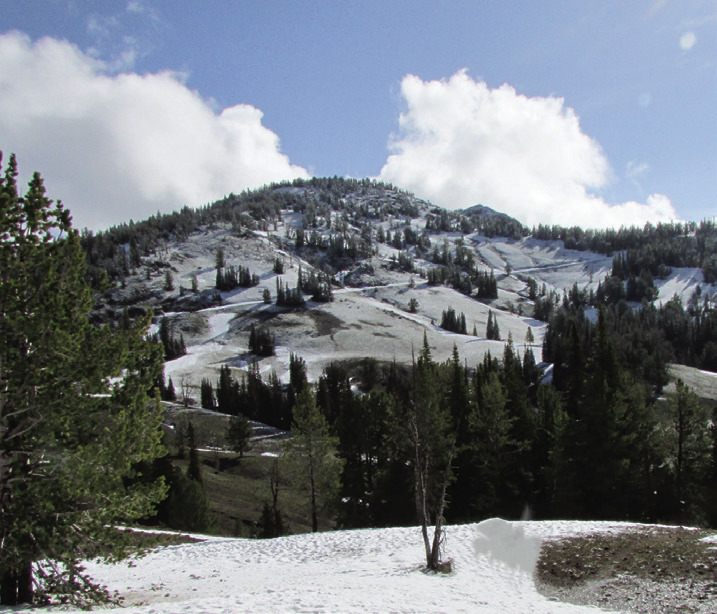
We took our three girls there on June 25, 1985 when we were still tent campers. I knew that campgrounds filled early, so the strategy was to get a room at the Inn so we could be inside the park and get in line for a campsite before breakfast the next morning. Campsites were not reservable back then. Turned out there was another reason this was an excellent strategy. It snowed. On June 25. We’re not talking about a few random flakes or flurries but several inches of actual snow. At an elevation of 8,000 feet, it can snow on any day of the year, so you should take cool-weather clothes even in summer. When we checked in, the lobby was full of people looking for a room. There were none, of course.
Another reason for planning early is to give your psyche time to adjust to the budgetary challenges. In ‘85, the Inn had not yet been renovated and upgraded. The bathroom, for example, was down the hall and shared with other guests. There are still rooms in the part of the Inn called the Old House where those without bath are now $199-$289. Today, there are also Old House rooms with a bath for only $369-439. Woohoo! Deluxe hotel rooms with queen beds go for $439-639, and suites are $1,099-$1,299. Park entry fees are $35/vehicle for 7 days, $70 for annual pass. The $80 senior pass provides life-time entry to more than 2,000 federal recreational facilities plus half-off camping fees. Sometimes it is good to be a geezer.
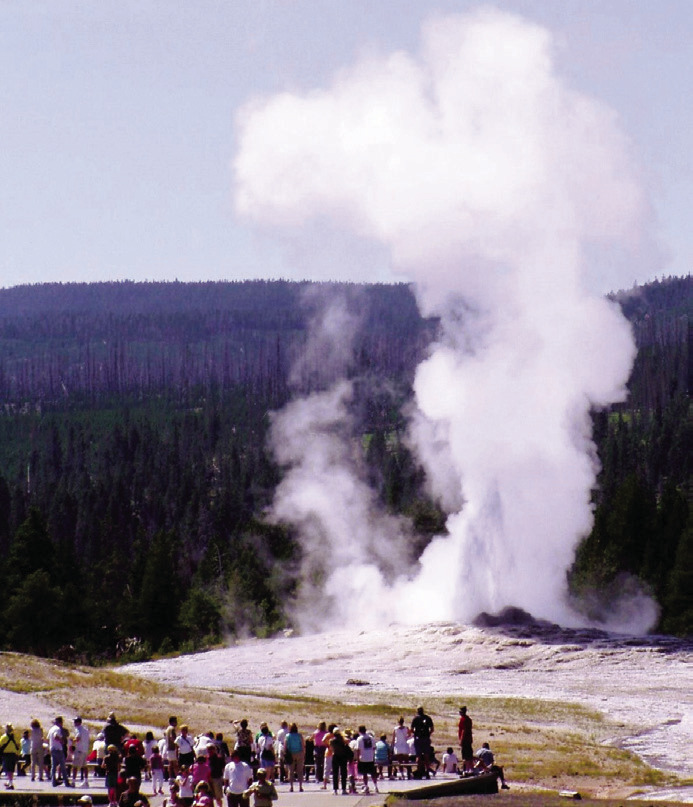
The Inn has neighboring facilities: Old Faithful Lodge and the Old Faithful Snow Lodge, both within an easy walk of Old Faithful and the surrounding geyser basin. Just be careful about those names. The Inn is the historic structure even though the term “Lodge” might sound more like it. There are also the Lake Hotel & Lodge, Mammoth Hotel & Cabins, Grant Hotel, and Roosevelt Lodge Cabins. Of course, all of them fill up early as do all the campgrounds.
If you can’t get lodging or a campsite inside the park, there are accommodations advertised as “within an easy drive of a park entrance.” Our friends Mark and Bonnie celebrated retirement in the summer of ‘22 by going to Yellowstone. They stayed in Cody, the closest town to the East Entrance, an “easy drive” of 53 miles. Still, the towns of Gardiner and West Yellowstone are right at the North and West Entrances.
Once you are inside the gates, it doesn’t mean it is an easy drive to Old Faithful or the Lower Falls of the Yellowstone or Mammoth Hot Springs. At 3,468 square miles, the park is huge, and there is no way to estimate how long it will take to get anywhere. Our advice is to get your day started as early as possible.
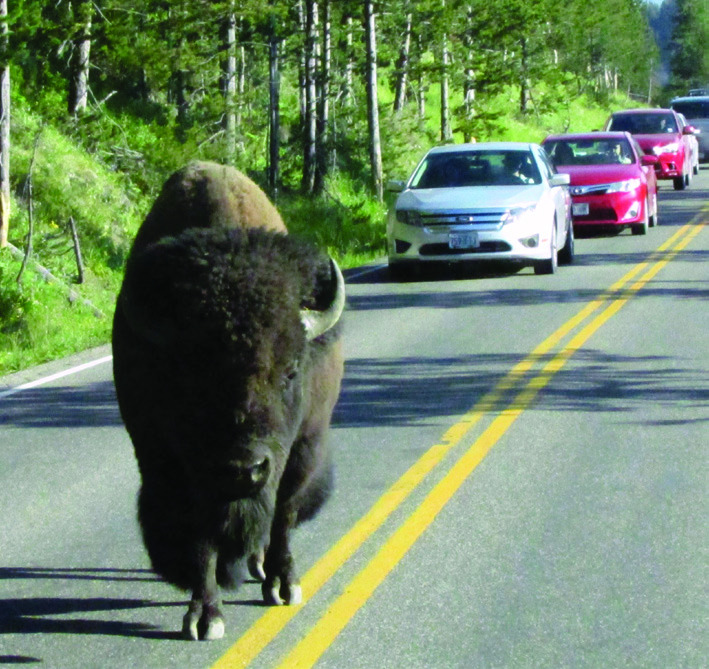
Some of the longest delays are foreseeable in the abstract but not predictable in the specific. No matter where you are headed, you can count on a bear jam, bison jam, elk jam, or moose jam occurring at any time and of any duration. If some tourist sees a big brown thing, he immediately stops to get out and look. The traffic behind him stops. Everybody in the oncoming traffic is also curious so they get out to see what everybody else is looking at. Many rush over to get an even closer look at mama bear with her adorable cubs. Eventually a ranger shows up to tell them they can’t do that. The ranger will be ignored unless he’s officially designated “law enforcement,” carrying a gun, and threatening to take the malefactors to the official lockup in Mammoth.
Yep. Yellowstone has its own jail for the safekeeping of noncompliant tourists and assorted criminals. Rangers work hard to protect visitors even if those visitors think they are just trying to spoil the fun. Google “People doing stupid stuff in Yellowstone.” See also “Yellowstone National Park: Invasion of the Idiots” or “Tourons in Yellowstone.” (A touron is a tourist acting like a moron.) The most common errors are behaving inappropriately with wildlife. All the park literature and thousands of park signs advise you to stay at least 100 yards from bears and wolves and 25 yards from bison, elk, and moose. Even so, a lot of people want to get selfies with one of those big brown things. Part of your planning should include at least a superficial knowledge of the major wildlife.
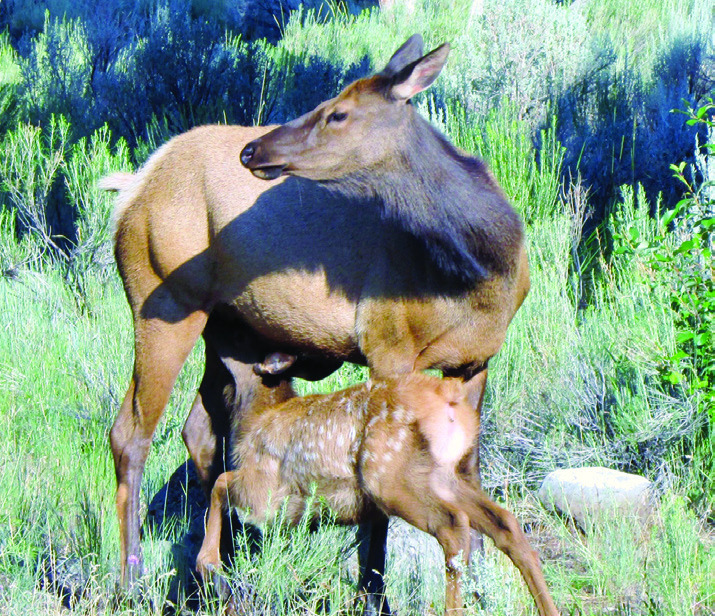
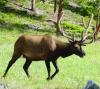
Large animals can appear amazingly docile until pushed just a little too far. Next thing you know, you have been gored and tossed 20 feet up into a tree. During the rut, from June to September, bull bison get all hopped up on testosterone and have no tolerance for foolishness. Likewise, in September, the bull elk compete for their harems and become just as touchy as the bull bison. Then, during the spring calving season, female elk become hyper-protective of their young and will enthusiastically escort you out of the neighborhood. Your plan should include being informed and obedient to rules regarding wildlife.
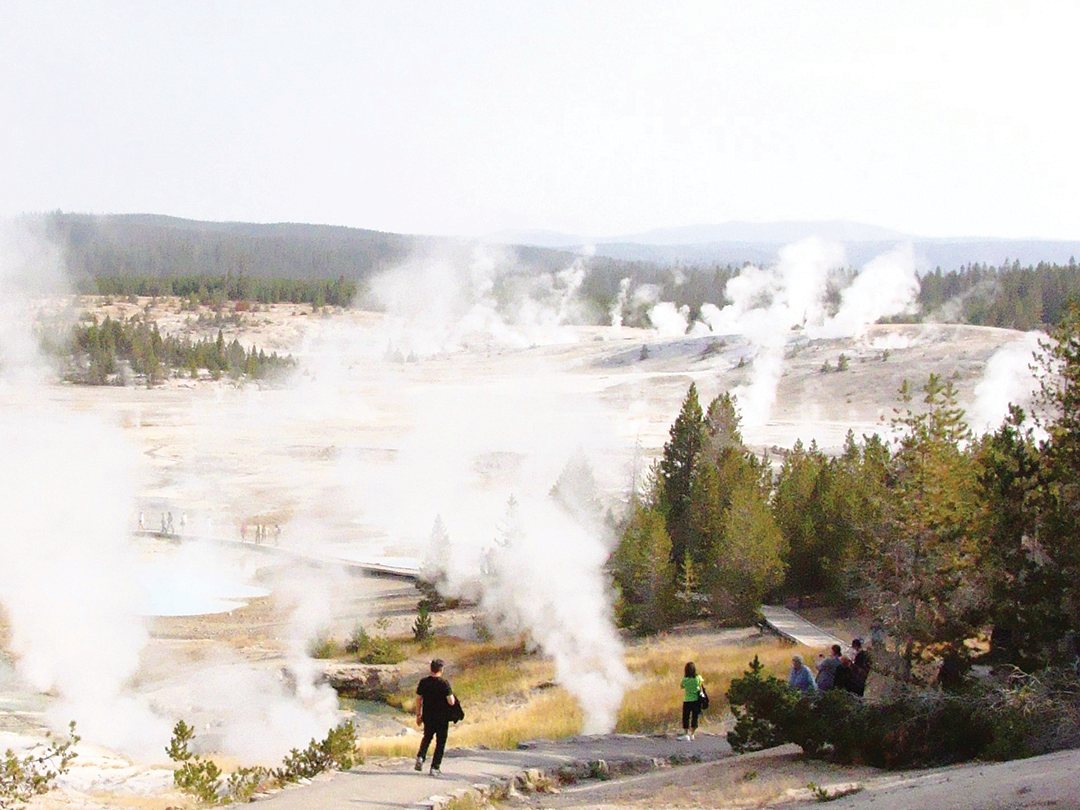
There are numerous other ways to get in trouble. In geyser basins, there are signs everywhere warning visitors to stay on the boardwalk or trail. Hot springs in Yellowstone are not like the warm spring spas and resorts in the East. In Yellowstone, hot springs can reach temperatures of nearly 300 degrees. In 2016, a young man looking for a place to swim got into a hot spring at Norris Geyser Basin. A place to swim! The rescue team concluded that his remains were dissolved by the combination of extreme heat and acidic water. Nothing left but his wallet and flip flops.
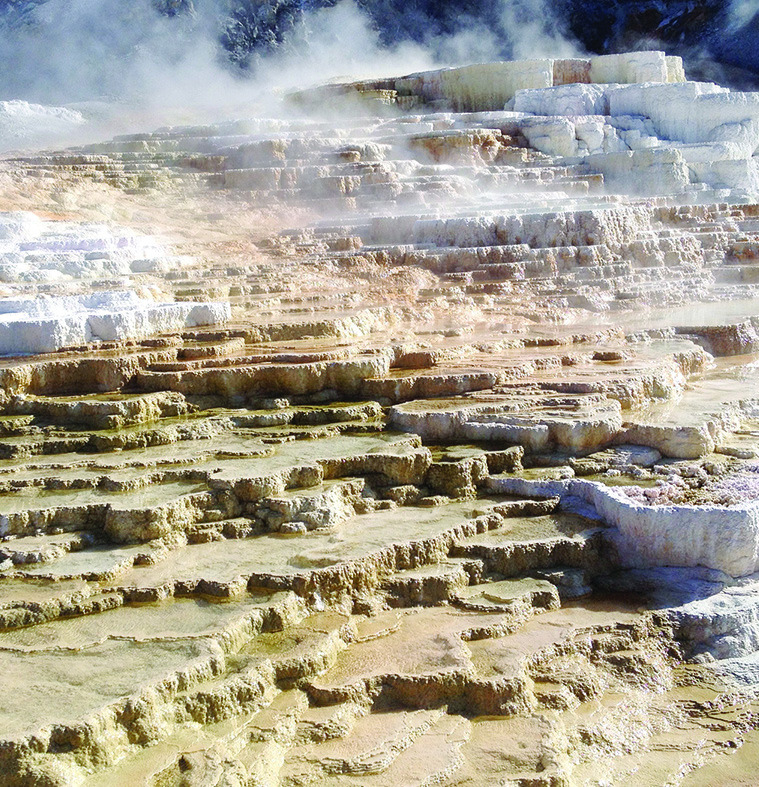
In 1985, we thought Yellowstone might be a once-in-a-lifetime experience, so we tried to “see everything.” But it can’t be done. Planning means setting priorities. Even surrounded by the wonders of Yellowstone, people have different preferences. Adolescents often find Mammoth Hot Springs far less fascinating than TikTok. Would you spend a day hiking to the 10,219-foot summit of Mt. Washburn? (Before you answer, do some research on altitude sickness.) What if you knew there was a good chance you would meet a herd of bighorn sheep up there? Want to go fishing for cutthroat trout? Which streams or lakes offer the best prospects? How about a guided horseback ride or even an overnight ride to a backcountry campsite?
Hayden Valley and Lamar Valley are where you can expect to see the great herd animals—bison, elk, pronghorns–but you can’t do both valleys on the same day. The main park road is a figure-8 so it is fairly easy to turn that into two separate circle routes and choose what to visit in each circle. Which means you need to research the location of the major attractions so you don’t lose too much time backtracking or driving around in circles.
Your plan will necessarily be influenced by how much total time you have and how much of that you need to allocate for going and coming. At Meriwether Lewis Campground on the Natchez Trace, we met a couple who described themselves as “destination travelers.” They picked a destination, went there, and came home. Picked another destination, went there—lather, rinse, repeat. Over the years, Shirley and I have visited hundreds of places all over the country that were not our primary destinations but were worth a visit because we were in the neighborhood.
Yellowstone and the Tetons are a natural pair because they are right next to each other, so we treat them as a single primary destination. They are about 1,600 miles from Toledo. People ask “How long does it take to get there?” The short answer is, “It’s hard to tell.” Besides, you are not required to drive. One summer our daughter and her two children flew to Salt Lake City and took a rental car to meet us in the Tetons for a few days before heading up to Yellowstone for a week. Some visitors fly to cities where they can rent an RV. Or you could book seats on a tour bus like thousands of little blue-haired ladies and an amazing number of visitors from other countries.
Still, most people who ask how long it takes are probably wondering if they are up for the drive. We think it’s a shame to drive 1,600 miles and miss something interesting along the way such as:
• Mount Rushmore
• Crazy Horse Memorial
• Little Bighorn Battlefield
• Devil’s Tower
• Scott’s Bluff
• Badlands National Park
• Cheyenne Frontier Days
• Fort Laramie
• Wind Cave National Park
• Buffalo Bill Ranch
• Bighorn Mountains
• Wall Drugs.
Wall Drugs? That was probably not on your list, but if you drive 300 miles on I-90 across South Dakota, you will see billboards promoting Wall Drugs every half mile or so. Eventually they will wear you down and you will stop for the best cinnamon roll you ever put in your mouth. Wash it down with a cup of 5-cent coffee.
How long does it take to include those additional stops? How much time do you have? We have never done all of them on a single trip. Shirley and I have been to Yellowstone 15 times and have reservations for a return in 2024. Even so, this July, our favorite campsites were already taken by better planners. Our route home is via Theodore Roosevelt National Park in North Dakota, then on to Pictured Rocks in the Upper Peninsula. We haven’t been that way in several years. Besides, it is a way to avoid Chicago. The planning and scheduling got a little tricky, but we are already looking forward to a walk in the park.
You might want to see more of his stories and photos at AnotherWalkinthePark.blogspot.com. ✲