LAST MONTH, I mentioned that Shirley and I visited Bandelier National Monument in New Mexico as a modest detour on our way from Santa Fe to Southern Colorado. Generally speaking, as RVers we are not urban tourists, but some cities are easier to navigate than others.
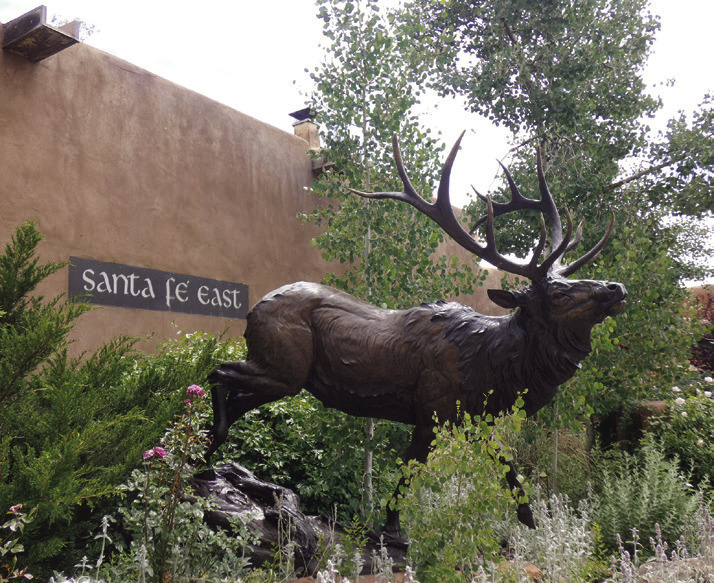
Santa Fe, NM is one of 137 cities worldwide with that name. The original was founded in 1491 by Queen Isabella near Grenada, Spain. She and King Ferdinand held court there during the re-conquest of Spain from the Moors that was finally accomplished in 1492, ending the longest war in history that had started in 718. Of course, you probably associate 1492 with the voyage of Columbus, financed by Ferdinand and Isabella, that resulted in Spain becoming enormously wealthy. Santa Fe, New Mexico, founded in 1610, is the oldest capital city in the US, so there is a lot to see if you are a history buff. Even if you are not, it is still both scenic and fascinating because of its Spanish heritage and culture that has blended with Native American.
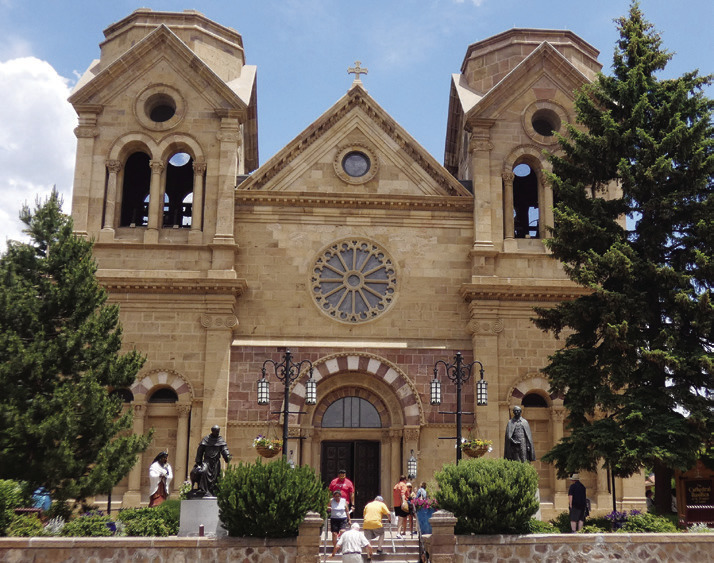
Our first stop in Santa Fe was at the Cathedral of St. Francis of Assisi to take a self-guided tour. We were there because of the historic and, to a lesser degree, the literary significance of the place. The Franciscan Friars arrived in 1598 with a party of Spanish colonists moving up from Mexico. They founded the city in 1610 and built the first adobe church on what is now the cathedral site. A larger church replaced it in 1714. As a result of the Mexican War, in 1846 New Mexico became a US Territory and responsibility for the cathedral was transferred to US bishops. Specifically, it became the diocese of Jean-Baptiste Lamy, a French priest who had been sent as a missionary to Ohio before he was appointed bishop of Santa Fe. Lamy’s statue now stands in front of the cathedral, and his remains are interred beneath the main altar. (You probably recall Lamy from Willa Cather’s novel, Death Comes for the Archbishop.)
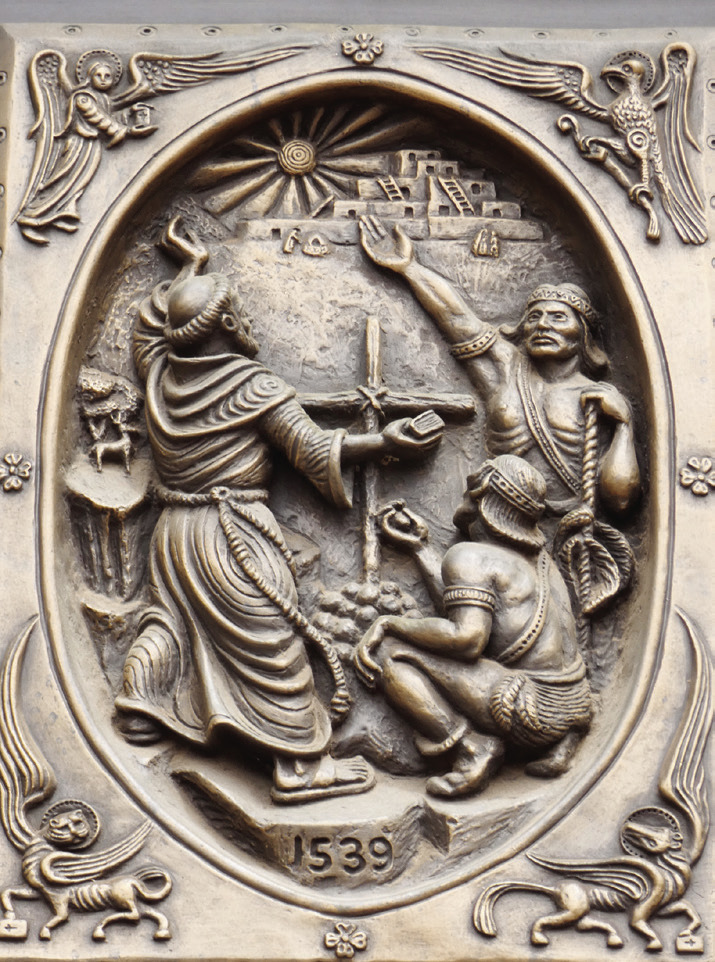
In 1869, Bishop Lamy built a new cathedral in the Romanesque style made of stone rather than the traditional adobe. Round arches. Corinthian columns. Statuary. The double doors of the cathedral hold 20 bas relief bronze plaques that illustrate significant events in the history of the church in Santa Fe. A woman trying to photograph the doors was frustrated by visitors constantly entering and leaving. While waiting patiently, she commented that they reminded her of the cathedral doors in Florence, Italy. Exactly!
But our access to the interior was delayed by the arrival of the current bishop for the ordination of priests. We met Fr. Scott Mansfield who introduced us to Jo Meuer, mother of soon-to-be Fr. Tim Meuer. She invited us to the reception following the service in the shady gardens of Guadalupe Plaza behind the cathedral. We enjoyed the hospitality, but when we headed back to tour the cathedral, it was then occupied by a wedding party posing for photos and the arrival of their wedding guests. Shirley said it was probably pushing our luck to hope for an invitation to the reception from the mother of the bride.
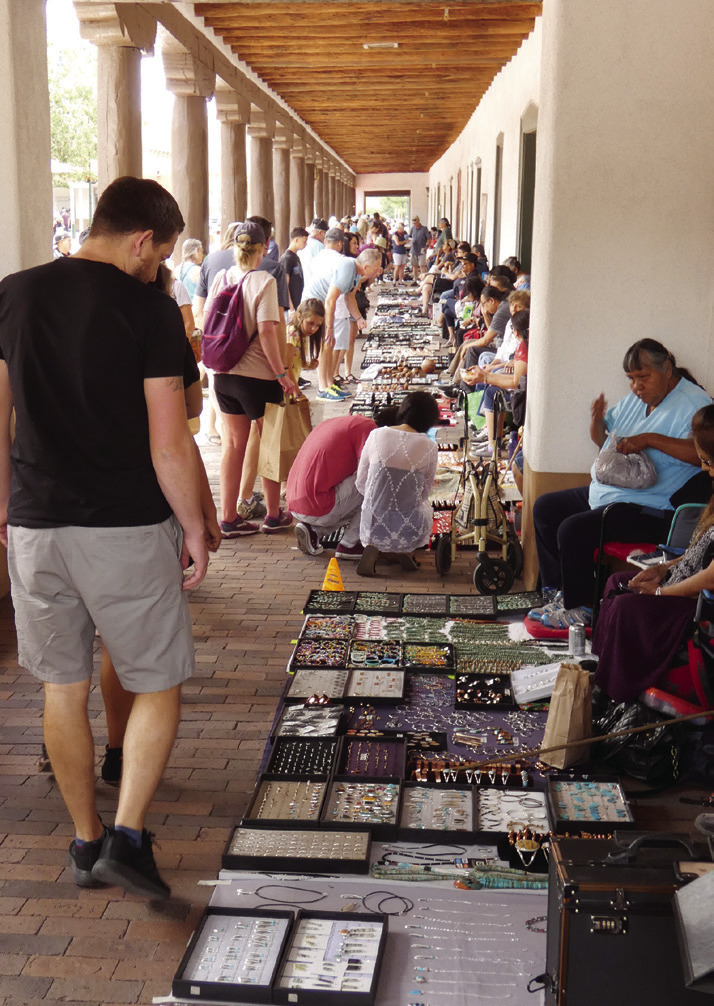
So, we occupied ourselves by heading over to the Plaza to continue our walking tour of the Historic District. The Plaza itself is a colorful place. Under the arcade at the Governor’s Palace were long rows of Indian artisans selling their wares—traditional jewelry of silver and turquoise, hand-woven rugs, leatherwork, and pottery. It was as much a community gathering as a sales opportunity for them.
From there, we headed for the Loretto Chapel to see the 360° staircase famous for being constructed in 1878 with no visible means of support. At the entrance, there was a sign that said the chapel was closed for yet another wedding. It was the middle of June. Who woulda thunk it!
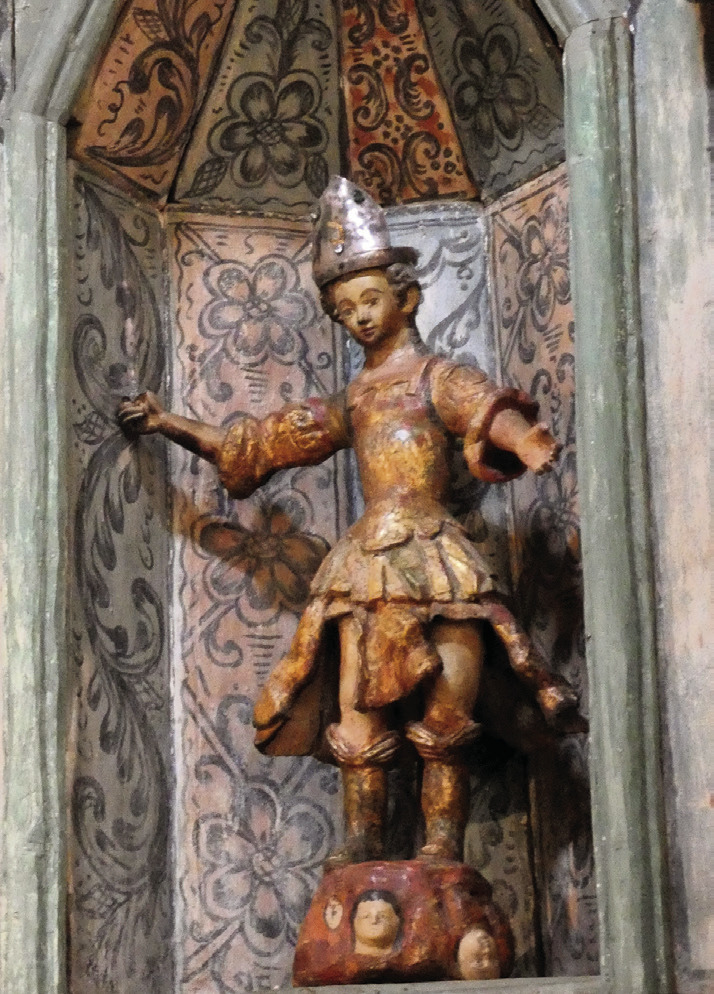
Just a little farther up the street, though, is San Miguel Mission Church, built by the Franciscans in 1610. (For perspective, the Mayflower Pilgrims landed at Plymouth Rock in 1620.) Archaeologists have determined that San Miguel rests on a Puebloan site dating from about 1300. San Miguel Mission is thought to be the oldest active church in the country. There is a painted and gilded statue of St. Michael the Archangel (Michael is Miguel in Spanish) brought from Mexico in the early 18th century. The wooden altar screen dates from 1798, so it is relatively new. San Miguel looks like what it is—a mission chapel. Its furnishings are appropriate for the period but crude by the standards of St. Francis Cathedral or any of the great churches of Europe. But, then, mission churches are the equivalent of starter homes, not designed to compete with cathedrals.
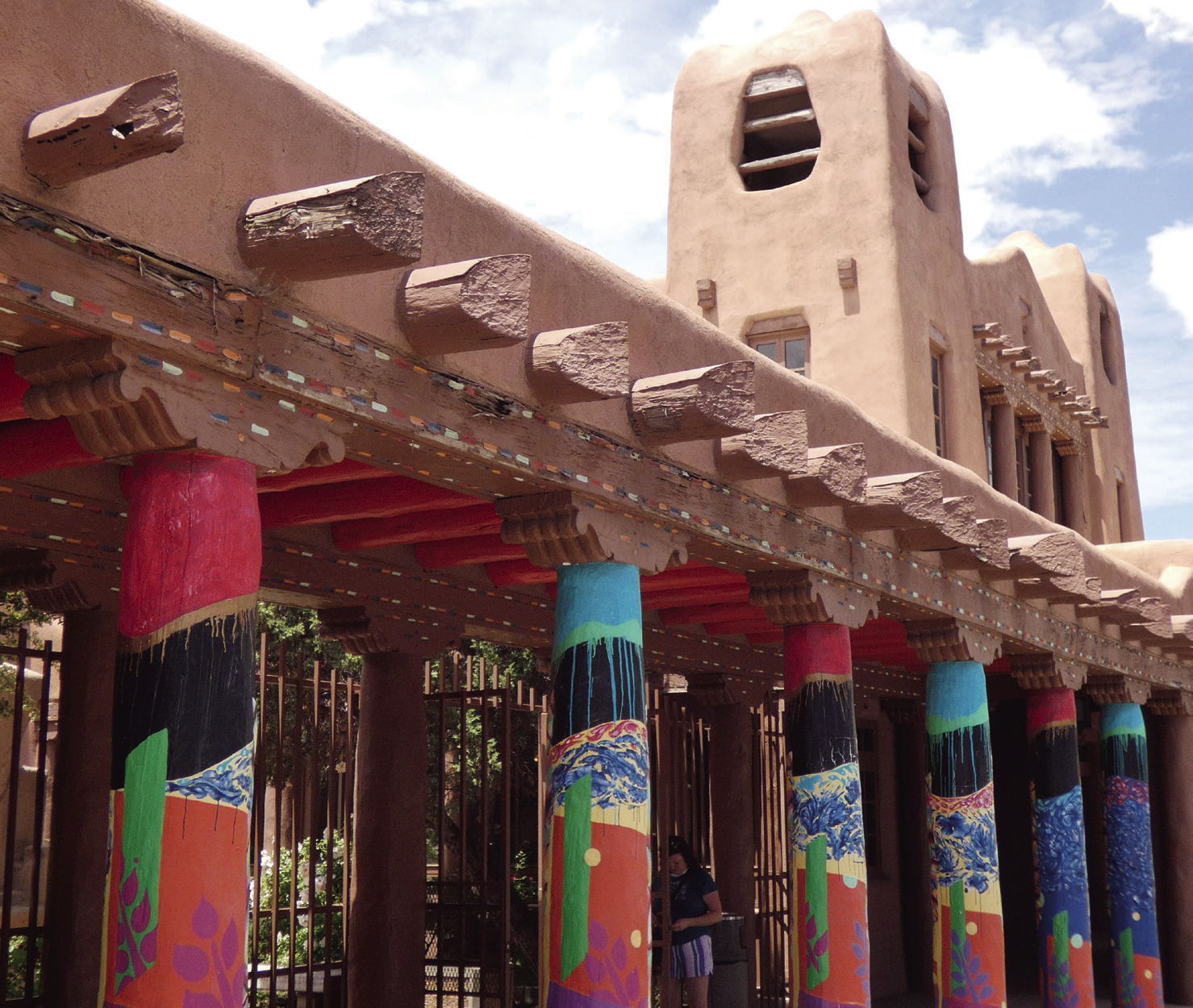
The dominant architecture in the Historic District evolved from what the Spanish adopted from Indians living in the Upper Rio Grande Valley. The Spanish called these communities “pueblos,” their term for villages that had houses built around a central plaza. The houses were constructed of adobe (sun-dried bricks containing straw as a binder) with rounded-corner walls and flat roofs supported by vigas, those wooden logs that protrude through the exterior walls. Laid crossways between the vigas are latillas, narrow wooden laths, to support the adobe between the vigas. Thick adobe walls with few doors and windows helped interiors stay cool in the summer and warm in winter. Santa Fe, at an elevation of 7,200 feet, is in high desert country that gets 32 inches of snow a year. There are ski resorts in the Sangre de Christo Mountains about 20 miles from town.
Since 1957, Santa Fe “H” Historical District Regulations require new construction to adhere to the strictly defined “Old Santa Fe Style.” That does not mean that everything must be built with adobe. It can be made of modern construction materials, but it must look like the historic buildings in the district. Stucco, for example, can be a reasonable approximation of adobe. Besides, how many tourists would bother visiting Santa Fe if it looked like any of 200 other middle-sized American cities? The population is only about 90,000 compared to Toledo’s 270,000 yet it manages to support more than 400 restaurants thanks to two million tourists who spend at least one overnight in town.
In the historic Plaza area, the streets are very narrow and the blocks are not necessarily neat rectangles. When they laid out the place in 1610, they were not thinking of 21st century vehicles or city planning. Within town, the Old Santa Fe Trail seems to wander all over the map. Turn just about any corner, and you’ll find yourself at the junction of Something-or-Other and the Trail. Likewise, the Paseo de Peralta circles the city. If your GPS says “Proceed to Paseo de Peralta,” there is no telling what direction on the compass you might be headed. Still, it is easy to find parking around the edges of the Plaza and set out to enjoy the shops, restaurants, and historic sites.
You might take the Margarita Trail and sample some of the 40 or so varieties. More than one or two a day may not be advisable. It is said that one Margarita at 7,000 feet elevation is equivalent to three at sea level. Furthermore, the air is thinner and drier at that elevation, so it is important to stay hydrated with actual water and, especially if you are older, to take it a little slower while you acclimate. While you are acclimating, sample some spicy Santa Fe cuisine. If you are intimidated by the fiery stuff, at least one of those 400 restaurants will provide enough alternatives to satisfy any appetite.
Art lovers will appreciate access to more than 250 galleries and 20+ museums of every kind, including the Museum of Indian Arts and Culture, the Museum of Spanish Colonial Art, and the Georgia O’Keefe Museum. She is famous for her representation of the Santa Fe area through her use of a strong, vibrant color palette that typically depicts desert landscapes and flowers. Real aficionados may want to visit Ghost Ranch, her home and studio north of the city.
On trips to Santa Fe, Shirley and I have arrived by the direct route down I-25 from Trinidad, Colorado and via the mountain route through the Taos area. As RVers, we have stayed in campgrounds in the Santa Fe National Forest to take advantage of the flyfishing in the Cimarron and Red Rivers as well as at Bandelier National Monument. There are numerous commercial campgrounds and RV parks around Santa Fe. If you are not interested in that sort of thing, there are plenty of B&Bs, hotels and motels, resorts, and vacation rentals in every price range.
The Historic District is compact, so exploring it doesn’t require much planning. Just put on some comfortable shoes and wander around the Plaza area. Any direction you take will be just a walk in the park.
You might want to see more of his stories and photos at AnotherWalkinthePark.blogspot.com.
✲