YOU PROBABLY DO SOMETHING with Velcro fasteners every day.
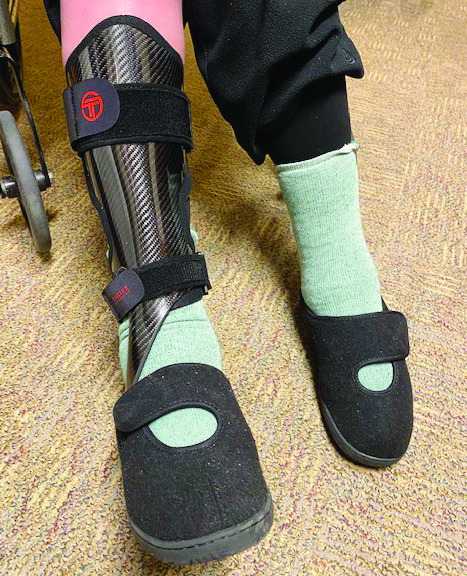
Velcro, the nylon fastener, is used in almost all areas of our lives. It is used in industrial, business, automobile, sports and recreation, clothing-shoes, wallets and purses, plus health care uses, too. People wearing an AFO (ankle foot orthotic) leg brace, placing cushions on chairs, or wearing a soft brace, like a carpal tunnel one, use Velcro fasteners. They’re also used in adaptive clothing, which is designed for people with physical disabilities, the elderly, and the infirm, who may experience difficulty dressing themselves due to an inability to manipulate closures such as buttons and zippers.
Because of their ease of use, these fasteners have been used for a wide variety of applications where a temporary bond is required. It is especially popular in clothing where it replaces buttons or zippers, and as a shoe fastener for children who have not yet learned to tie shoelaces.
Velcro is a hook-and-loop fastener that consists of two lineal fabric strips. The first side has tiny hooks, and the opposite side has smaller loops. When the two are pressed together, the hooks catch in the loops and the two pieces fasten together and bind temporarily. When separated by pulling or peeling, the two strips make a distinctive ripping sound.
Velcro was conceived in 1941 by Swiss engineer George de Mestal. He got the idea one day after returning from a hunting trip in the Alps with his dog. He noticed that burs of burdock kept sticking to his clothes and his dog’s fur. He examined them under a microscope and noticed they had hundreds of “hooks” that caught on anything with a “loop” such as clothing, animal fur, or hair.
After experimenting with fabrics that ripped and could become moldy, he eventually used nylon for the product, making his little hooks smaller. He used many little hooks and eyes so it would hold what it was fastening.
Medicine is just one area where Velcro fasteners are used. These hook and- loop fasteners held together a human heart during the first surgery. Velcro is used in nuclear power plants and army tanks to hold flashlights to walls. In cars, hook-and-loop fasteners are used to bond headliners, floor mats, and speaker covers. Velcro is used in the home when pleating draperies, holding carpets in place, and attaching upholstery. Closures on backpacks, briefcases, and notebooks often make use of hook-and-loop fasteners. So do diapers. Velcro is an integral part of games such as flag football, and is used in surfboard leashes and orthopedic braces.
NASA reports that it makes “significant use of hook-and-loop fasteners. Each space shuttle flew equipped with ten thousand inches of a special fastener made of Teflon loops, polyester hooks, and glass backing. Hook-and-loop fasteners are widely used, from the astronauts’ suits to anchoring equipment.” In the near weightless conditions in orbit, hook-and-loop fasteners are used to temporarily hold objects and keep them from floating away. A patch is used inside astronauts’ helmets where it serves as a nose scratcher. During mealtimes, astronauts use trays that attach to their thighs using springs and fasteners. Hook-and-loop fasteners are also used aboard the International Space Station.
Those of us who use Velcro fasteners appreciate its strong fastening qualities. However, just like the inventor observed that the hook fastened very strongly to plants and animal fur, those using Velcro today are fascinated by the strength of its holding power and frustrated by the fact that it sometimes holds on to our hair, clothing, and other bits of material.
But those are minor problems compared to how convenient Velcro is with things in our everyday life. Because, overall, it works so well.
Sister Karen Zielinski is the Director of Canticle Studio. Canticle Studio is a part of the Sisters of St. Francis of Sylvania, OH’s overall advancement effort and has a mission of being a creative center where artists generate works, products, and services in harmony with the mission of the Sisters St. Francis. She can be reached at kzielins@sistersosf.org or 419-824-3543. ✲