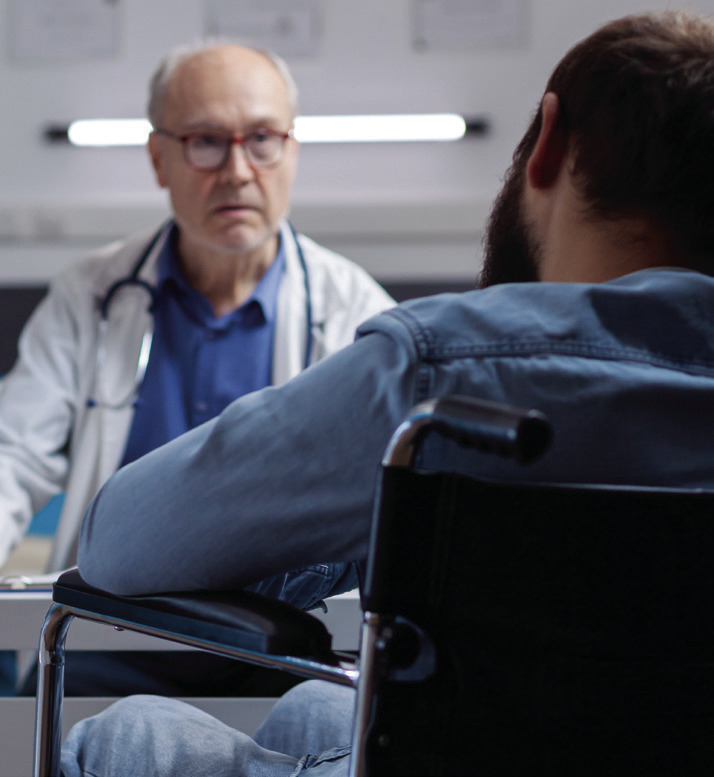
SUSAN PUT OFF SCHEDULING her annual doctor’s checkup for months. It wasn’t that she was afraid of the blood tests or medicines, it was an anxiety about getting in place safely.
Getting into the office is a challenge for her. There is a paved ramp with a sharp turn on it leading to the entrance. When she gets to the entrance door, it is hard to reach the door handle. She backs up to make room for the door, which swings out toward her. She takes out her phone to call the receptionist to open the door, but it takes a few minutes. It is raining, and the roof only covers the door area. She gets wet and the receptionist tells her next time to call when she gets to the door. (She did!)
Susan hasn’t been on an examination table for years, nor the stand-up scale. The scale is especially challenging. She broke her leg years ago and cannot do much weight bearing on it. She has trouble standing up and transferring from her wheelchair to a chair, toilet, or examination table. Getting on a scale is a real challenge for her since the grab bar near the scale is on the wall and shorter than she used at other places.
For her to transfer to an examination table is scary and embarrassing. As a grown woman, to have nurses and therapists help her transfer without falling makes her anxious, and she would prefer not going to the doctor. Her family has advised Jean not to go to the doctor for regular medical checkups, and only if something is seriously wrong with her.
Title III of the Americans with Disabilities Act (ADA) declares medical offices and hospitals as “public accommodations” that must comply with ADA regulations. It is important for people with disabilities to receive medical services equal to those services received by a person without a disability. This has not happened yet.
If a patient cannot safely be examined by their physician, they are not getting a complete examination. Some people with disabilities also avoid appointments because they cannot get rides with their wheelchairs or walkers to their doctor’s office.
Many persons with mobility challenges feel the same way. Dental chairs, examination tables, and some medical equipment, like chairs in ophthalmologist’s offices or other medical tests, can be challenging for persons who do not move well. So, people with mobility challenges are getting subpar medical care. They wait until there is a medical problem to seek help, not getting early care.
Despite the Americans with Disabilities Act, (1990) people with disabilities are not getting good care. According to a recent study published in Annals of Internal Medicine, people with disabilities receive subpar medical care.
Recently, the Department of Justice (DOJ) issued a notice of public rule-making (NPRM) that would require accessible medical diagnostic equipment for persons with disabilities and other accessibility-related practices in the healthcare industry.
On January 9, 2024, the DOJ explained in a press release that the proposed regulation addresses the perceived failure of healthcare entities to provide accessible diagnostic and preventive medical care to individuals with disabilities.
The proposed regulation, if adopted, would have potentially broad and far-reaching implications for healthcare providers. First, while the proposed regulation is ostensibly directed at state and local governments covered by Title II of the ADA, one can expect its provisions to apply very soon to the entire healthcare industry. Second, the proposed regulation goes beyond the design requirements for Medical Diagnostic Equipment (MDE) in two important ways. It would require staff to be trained on how to work with patients with disabilities, including their safe transfer between their wheelchairs or other devices and the healthcare provider’s equipment and the provider’s furniture.
The proposed regulation applies primarily to medical equipment used for diagnostic purposes, although the DOJ indicated that it would broaden the rule’s application to non-MDE used in the healthcare industry. The proposed regulation defines “medical diagnostic equipment” as “equipment used in, or in conjunction with, medical settings by healthcare providers for diagnostic purposes.” This definition encompasses the non-exhaustive list of MDE, which includes examination tables and chairs, weight scales, and radiological diagnostic equipment such as mammography equipment and x-ray machines.
Basically, design standards would be regulated and codified. Equipment standards for medical equipment such as scales, treatment or examination tables and chairs, and x-ray and other scanning equipment would have design standards. At least one examination room would need to be accessible with an examination table, a scale in the office, and toilets. Staff would need training to make sure they know how to use equipment safely as well as safely transfer persons who use wheelchairs and other devices. Purchasing a Hoyer lift or other assistive equipment would help with safe transfers.
Time and financial constraints are important obstacles. Regular examining tables cost about $1,000. Height adjustable tables can cost $4,000 or more. The additional time of transferring a patient can take up more office time, none of which is reimbursed. There are federal tax credits available and deductions for disability-related equipment, but the additional work of transferring a patient, which takes up more office time, is not reimbursed.
Standardization of equipment and a trained staff would truly make a medical office accessible and safe. Accessibility takes more than a grab bar.
For any questions about accessibility, call the ADA National Network at 1-800-949-4232 or email them at adata.org/email.
Sister Karen Zielinski is the Director of Canticle Studio. Canticle Studio is a part of the Sisters of St. Francis of Sylvania, OH’s overall advancement effort and has a mission of being a creative center where artists generate works, products, and services in harmony with the mission of the Sisters St. Francis. She can be reached at kzielins@sistersosf.org or 419-824-3543. ✲