I WAS BEING FOLLOWED.
Several years ago, I was teaching choral music in a large urban high school. We had just finished our technical rehearsal for the spring musical. After practice ended at 10:00 p.m., I got into my car and headed home. As I exited the freeway, I noticed that a car seemed to be following me to my central city neighborhood. I turned sharply at a few corners, just to see if the driver in the car behind stayed with me. He did.
Panicked, I finally pulled into my driveway, turned on my bright high-beam headlights and honked loudly to wake the neighbors. When the neighbors turned on their porch light and came out, the car sped away. Frazzled but relieved, I wondered aloud why they had followed me. My neighbor mused, “Maybe they saw that handicapped parking permit hanging from your rearview mirror!” I was stunned. It had never occurred to me that someone might follow me because of that! I have never forgotten that frightening drive home.
Hate crimes?
People with disabilities are not exempt from violent crimes such as robbery and assault. Just the opposite. Some research finds that the rate of major crimes against people with substantial disabilities is four to ten times higher than that of the general population.
When people with disabilities are specifically targeted, they become what many would call victims of a hate crime. The International Association of Chiefs of Police (IACP) defines a hate crime as “a criminal offense against a person, property, or society that is motivated, in whole or in part, by the offender’s bias against race, religion, ethnic/national origin, gender, age, disability, or sexual orientation.’’ A person has committed a hate crime when, based on the above criteria, he or she commits assault or battery, theft, criminal trespass, damage to property, mob action, disorderly conduct, or telephone harassment upon an individual or a group.
Hate crimes and the disabled In 2017, the FBI said that its highest civil rights priority is the investigation of hate crimes. There were 7,106 single-bias incidents involving 8,493 victims. A percent distribution of victims by bias type shows that 59.6 percent of victims were targeted because of the offenders’ race/ethnicity/ancestry bias; 20.6 percent were targeted because of the offenders’ religious bias; 15.8 percent were victimized because of the offenders’ sexual orientation bias; 1.9 percent were victimized because of the offenders’ disability bias; 1.6 percent were targeted because of the offenders‘ gender identity bias; and 0.6 percent were victimized because of the offenders’ gender bias. (Due to rounding, percentage breakdowns may not add up to 100.0 percent.)
Vulnerability
Why would someone attack a person with a disability? The group All Walks of Life (http://www.awol-texas. org), whose mission is to empower social solutions for people with disabilities, believes the main reason is that someone with a disability is simply more vulnerable to predators. They explain, “When your ability to see or hear is reduced or eliminated or when your mobility is reduced or eliminated, you are more at-risk for violence than your non-disabled peers because your ability to know who is in your environment by sight or sound, or to escape your environment, is reduced or eliminated.” People who use braces, canes, or other aids, give visible clues to predators that they are less likely to escape or fight back. To compound the problem, even the ability to accurately describe what occurred is in jeopardy because of the disability. For those of us living with a disability, daily living means managing our disease. But we also need to manage our personal safety. Whether crime is motivated by hate or simply because we seem to be easy prey, the statistics say we can be targeted. Crimes against people with disabilities occur in many places: assisted living centers, group-care homes, hospitals, public transportation systems, parking lots, nursing homes, schools, and the work place.
Commonsense crimeprevention strategies:
• Be aware of your surroundings—on the street, in a shopping mall, or waiting for a bus or subway.
• Act in a manner that says you are calm, confident, and sure of your purpose and destination.
• Know the neighborhood where you live and work. Check out the locations of fire and police departments and stores that are open and accessible.
• Consider carrying a personal alarm such as the type joggers use to signal an emergency, or wear a smart watch.
• If you exit a store or mall for a large parking lot, ask a security person to accompany you to your vehicle.
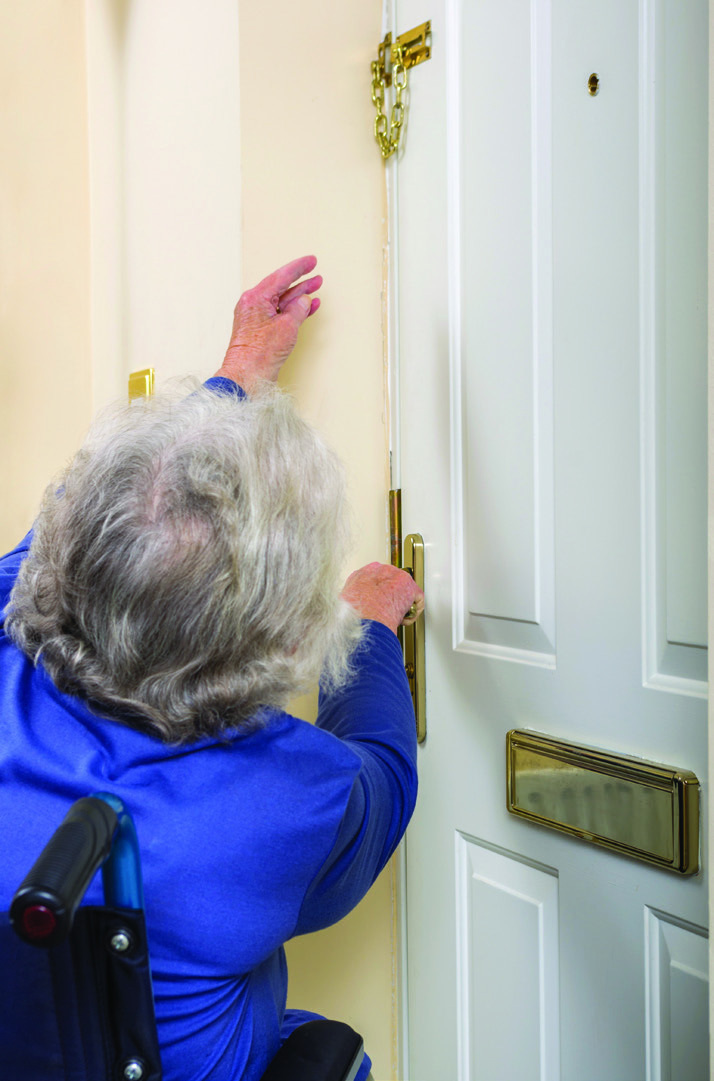
• Install peepholes on the front and back doors at eye level— at two eye levels if you use a wheelchair.
• Get to know your neighbors. Watchful neighbors who look out for each other are a frontline defense against crime!
• Never open the door to a stranger without first verifying the stranger’s identity and the purpose of the visit.
• Never tell a stranger on the phone that you are disabled.
• Stick to well-lighted, welltraveled streets. Avoid shortcuts through vacant lots, wooded areas, parking lots, or alleys.
• Carry your purse close to your body, not dangling by the straps.
• Carry and know how to use a cellular phone.
• If your state offers the option, choose a hanging handicapped parking tag instead of a license plate, so you have the option not to reveal this information.
People with disabilities are tough. We deal with multiple challenges in daily life. Although some of us might not be able to enroll in a self-defense class, all of us can arm ourselves with one type of critical self-defense: common sense.
Sister Karen Zielinski is the Director of Canticle Studio. Canticle Studio is a part of the Sisters of St. Francis of Sylvania, OH’s overall advancement effort and has a mission of being a creative center where artists generate works, products, and services in harmony with the mission of the Sisters St. Francis. She can be reached at kzielins@sistersosf.org or 419-8243543.
✲