
AS A KID, I MANAGED my medications quite well. Of course, I only took an aspirin for any aches and pains, and a multivitamin for overall health. Those were the days.
As I got older, I moved into using a little, round plastic case (one type of pill) only containing aspirin, then on to a rectangular pill box with seven columns for each day of the week (containing 21 pills, some of different types). The little divisions on the pillbox were divided into “morning,” “noon,” and “night.” My current pill case has seven days divided into four times—”morning,” “noon,” “evening,” and “bed” (28 pills of varying types. And more!).
Getting a pill box is quite easy. Local health fairs, community centers, and colleges and universities often give out pill boxes free of charge to those who attend medical events. Other stores sell them, too, and they are pretty inexpensive.
A friend of mine told me she was looking for one and mentioned it to her neighbor who gave her one—she had a few unused ones stored in a cabinet. Basic organizers have separate compartments for each day of the week. Bigger ones have multiple slots if you take pills more than once a day. This allows you to sort drugs according to exactly when you need to take them. (If you want a pillbox alternative, you can put medications in different-colored bottles for separate times of day.)
You can safely store most medications in the same organizer compartment with other drugs for short periods of time without them interacting. But check with your doctor or pharmacist to make sure. Also, make sure your pillbox is filled correctly. It’s easy to drop in two pills where there should be one.
Although a multi-compartment pill box can make taking one’s pills pretty easy, I offer a few challenges I have faced from my own lived experience.
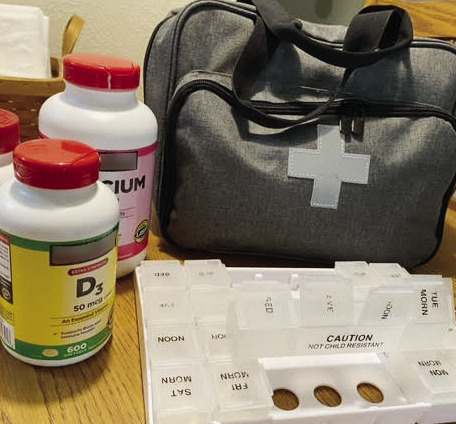
Saturday is my fill the box day! I place my rectangular seven-day pill cases with their four daily pill times (Morn, Noon, Eve, and Bed) on my kitchen table and open all 7 little hinged pockets. I have my pill-dose schedule written down next to me, but I know it! Then the routine begins. I turn off the TV or my music, do not talk to anyone, and mute my phone.
I have a little medical bag I bought online where I store all my medications. It reminds me of a baby suitcase. First of all, I remove my pills from my “medicine bag,” as I like to call it. I begin filling my pill box with all medications I take four times a day, in their pockets, then the two times a week, then once a day per week. It seems simple enough, but I have to pay attention and watch closely.
Five of my prescription medications are small, white, flat circles. I can tell them apart now, but once I noticed when I took my morning pills, I had three of the same pill in the box. That taught me to pay closer attention to setting up my pills. I was so relieved when I bought my vitamin D supplements. They were beige gel caps! Not white. Next, my calcium pill, although white, was a huge little football shape! A relatively new pill I started taking to manage my MS was white, too, but a smaller football shape. I could tell them apart pretty well. I was tempted to place some food coloring on my white pills to be able to tell them apart, but I was too lazy to do it.
We all need to make sure our pillbox is filled correctly. It’s easy to drop in two pills where there should be only one or to put the wrong medicine into a bottle. You also need to remember to refill your organizer when it’s empty. It may help you to do it on the same day each week or month. If you need extra help, ask a friend or a relative to fill your pillbox when they visit.
I get most of my prescriptions filled online. It is convenient since they come in the mail and medications come in three-month supplies. Some medications, like the one I take for my MS, are often not available at local pharmacies. Also, storing three months of prescription drugs takes room. That’s another reason I have a “medicine bag.” Supplements and pain relievers in big box sizes can contain hundreds of pills.
According to WebMD, there are automatic pill dispensers that you can buy (they are expensive but might be covered by insurance.) The fanciest dispensers can connect wirelessly to your pharmacist to let them know if you skip a dose. Medicare for seniors doesn’t cover these gadgets. But some state Medicaid programs for people with low incomes or disabilities may pay for them. Check with your insurance.
Another way to simplify taking your pills is taking dose packets. Ask your doctor or pharmacy if they can give you predated single doses or blister packs. Some pharmacies will organize your meds into separate, custom-filled packets, which are marked with the date, day of the week, dosage, and even the time of day when you should take the drugs. Just make sure to let your pharmacy know right away if your prescriptions change. Predated packets work best when you know your routine will stay the same. You may still want to order a few at a time in case there’s a change in your prescriptions.
However you take your pills, find a way that works best for you.
Sister Karen Zielinski is the Director of Canticle Studio. Canticle Studio is a part of the Sisters of St. Francis of Sylvania, OH’s overall advancement effort and has a mission of being a creative center where artists generate works, products, and services in harmony with the mission of the Sisters St. Francis. She can be reached at kzielins@sistersosf.org or 419-8243543.
✲
