
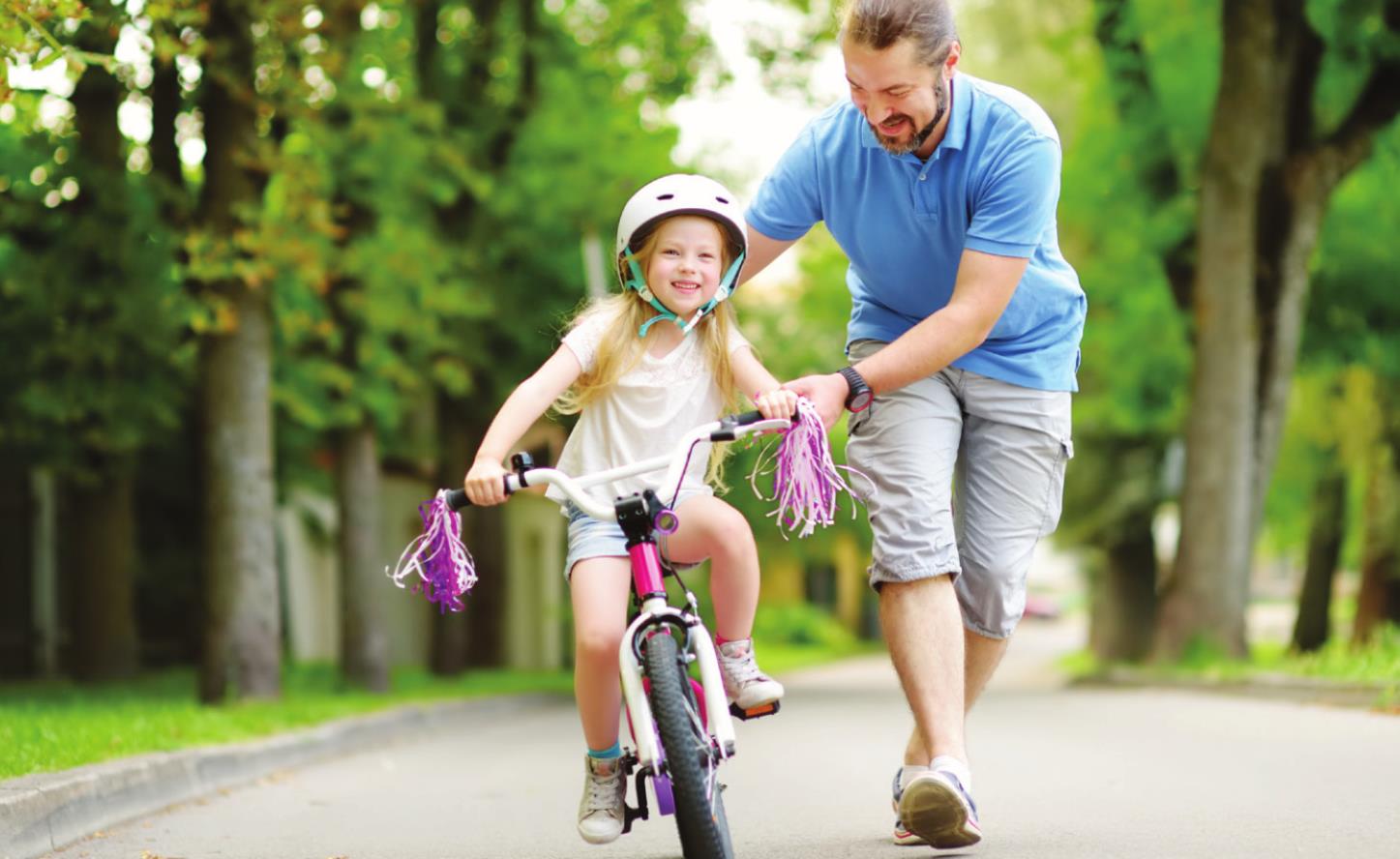
LEARNING TO RIDE A BICYCLE is an important rite-of-passage and developmental milestone for children. Leaving behind those training wheels and pedaling away from Mom or Dad for the first time is an exhilarating, confidence-building experience that helps kids begin to establish a sense of independence. But, along with that newfound autonomy comes a whole new world of risks and responsibilities.
Protect their greatest asset
The most important bike-safety measure parents must demand of their children is to wear a helmet— whenever they ride and regardless of how far they’re going. In fact, wearing a bicycle helmet reduces the risk of brain injury in the event of a fall or collision by almost 90 percent. Furthermore, many states require children under a certain age (often age 16) to wear bike helmets. Be sure to verify the legal requirements in your community.
Of course, for a bike helmet to provide the highest level of protection, it must be properly designed and tested. Choose a helmet with a certification sticker from the US Consumer Product Safety Commission (CPSC).
Also, it’s vital to ensure the helmet fits your child’s head properly. To achieve the right fit, AAA advises:
• Read the manufacturer’s instructions. They typically describe how to use the padding to properly fit the helmet.
• The fit should be snug, level, and stable. Ensure the helmet covers the head snugly.
• Position the edge of the helmet two fingers above the eyebrows to protect the forehead. The strap should meet in a V shape just below the ears. One finger should fit between the chin and the strap.
• With the helmet on the child’s head, try to move it gently from side to side and back and forth. It should be snug enough to move the skin. If not, use the thicker foam padding provided with the helmet to make it snug. Then tighten the straps with enough room to slide one finger between the strap and the chin.
Buy an appropriately sized bike Knowing how quickly kids grow,
Knowing how quickly kids grow, parents may be tempted to buy an oversized bike for their child, with the expectation that he or she will “grow into it.” However, it’s important to buy a bike that fits right now—and to replace the bike as soon as it becomes too small.
When a bike is sized properly, your child should be able to sit on the seat and balance the bike with the tips of the toes touching the ground. When standing over the bike, there should be one to two inches of clearance between your child and the top bar. The seat should be level from front to back, and the handlebars should be adjusted to the same level as the seat.
Inspect the bike
Parents should routinely inspect their child’s bicycle for proper maintenance. Tires should be properly inflated; the chain, brakes, and steering gears should be properly adjusted, functioning properly, and lubricated as necessary; and the frame should be intact, with no loose, missing, bent, broken, or rusted parts. To ensure that the wheels spin freely without wobbling or rubbing against the frame, invert the bicycle and inspect each wheel’s rotation while operating the pedals by hand.
Lighten up
To ensure that young cyclists are clearly visible to motorists, they should be encouraged to wear brightly colored clothing (fluorescent or neon-colored garments are preferable to white) or reflective tape when riding. Also, bicycles should be outfitted with front and rear reflectors, as well as a headlight that is visible up to 500 feet.
Think like a motorist
Kids need to be taught that a bicycle is a vehicle, not a toy, and that all of the rules of the road apply to cyclists just as they do to motorists. That means they must be prepared to:
• Observe and obey all traffic signs and signals.
• Ride on the right-hand side of the road—the same direction as the flow of motor vehicle traffic.
• Ride predictably so motorists can anticipate their actions.
• Use hand signals when stopping or turning.
• Look left, right, left for traffic at stop signs and driveways before entering the street.
• Maintain control at all times by keeping both hands on the handlebars and staying alert to hazards on the road. ✲
It’s incumbent upon parents to teach their kids the rules of safe bicycling and to make sure they’re outfitted with the proper safety equipment before they take to the streets.
