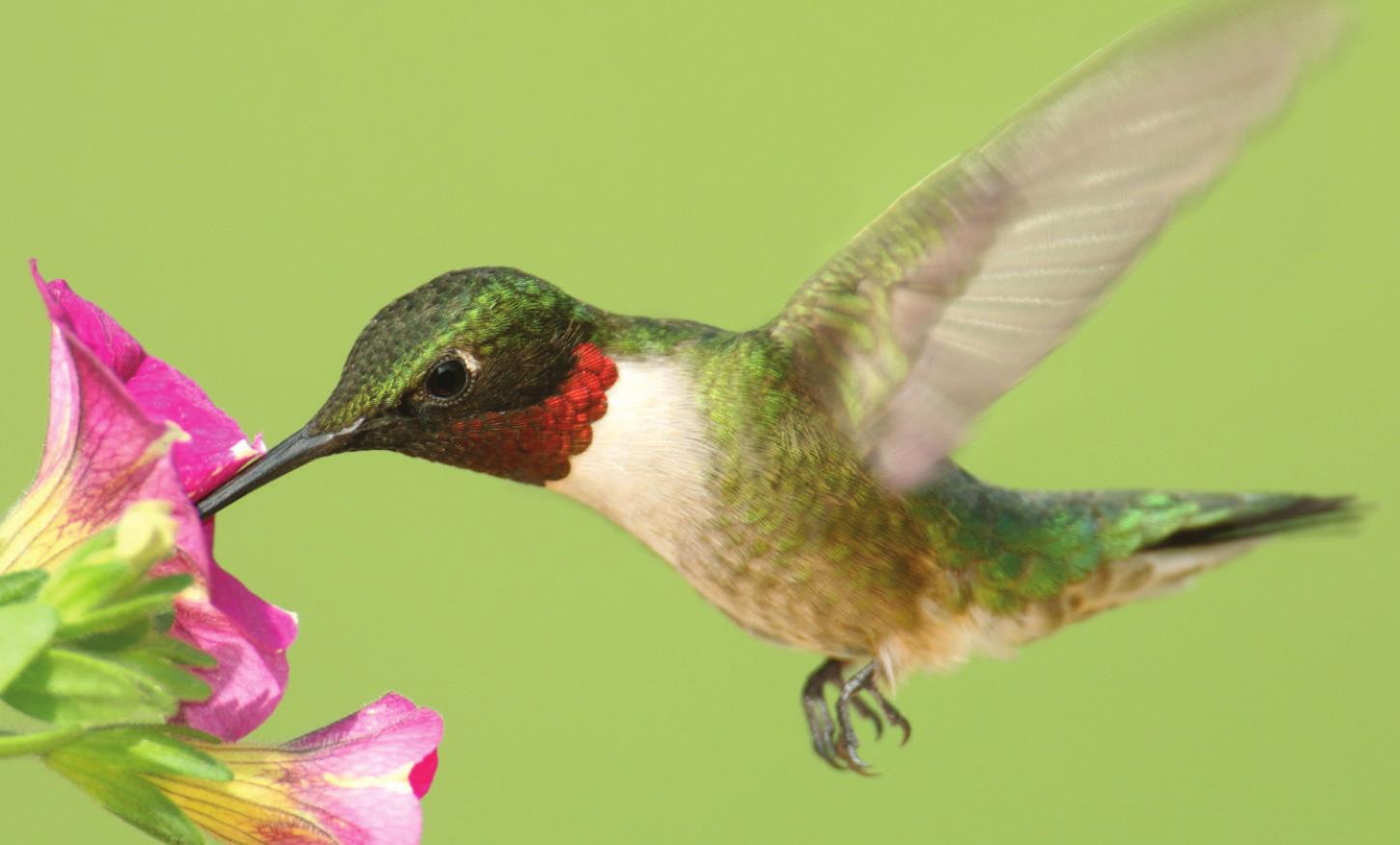
THE HUMMINGBIRD IS A WELCOME, albeit infrequent, guest in any garden. If you’ve ever observed one of these little winged jewels in action, its tiny wings blurring the air as it darts from blossom to blossom in search of nutritious nectar, you can certainly understand why so many gardeners invest a little extra effort to attract them.
If hummingbirds seldom or never visit your garden, why not invite them in by planting a hummingbird garden this season? With a few carefully chosen plant species, a place to perch, some dripping water, and a nectar feeder or two, you can create a charming hummer habitat in your own backyard.
Seeing red
Virtually every gardener has heard that hummingbirds are attracted to tubular flowers in shades of red or orange. That’s true enough, but once they’re invited in, hummingbirds will feed on almost any flower in the garden just as readily. In fact, they seem to find impatiens of any color as well as the relatively inconspicuous blossoms of coral bells irresistible. Still, the best strategy is to combine attractive, brightly colored blossoms with smaller, nectar-rich ones.
Plantings should be arranged in clumps. And, of course, try to plant for a succession of flowers throughout the growing season rather than a single springtime flush of blooms that gives way to a uniform “sea” of green. Otherwise, hummingbirds won’t be inclined to hover around.
Here’s a (by no means all-inclusive) sampling of some good plant choices for attracting hummingbirds (in our area, the ruby-throated hummingbird):
Annuals: fuchsia, impatiens, morning glory, nicotiana, petunia, salvia, scarlet runner bean, zinnia.
Perennials: bee balm, canna, clematis, columbine, coral bells, daylily, delphinium, hibiscus, hollyhock, hosta, penstemon, phlox, trumpet vine.
Shrubs: butterfly bush, lilac, weigela.
Hummingbird feeders
Though the right assortment of plants will usually suffice when it comes to attracting hummingbirds, one or two hummingbird nectar feeders will be an added incentive for these little beauties to visit your garden. A nectar feeder is a glass or plastic reservoir that you fill with sugar water or a commercial hummingbird food (available at any garden center). Some of these feeders can be quite ornate and make a delightful accent to the garden whether they succeed in attracting hummingbirds or not.
To mix your own sugar water, simply combine one part sugar with four parts boiling water. Allow the mixture to cool, and then pour it into the feeder. Leftover liquid can be stored in the refrigerator for a week or two.
It’s very important to keep the nectar feeder clean to prevent the mixture from fermenting and to keep mold from developing. Each time you refill the feeder, rinse it with warm water and scrub it with a baby bottle brush. Avoid using soaps or detergents. Once a month, wash the feeder thoroughly with a vinegar-and-water solution.
If bees and wasps are attracted to your nectar feeder (a common occurrence), consider purchasing a feeder that comes equipped with bee guards. Foraging ants can be discouraged by placing a water-filled ant trap between the hanging pole and the feeder. Some gardeners attempt to discourage ants by coating the hanging wire with petroleum jelly or mineral oil. However, this approach is not recommended because if the hummingbirds get the jelly or oil on their feathers, it can interfere with their ability to clean themselves.
A place to perch and a place to bathe
Hummingbirds exert a considerable amount of energy as they flit about in search of nectar-rich flowers, so a convenient perch adjacent to the nectar feeder is a welcome addition to the hummingbird garden. Slender overhanging tree or shrub branches or vines will suffice for this purpose. Or, if no natural perches are available in the immediate area, you can simply insert a cut branch into the ground near the feeder or utilize a commercially manufactured hummingbird perch.
Also, like many other birds, hummingbirds appreciate an occasional bath. However, don’t expect these dainties to splash around in a birdbath like your run-in-the-mill starling or grackle. Instead, they prefer to make repeated passes on the wing through dripping water or to rub themselves against moist leaves. A gently dripping multi-tiered fountain is one solution. There are also various commercial hummingbird dripper and mister kits on the market to choose from.
Ephemeral beauty
Unfortunately, hummingbirds remain in our area only during the warmest months. Once their inner clocks tell them it’s time to move on in search of warmer climes, not even the most welcoming hummingbird garden will persuade them to remain. But then, their transient nature is partly what makes them so alluring to gardeners. If you take care to provide for all of their basic needs, you can expect these delightful winged jewels to return to your garden—along with the warm springtime breezes—year after year.