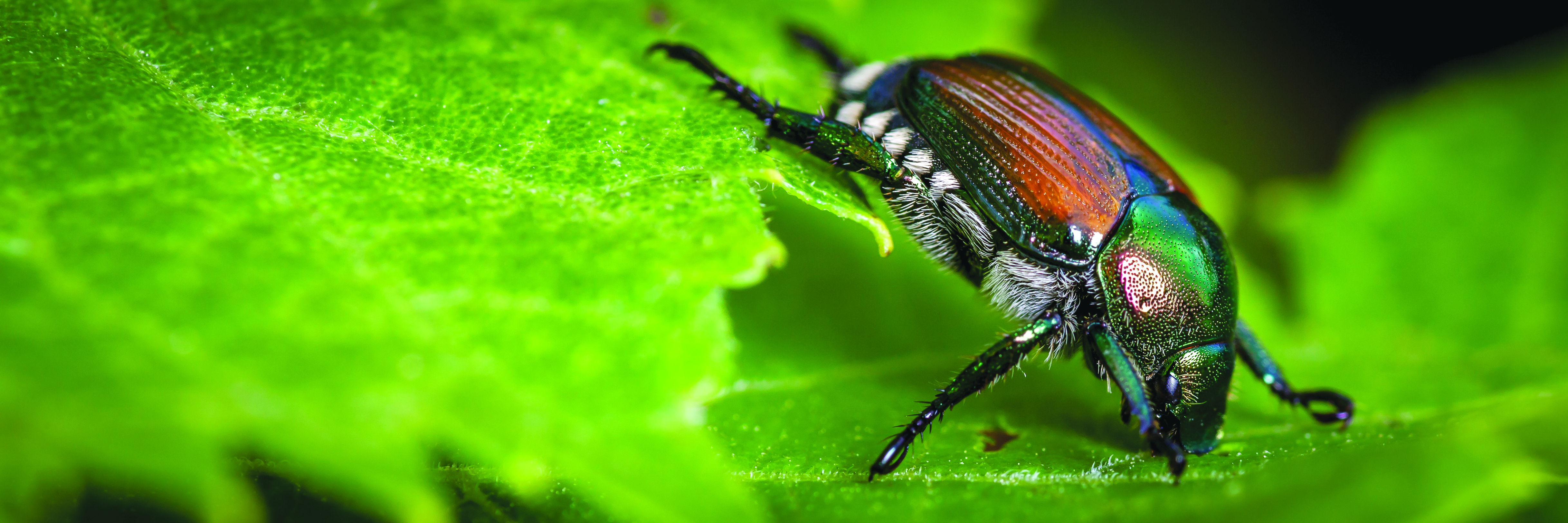
ACCORDING TO THE UNITED STATES DEPARTMENT OF AGRICULTURE (USDA), the Japanese beetle ( Popillia japonica Newman) first appeared in America in the year 1916 near Riverton, New Jersey, its larvae concealed within the potting soil of a plant imported from Japan. This uninvited, irksome guest has since spread throughout most of the Eastern states. Scattered populations have also been observed in several states west of the Mississippi.
Japanese beetles are destructive to plant life in both the larval and adult stages. The larvae, or grubs, hatch from tiny translucent eggs, which are laid in the soil by adult females in late summer or early autumn. As the weather grows warmer in spring, the grubs move closer to the soil surface where they feast on the rootlets of turf grasses, causing considerable damage to lawns. Unfortunately, homeowners seldom realize they have a problem with grubs until the damage is already done.
What do grubs look like?
The Japanese beetle grub has a white, C-shaped body, brown head, and three pairs of legs located close to the head. The grubs can be distinguished from the larvae of similar species by the presence of a V-shaped arrangement of setae (tiny bristles) on the anal segment.
You can check for grubs in your lawn in springtime (before they emerge as adult beetles) by digging up and
rolling back a small section of sod in an inconspicuous part of your lawn (be sure to replace the sod firmly afterward). If more than two or three grubs are visible in that small exposed area of soil, you’ll know corrective action is needed to protect your lawn. If in doubt, any qualified lawn-service expert can help identify a grub problem, as well.
The adult stage
At the end of their short but destructive larval stage, the grubs change into pupae, after which they emerge from the soil as adult Japanese beetles and begin flying from location to location in search of plants to eat. And they’re not finicky! In fact, the USDA notes that the foliage, flowers, or fruits of more than 300 different ornamental and agricultural plants are on their menu.
Adult Japanese beetles are approximately one-half inch long with a metallic green body and copper-colored wing covers. Like many plant-eating insects, they usually attempt to conceal themselves by feeding on the undersides
of leaves. However, it’s hard to miss them once they really start to swarm on your plants.
Japanese beetle damage to plants is unmistakable. The leaf tissue between the veins is usually devoured completely, but the veins themselves are left intact. This gives the affected foliage a distinct “skeletonized” appearance. Stringy, black droppings will also be present on the damaged leaves.
Control methods
Grubs
There are several methods you can use to eliminate grubs in your lawn. Of course, there are various liquid and granular chemical pesticides you can apply, but keep in mind that many of these products will also eradicate desirable soil-inhabiting insects in the process—killing the good along with the bad, so to speak. If you choose to pursue this route, be sure to consult with a lawn-care expert on which product is best for your needs and apply the product in strict accordance with label instructions.
If you’d prefer a more environmentally friendly approach, the USDA identifies various biological controls that can be effective against grubs, for example the insect-eating nematode Heterorhabditis bacteriophora, the soil bacterium Bacillus thuringiensis (Bt), and spores of the bacterium Bacillus papillae (milky-spore). All these products can be purchased through your local garden center or online.
Yet another natural control is neem oil, derived from the neem tree of India. Neem oil not only kills grubs and adult Japanese beetles on contact but also prevents adults from feeding if applied to foliage. It is safe for use on both ornamental and edible plants.
Adults
To protect your plants from the voracious adults, you can try covering yourvaluedornamentalsandfoodcrops with special netting designed to prevent beetles from reaching the foliage. You can also manually remove the beetles whenever you see them and drown them in soapy water. However, these approachesaren’talwayspracticalwhen there are numerous plants to protect or when the beetles are swarming heavily. Not to mention, many people aren’t overly enthusiastic about handpicking beetles. In these cases, spraying with the aforementioned neem oil or insecticidal soap is a better option. Be sure to apply these treatments to the tops and undersides of leaves.
Pheromone traps can also be used to attract and eliminate the Japanese beetles. These are simply plastic bags baited with a reproductive pheromone and suspended above the ground. The hourglass shape of the trap allows the beetles to enter the trap, but they can’t escape once they fall past the narrow center of the bag.
The drawback to these traps is that they tend to attract more beetles than might otherwise enter your property, and those swarming adults can do a lot of damage to your valued plant specimens before they find their way to the trap. If you choose this method, be sure to place the traps downwind and at least 50 feet away from any plants you’re trying to protect. ✲