HALLOWEEN IS MEANT TO BE FUN AND FESTIVE, but it’s “not the healthiest of holidays, because people are imbibing immense amounts of processed sugar.”
That’s from someone with a finger on the pulse of holiday safety: Hannah Fairchild, Trauma and Burn Education Coordinator with Mercy Health. No grinch when it comes to Halloween, she simply suggests ways for pedestrians, motorists, homeowners, and, most of all, kids to be around to enjoy the fruits—or the sweets—of the holiday. She also notes that, especially lately, the traditional Halloween colors of orange and black are being joined by teal and blue.
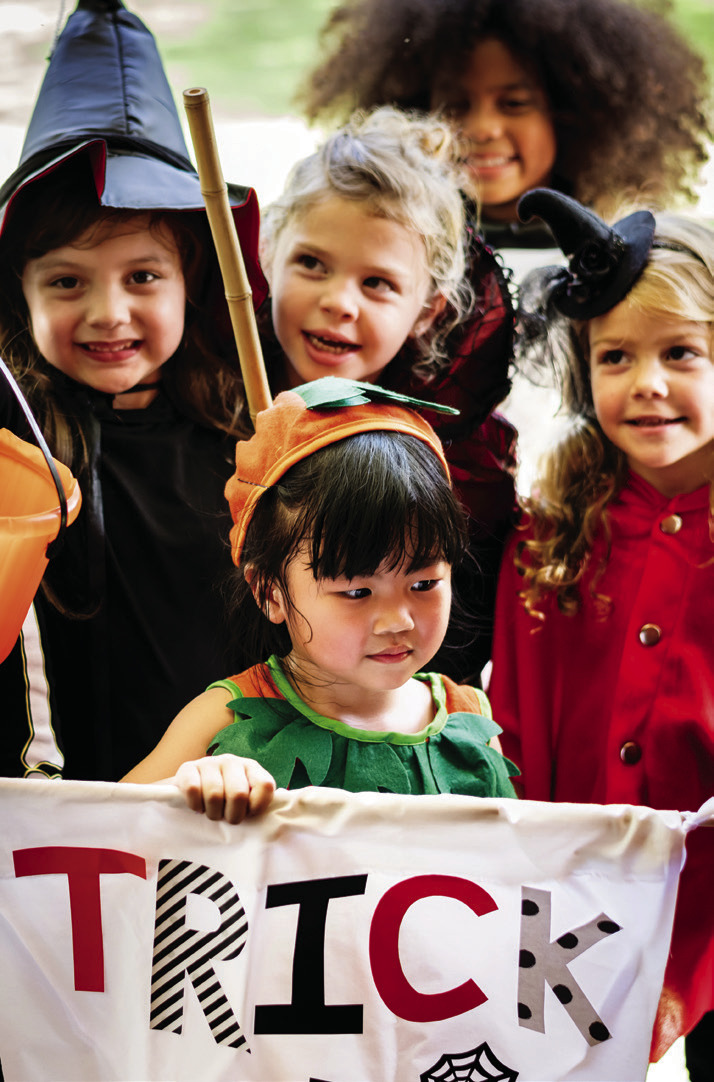
Foremost is making sure trick-or- treaters are safe. “There are ways to mitigate the risk with kids,” Fairchild said. That starts with choosing a costume that fits properly so as not to sag or fall down to cause the trick-or-treater to trip. Costumes and the bag in which they’ll collect their candy should have reflective tape.
Fairchild encourages non-toxic face paint instead of a mask, which could obscure vision.
And she suggests dressing for the
n weather, which in late October could be cold. “The last thing I wanted to do when I was a kid was to wear a coat over my costume,” she said. “It’s best to wear layers as needed under the costume.”
When they’re actually trick-or-treating, younger kids need to be with adults. Older kids, ages 10 through 12 or thereabouts, can go in a group, so long as they stick to a planned route known by their parents. At least one in the group should have a cell phone in case of emergency.
An emergency includes anything health related. Fairchild said a child with a medical condition should have an epinephrine pen, an inhaler, or seizure medication, all of which an accompanying parent or responsible adult should know how to administer.
When walking from house to house, trick-or-treaters and their “entourage” should stick to one side of the street, crossing only at a corner or traffic light—”don’t zig-zag,” Fairchild said. And don’t cross between parked cars. If crossing in front of a car at a light or stop sign, “make eye contact with the driver,” she said. “And don’t cross while looking at your phone.”
According to the National Safety Council, children are more than twice as likely to be hit by a vehicle and killed on Halloween than on any other day of the year.
Fairchild has a few words for motorists. “Drive slower and be more vigilant, even if you’re paying attention. Be cognizant about distractions in the car. Be more mindful in any residential area. Turn on your headlights earlier.”
Be aware when trick-or-treating is being held where you’re driving. Not every community celebrates Halloween on October 31, which this year falls on a Monday.
She has a few suggestions for those giving the treats. “If you plan on receiving trick-or-treaters, be sure your house is well lighted. Replace burned-out bulbs. Remove items in the yard that would be a tripping hazard. If there are wet leaves, sweep them away.
“This doesn’t mean you can’t decorate,” she adds. For instance, for those hollowed-out pumpkins, use an LED light instead of a candle, which might cause a fire if knocked over.
Now about those “new” Halloween colors—one focuses on health, the other on safety and understanding.
“Something that has been a nationwide push is the teal pumpkin initiative,” Fairchild said. A house that displays a teal-painted pumpkin or a teal sticker on the door signifies that that house provides treats like small toys or glow sticks—but not candy or any kind of food.
This is important for kids who have food allergies—they can go to teal-sporting houses and know they’ll get a treat that won’t trigger their allergies to peanuts or the like. “Teal has gained a lot more traction recently because there are so many things kids can be allergic to.”
She adds, “This also provides different things for the kids to enjoy and reduces the amount of candy they’re getting.”
Fairchild cautions that small toys and some candies pose choking hazards for the very young. Parents always should go through the treats to weed out any potential hazards before letting the kids enjoy their bounty.
While treat-givers showcase teal, treat-takers can sport the other new Halloween color, blue, somewhere prominently on their costume. “Blue signifies kids on the autism spectrum or who may use nonverbal communication,” Fairchild said.
The meanings of teal and blue transcend Halloween and are symbolic year-round.
Fairchild realizes that these suggestions are commonsense, but they still need to be said. “People tend to be more reckless around the holidays and throw caution to the wind,” she said. “Even though it’s a holiday and it’s supposed to be fun, you still need to use common sense and have safety in mind.”
✲