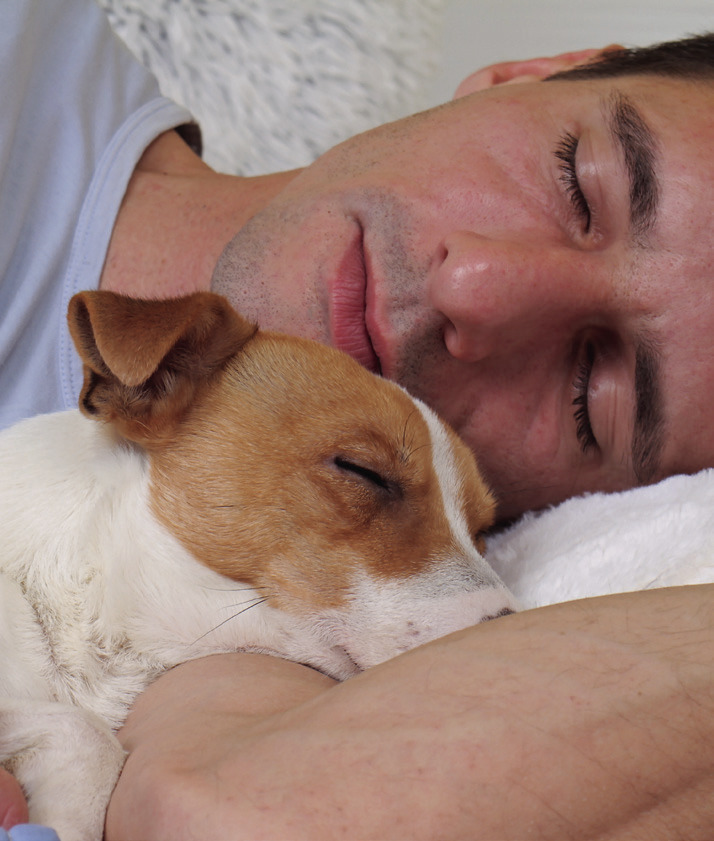
AFTER ADOPTION, A PET typically takes about three months to bond and build trust with its owner. For many pet owners, part of building trust and bonding includes co-sleeping with their pet: 56% of Americans report sleeping with their pets in their bedroom or in their bed, based on survey findings by Mayo Clinic in Arizona.
Pet owners who sleep with their pets do so for a variety of reasons, such as to have a greater sense of safety while sleeping (e.g., a dog’s barking can alert a sleeping owner to an intruder), to reduce the occurrence of nightmares in children or people with post-traumatic stress disorder (PTSD), or because it just simply “feels good” or “comforting.” In support of the latter, some research indicates that the level of the chemicals oxytocin (pronounced “OX-ih-TOH-sin”) and dopamine (pronounced “DOH-puh-MEEN”) are increased in the brain when a pet owner interacts with a pet. Oxytocin is involved in bonding, and dopamine is involved in bonding and in relieving anxiety and stress. Reduced levels of stress and anxiety can help reduce nightmares in children and people with PTSD, as well as improve sleep. Despite these benefits, sleeping with your pet may not always be a good idea.
A recent survey by the American Academy of Sleep Medicine (Darien, IL) found that among respondents who slept with their pet, 33% of them reported their sleep was “always” or “often” disrupted because of their pets. Some common ways that pets disrupt an owner’s sleep are as follows: the pet snores; the pet awakens the owner by scratching the floor or at a door, barking/whining, or licking the owner’s face; the pet’s movements on a bed (e.g., jumping on or off the bed) awaken the owner; and behavioral issues (e.g., a dog may not be fully house-trained and the owner needs to awaken several times to prevent “accidents”).
In addition, differences between a human’s circadian rhythm and a pet’s circadian rhythm can be a factor in the pet’s disrupting its owner’s sleep. For example, in a 24-hour period, a human will have one sleep phase and one wake phase, whereas a dog will have about 20 sleepwake phases (i.e., dogs sleep off and on throughout the day and night). Thus, humans will normally sleep through an 8-hour sleep period at night, whereas a dog will naturally awaken about three times during that period, and the actions of the dog may then awaken its owner.
If you sleep with your pet but your pet is disrupting your sleep, the following tips may be beneficial:
• Create a separate place in your room for your pet to sleep.
Studies in which pet owners were monitored while they slept with their pet indicate that your sleep quality is better if your pet sleeps in your room but not on your bed.
• Accommodate your pet’s natural rhythm into your daily schedule. For example, if a dog is awake and active in late evening, incorporate taking it for an evening walk in your daily schedule. After an energetic walk, the dog will more readily go to sleep in the evening.
• If you are a light sleeper (i.e., easily awakened by environmental noise), establish a separate area outside of your bedroom for your pet to sleep.
Regina Patrick, RPSGT, RST, is a freelance writer/editor and a registered sleep technologist. She has been involved in the sleep field for more than 30 years.
✲