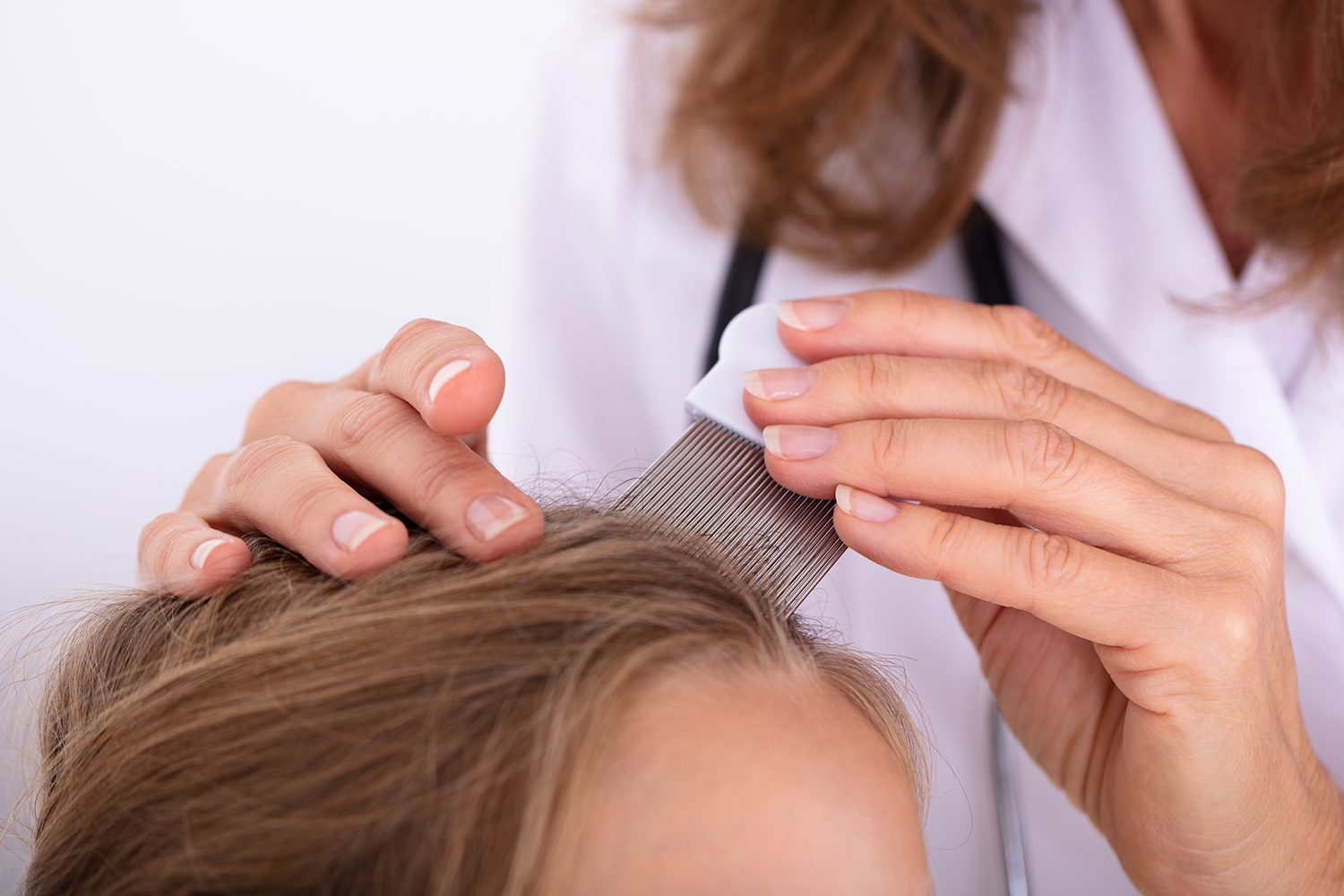
A call from the school nurse telling you that your child has head lice is enough to send shivers up your spine. After all, no parent wants to hear that their child is infested with a parasite. However, while lice certainly aren’t nice, misinformation about these pests leads only to unnecessary worry and overreaction, not the effective resolution of the problem.
What are head lice?
Head lice are tiny, wingless insects, approximately the size of a sesame seed, that reside on the scalp and hair of humans and feed on blood from the scalp. They do not, contrary to popular misconception, live on pets. Female lice lay poppy-seed-sized eggs, called nits, on the shaft of hairs, usually around a half inch from the scalp (where heat from the scalp incubates them). The nits hatch in about a week, and it takes 10 days for the newly hatched lice to reach adulthood, at which point the females lay more eggs and the cycle continues.
What are some common head lice myths?
Myths about head lice abound. Here are some of the more common examples followed by the straight scoop:
Myth: Head lice can easily spread by jumping from one person’s head to another.
Fact: Lice cannot jump, fly, or hop to another host. They can, however, crawl to another host. They most commonly spread by direct headto- head contact or by sharing items that come into direct contact with the head or neck, such as combs, brushes, barrettes, hair ribbons, head bands, bandanas, sports helmets, hats, scarves, pillows, or earphones. Also, lice do not reproduce off the human body, and unhatched eggs do not spread from person to person. Lice cannot live long without a human host, only about two days.
Myth: Lice are a sign of poor personal hygiene.
Fact: Lice will infect a clean, healthy head just as quickly as they will an unclean head. No amount of bathing or shampooing will reduce the likelihood of becoming infested.
Myth: Only children are vulnerable to lice infestations.
Fact: Head lice infestations tend to be most prevalent in children age 3 to 12 because they are more likely to come into close contact with one another during play or athletics and to share personal items; however, people can get them at any age. Furthermore, having longer hair does not put a person at greater risk of becoming infected with lice.
How can head lice be prevented?
The Centers for Disease Control and Prevention website (www.cdc. gov) recommends taking the following precautions to prevent and control the spread of head lice:
• Avoid head-to-head (hair-tohair) contact during play and other activities at home, school, and elsewhere (sports activities, playground, slumber parties, camp).
• Do not share clothing such as hats, scarves, coats, sports uniforms, hair ribbons, or barrettes.
• Do not share combs, brushes, or towels. Disinfest combs and brushes used by an infested person by soaking them in hot water (at least 130°F) for 5-10 minutes.
• Do not lie on beds, couches, pillows, carpets, or stuffed animals that have recently been in contact with a person infested with head lice.
• Machine wash and dry clothing, bed linens, and other items that an infested person wore or used during the two days prior to treatment using the hot-water (130°F) laundry cycle and the high-heat drying cycle. Clothing and items that are not washable can be drycleaned or sealed in a plastic bag and stored for 2 weeks.
• Vacuum the floor and furniture, particularly where the infested person sat or lay. However, spending much time and money on housecleaning activities is not necessary to avoid reinfestation by lice or nits that may have fallen off the head or crawled onto furniture or clothing.
• Do not use fumigant sprays or fogs; they are not necessary to control head lice and can be toxic if inhaled or absorbed through the skin.
Treatment of head lice usually entails the use of a medicated shampoo, cream, or lotion. Over-the-counter products are often successful, but if these aren’t effective, your doctor can order a prescription-strength product. A fine-tooth nit comb can be used to manually remove dead lice and their eggs from the hair shaft.
Whether using over-the-counter or prescription-strength head lice treatments, it’s critical to apply them in strict accordance with label instructions or your healthcare practitioner’s recommendations. ✲