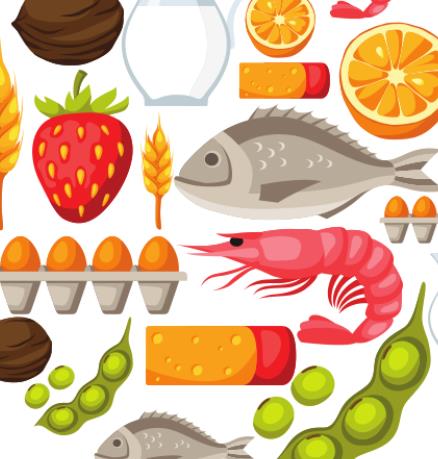
WE’VE ALL BEEN IN THAT SITUATION where something we’ve eaten “doesn’t agree with us,” but for people who have food allergies, the simple act of ingesting a particular food can have consequences much more serious than a case of indigestion or sour stomach. For them, eating the wrong thing can cause an adverse physical reaction, ranging in severity from minor irritation in the mouth to a full-blown, potentially life-threatening anaphylactic response.
According to the Centers for Disease Control and Prevention, food allergies affect an estimated 4%-6% of children and 4% of adults. Symptoms most commonly occur in babies and children but can appear at any age. It’s also possible to develop an allergy to foods one has eaten for years with no problems.
What is a food allergy?
A food allergy can be defined as a misplaced immune response. Essentially, the body’s immune system mistakenly perceives a protein in a particular food as an invader and launches a counterattack, releasing chemicals, such as histamine, in an attempt to eliminate the “invader.” As a result, the allergic individual can experience symptoms such as tingling in the mouth, swelling of the tongue and throat, hives, abdominal cramps, diarrhea, vomiting, breathing difficulty, drop in blood pressure, loss of consciousness, and even death.
It’s important to note that a food allergy is not the same thing as a food intolerance. People who have a food intolerance do not have an immunological response when they consume a particular food. Rather, they are unable to digest that particular food properly. The classic example is lactose intolerance, which occurs in people who lack the necessary enzyme to digest milk sugar, or lactose.
Common food allergens
The American College of Allergy, Asthma & Immunology (ACAAI) attributes approximately 90 percent of all food-related allergic reactions to eight particular foods— eggs, milk, peanuts, tree nuts, fish, shellfish, wheat, and soy. The ACAAI website (acaai.org) states that “certain seeds, including sesame and mustard seeds (the main ingredient in the condiment mustard), are also common food allergy triggers and considered a major allergen in some countries.”
In terms of reaction severity, peanuts are high on the list, being one of the food allergens most commonly associated with anaphylaxis, which is a potentially deadly condition that requires immediate treatment. Symptoms of anaphylaxis may include impaired breathing, swelling of the throat, a sudden drop in blood pressure, pale skin or blue lips, fainting, and dizziness.
Food allergen cross-reactivity
It’s interesting to note that if someone is allergic to a particular food, there’s a good chance that he or she will react to other foods containing similar antigens (substances that stimulate an immune response). This phenomenon is known as food allergen cross-reactivity. For example, someone who is allergic to shrimp would be advised to avoid eating crab and lobster, which contain similar antigens.
How are food allergies diagnosed?
In most cases, food allergies are identified after the allergic individual ingests a particular food and experiences some type of reaction. However, allergists can perform certain tests to aid in diagnosis. These include the percutaneous scratch test and a blood test. With the scratch test, a drop containing the antigen from the food being tested is placed on the patient’s skin and the skin is pricked with a probe. A small bump, similar to a mosquito bite, will soon form at the site if the patient is potentially allergic to the food antigen. With the blood test, a blood sample is taken from the patient and sent to a laboratory where it is tested for IgE antibodies specific to the particular food being tested.
How are food allergies treated?
Unfortunately, there is no treatment that will cure food allergies. Some progress has been made in the area of immunotherapy, most notably for reducing sensitivity in people with peanut allergy. However, the primary method for managing food allergies remains strict avoidance of the food that is known to cause a reaction. In people with severe food allergies, a device for auto-injecting epinephrine (i.e., EpiPen ® ) is usually prescribed and kept on hand at all times to control a severe reaction if one should occur.
Also, with back-to-school season right around the corner, it’s important for parents of children with known food allergies to make their kids’ teachers and school aware of the problem so they know what potential symptoms to watch for and steps can be taken to reduce the risk of exposure during lunch and snack times. Parents should also verify that any supervising adults at the school understand how to use an epinephrine auto-injector properly.